
Key Takeaways:
- The article details a series of celestial observations scheduled for December 17th, primarily involving the Moon, Mercury, and the star Antares.
- Specific appulses include the Moon passing 6° south of Mercury at 7 A.M. EST and 0.4° south of Antares at 8 A.M. EST, followed by Mercury passing 6° north of Antares at 4 P.M. EST.
- The Moon will present as a slim, 2 percent lit waning crescent, rising approximately 6:20 A.M. local time, and is recommended for observation with binoculars or a telescope to better discern its form and earthshine.
- Mercury, with a magnitude of –0.5 and 84 percent illumination, will be situated nearly 7° to the Moon’s upper left within the southwestern region of Ophiuchus.
Looking for a sky event this week? Check out our full Sky This Week column.
December 17: The Moon meets Mercury
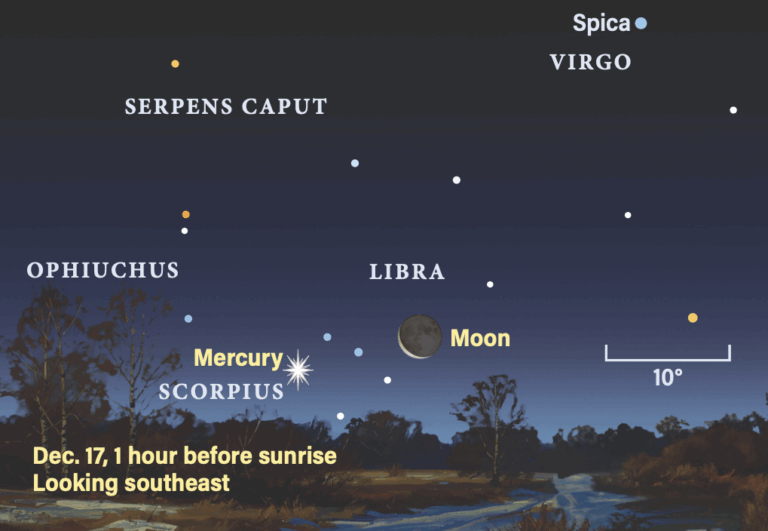
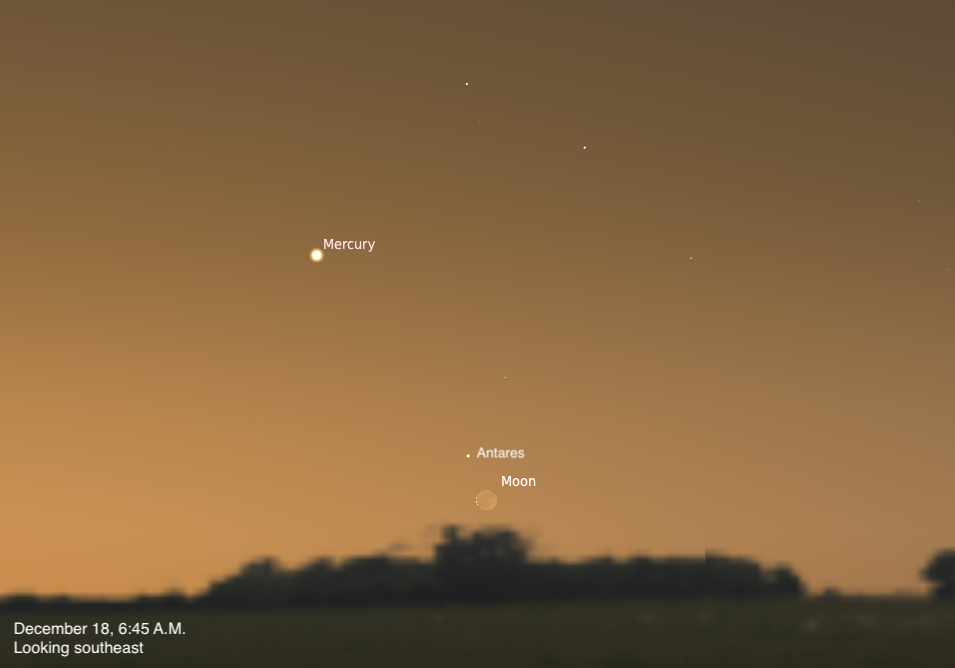
The Moon passes 6° south of Mercury at 7 A.M. EST, then passes 0.4° south of Antares at 8 A.M. EST. Later today, Mercury passes 6° north of Antares at 4 P.M. EST.
Mercury rises this morning around 6 A.M. local time, with the Moon following later around 6:20 A.M., just after Scorpius’ heart, the red-hued star Antares.
The Moon is now just 2 percent lit — potentially a challenge to view with the naked eye, but its slim crescent should look lovely though binoculars or a telescope. Look for earthshine lighting up the darkened regions of the nearside, as sunlight bounces off Earth and illuminates the portions of the Moon already experiencing night.
Magnitude –0.5 Mercury is now nearly 7° to the Moon’s upper left, in far southwestern Ophiuchus. The planet is now 84 percent lit; a small change from yesterday.
Sunrise: 7:17 A.M.
Sunset: 4:37 P.M.
Moonrise: 6:21 A.M.
Moonset: 3:14 P.M.
Moon Phase: Waning crescent (1%)
*Times for sunrise, sunset, moonrise, and moonset are given in local time from 40° N 90° W. The Moon’s illumination is given at 10 P.M. local time from the same location.