Key Takeaways:
- The Orion Nebula (M42), a prominent star-forming region with a magnitude of 4.0, is observable as a fuzzy patch below Orion's belt in the evening sky, especially in the absence of significant lunar illumination.
- Detailed observation of M42 through optics reveals its intricate gaseous structures and the central Trapezium Cluster (Theta1 Orionis), a group of hot, young stars whose powerful radiation actively sculpts the surrounding nebular material.
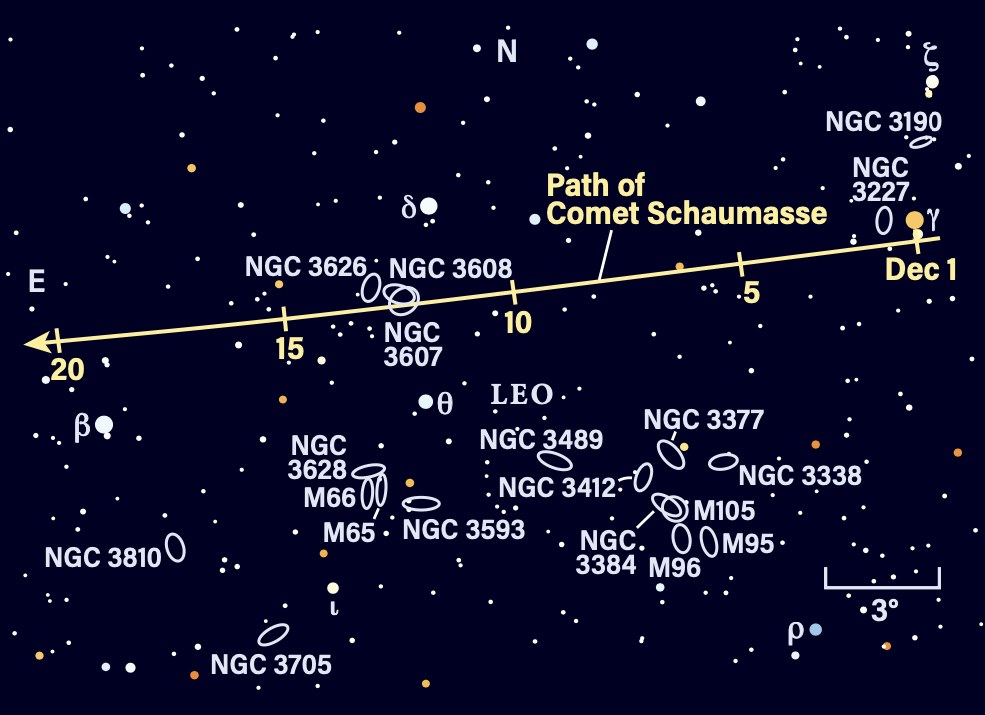
- By December 12 at 3 A.M. local time, Comet Schaumasse, estimated at 12th magnitude, will be detectable in the constellation Leo, situated near the background galaxies NGC 3607 and NGC 3608.
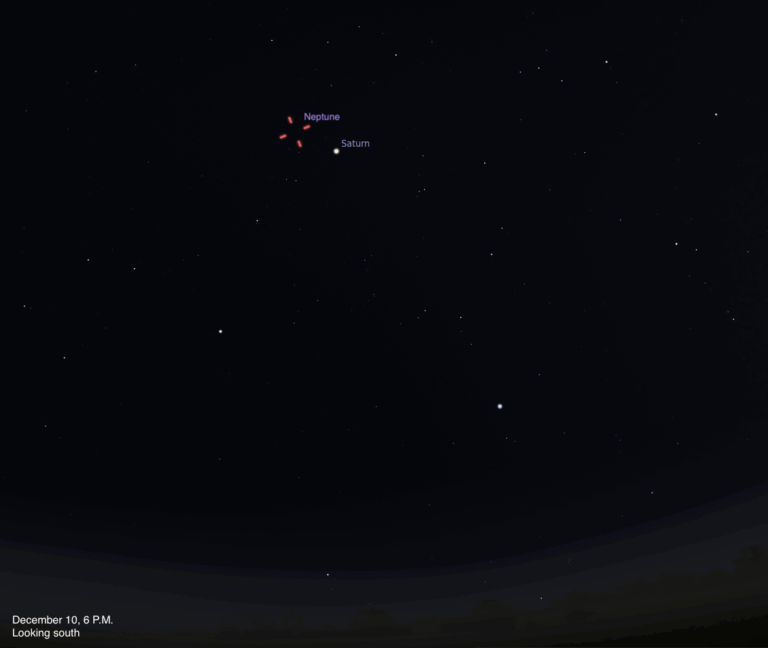
- The article also notes "Spot Neptune" as an observing opportunity for December 10 and provides local astronomical data, including sunrise, sunset, and a 47% waning crescent Moon phase.
Looking for a sky event this week? Check out our full Sky This Week column.
December 10: Spot Neptune
With no Moon in the evening sky, let’s visit a favorite gem that’s now well above the horizon in the few hours leading up to midnight: the Orion Nebula (M42).
Hanging below the easily recognized belt of Orion, M42 is often envisioned as part of the Hunter’s sword. It is so large and bright — some 85’ by 60’ and magnitude 4.0 — that it is visible to the naked eye as a faint, fuzzy patch below the leftmost star in the belt as Orion stands nearly upright in the southeastern sky around 10:30 P.M. local time.
This nearby massive star-forming region is lovely through any optics. Try progressing from your eyes to binoculars to a telescope to see how the view changes. A telescope is best for picking out detail, and the larger the better, as always. Look toward the center of the nebula for four tightly packed bright stars — this is the Trapezium Cluster, cataloged as Theta1 (θ1) Orionis. It’s a group of hot, young stars that you may notice is surrounded by less intensely glowing gas. That’s because their radiation and winds are so powerful that they’re essentially blowing away the nearby gas and dust, carving out a region of the nebula as they shine.
Take your time with the nebula, enjoying its swirls of gas and darkness with your eye — or with a camera. Astrophotographers love to image this region, and it’s a great easy object for beginners.
Want some more tips on how to observe this region’s rich detail? Check out Astronomy contributor Stephen James O’Meara’s guide to observing the “dark side” of this famous nebula.
Sunrise: 7:12 A.M.
Sunset: 4:35 P.M.
Moonrise: —
Moonset: 12:07 P.M.
Moon Phase: Waning crescent (47%)
*Times for sunrise, sunset, moonrise, and moonset are given in local time from 40° N 90° W. The Moon’s illumination is given at 10 P.M. local time from the same location.
By 3 A.M. local time on December 12, Leo the Lion is nearly 50° high in the east — look for Denebola, the bright star marking Leo’s tail, then scan about 8.8° west-northwest for your target. Now glowing around 12th magnitude, Comet Schaumasse today lies near two slightly brighter background galaxies: 10th-magnitude spiral NGC 3607 and 11th-magnitude elliptical NGC 3608. Schaumasse is just 2.5° north of magnitude 3.3 Chertan (Theta Leonis), and about ¼° southwest of the two galaxies, which themselves are only about 6’ apart. The chart below should help guide the way.