Looking for a sky event this week? Check out our full Sky This Week column.
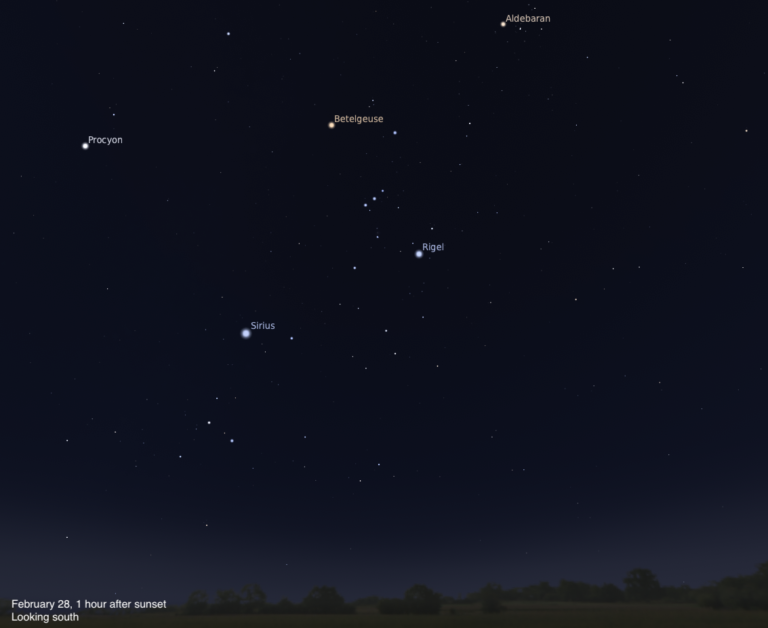
February 28: Orion stands tall
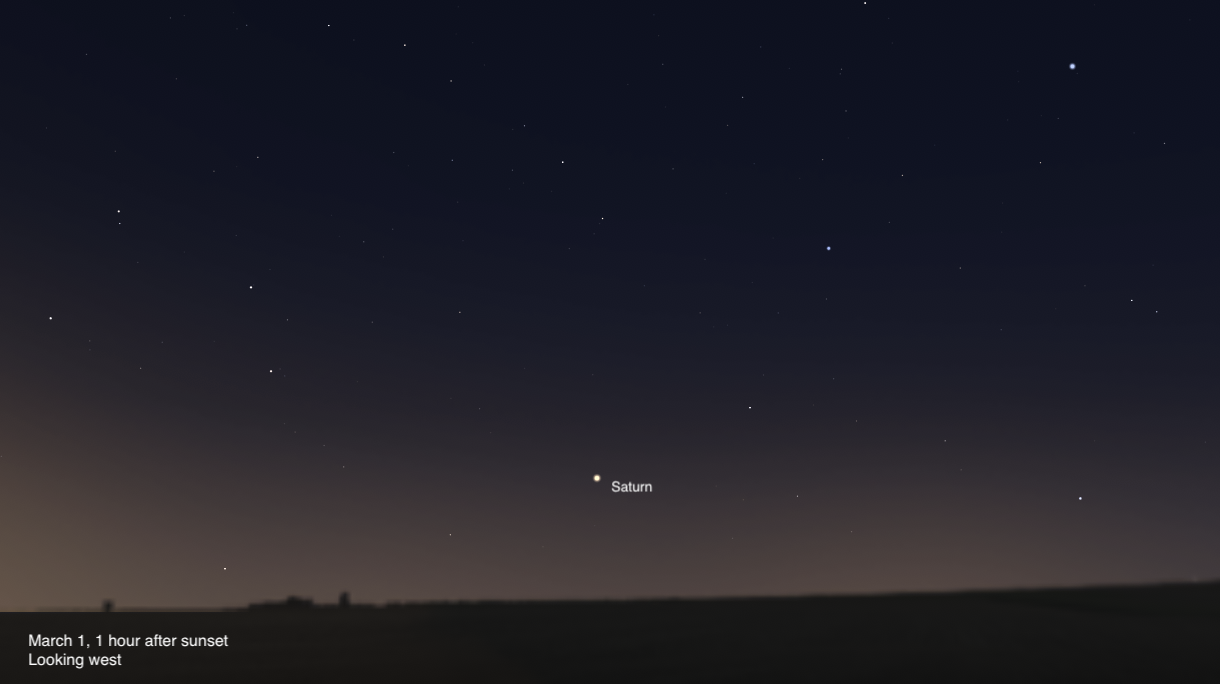
We are quickly losing sight of Saturn in the evening sky — tonight, take some time to glimpse the glorious ringed planet before it gets too low in the west.
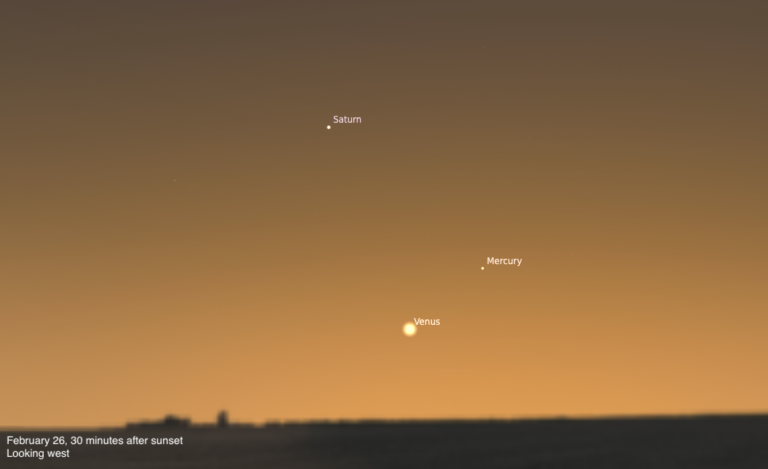
An hour after sunset, Venus and Mercury have set and Saturn is the brightest light in the western sky, now roughly 7° high. That’s already getting quite low, but try training your telescope on the distant world for a glimpse of its lovely ring system, now stretching about 36” from end to end and showing off its southern side. The gas giant’s disk is some 16” wide, with its southern hemisphere also fully visible. You may just be able to spot Titan, Saturn’s brightest moon, some 2.5’ west of the planet, though this observation may be difficult in the muddy air near the horizon.
Day by day, Saturn will set earlier and earlier, even as Venus rises up to meet it. We’ll get a lovely conjunction of the two worlds in about a week, right around the switch to daylight saving time.
Sunrise: 6:33 A.M.
Sunset: 5:52 P.M.
Moonrise: 4:06 P.M.
Moonset: 5:42 A.M.
Moon Phase: Waxing gibbous (98%)
*Times for sunrise, sunset, moonrise, and moonset are given in local time from 40° N 90° W. The Moon’s illumination is given at 10 P.M. local time from the same location.
The nearly Full Moon passes just 0.4° north of Regulus at 8 A.M. EST on March 2; you can catch the pair close together in the predawn sky, standing roughly 20° high in the west two hours before sunrise. The Moon is located just to the lower right of Regulus, which anchors the famous Sickle asterism of Leo, which to many looks like a backwards question mark.
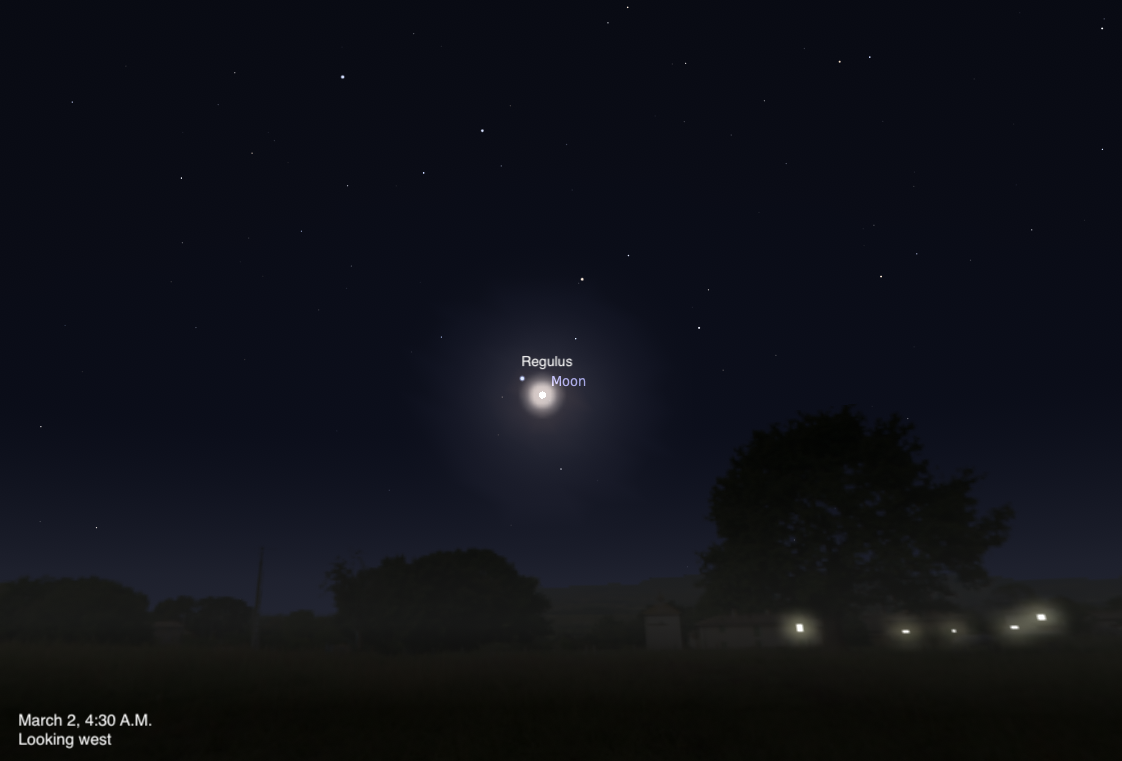
Regulus is also the bright star marking the heart of the Lion. Shining at magnitude 1.4, it is in actuality a four-star system, which observers can split into the brightest two components with a telescope. (Note the companion is quite far away, some 175”, so you’re not looking for a close double!) Regulus is also located nearly on the ecliptic, the plane of our solar system and the path of the planets, Sun, and Moon, so it is often occulted by other objects as they appear to pass in front of the star from our point of view.
Although not visible in the majority of the U.S., some parts of the world (including Hawaii, Japan, and Russia) will see the Moon pass in front of Regulus today. The visibility and timing of the event are heavily location dependent — you can find more information on the In-The-Sky.org‘s page for the event here.