Looking for a sky event this week? Check out our full Sky This Week column.
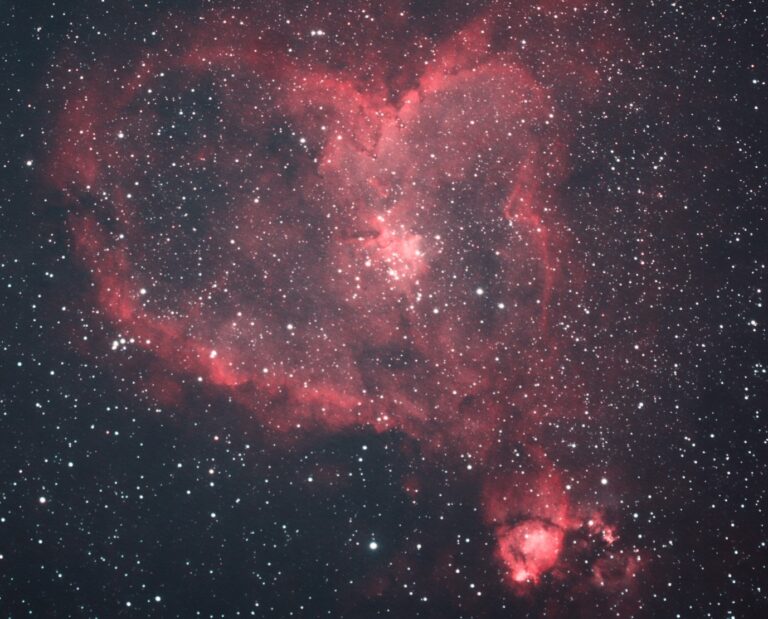
February 14: A Valentine’s Heart (Nebula)
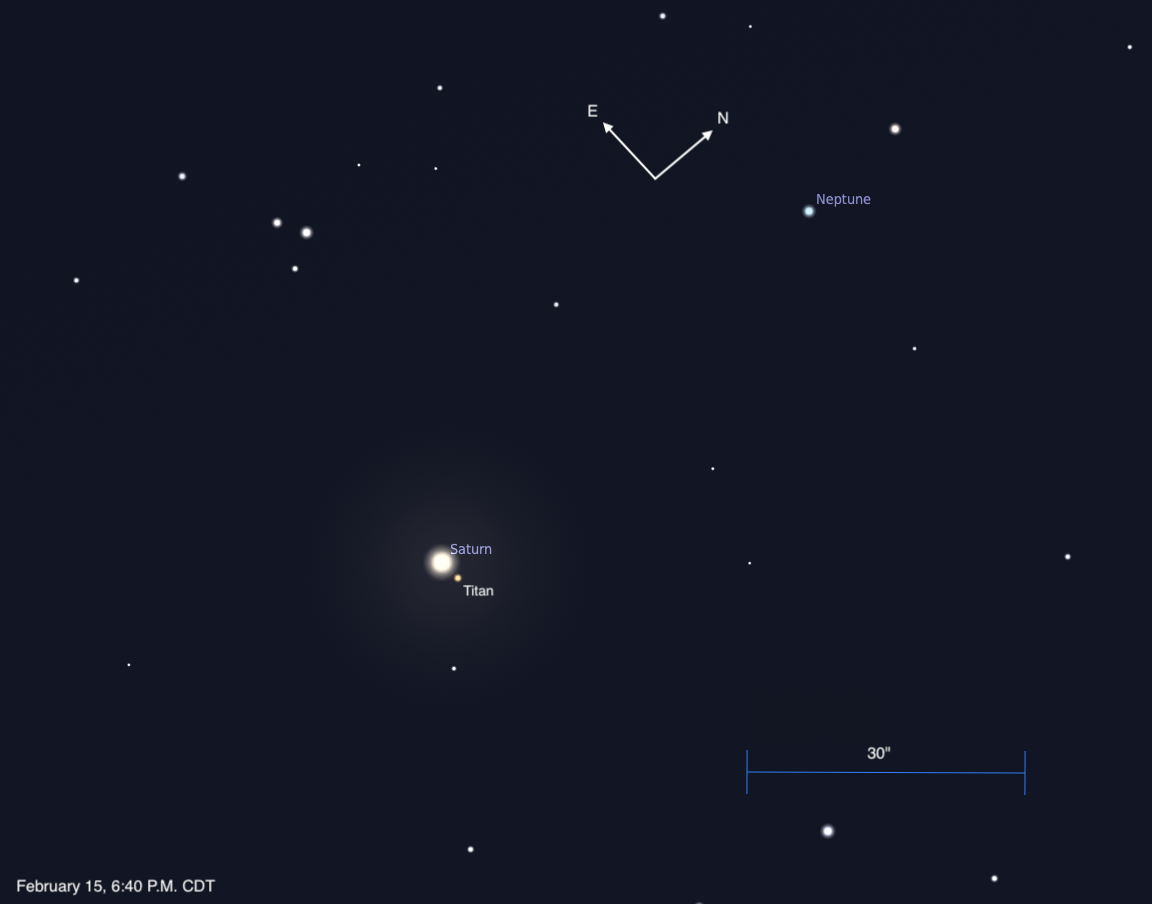
This evening, Saturn passes 0.9° south of Neptune at 11 P.M. EST. The two planets stand together in Pisces, located in the west after sunset. An hour after the Sun goes down, the pair is still nearly 20° high, visible together in binoculars or a telescope.
Saturn is visible to the naked eye, shining at magnitude 1.0. It’s easy to find above and slightly to the left of brighter, magnitude –0.9 Mercury, which sits about 4° above the horizon at this time (even brighter Venus has already set). Saturn is the brightest point of light in Pisces, outshining all of the stars in this region of the sky.
Center binoculars or a telescope on Saturn, then look just north of the ringed world to land on magnitude 7.8 Neptune (not visible without optical aid). Neptune’s tiny disk measures only 2” across and will look like a “flat,” blue-gray star. Saturn, however, looks lovely at higher magnifications, with a disk 16” across and rings stretching 36” from end to end. Its brightest moon, Titan, may also be visible this evening even under lower magnification, sitting some 2.5’ west of Saturn’s center.
Sunrise: 6:53 A.M.
Sunset: 5:36 P.M.
Moonrise: 6:04 A.M.
Moonset: 3:47 P.M.
Moon Phase: Waning crescent (2%)
*Times for sunrise, sunset, moonrise, and moonset are given in local time from 40° N 90° W. The Moon’s illumination is given at 10 P.M. local time from the same location.