Looking for a sky event this week? Check out our full Sky This Week column.
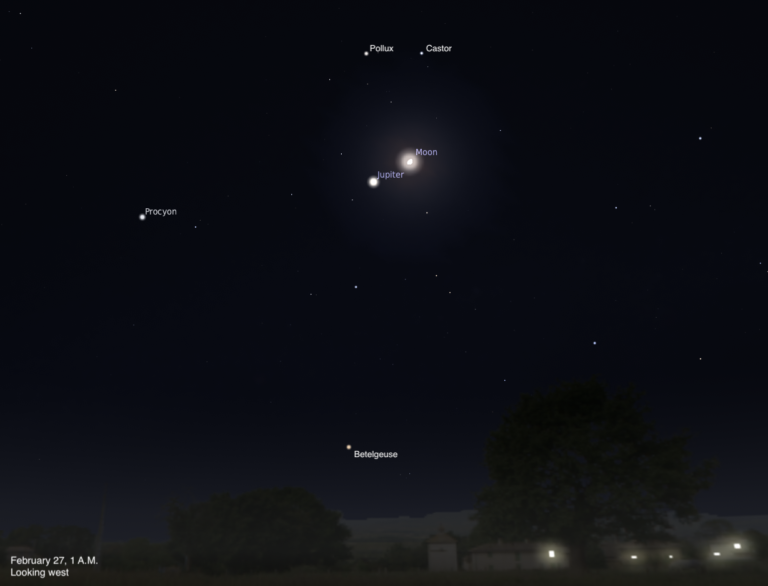
February 27: The Moon and Jupiter meet up in Gemini
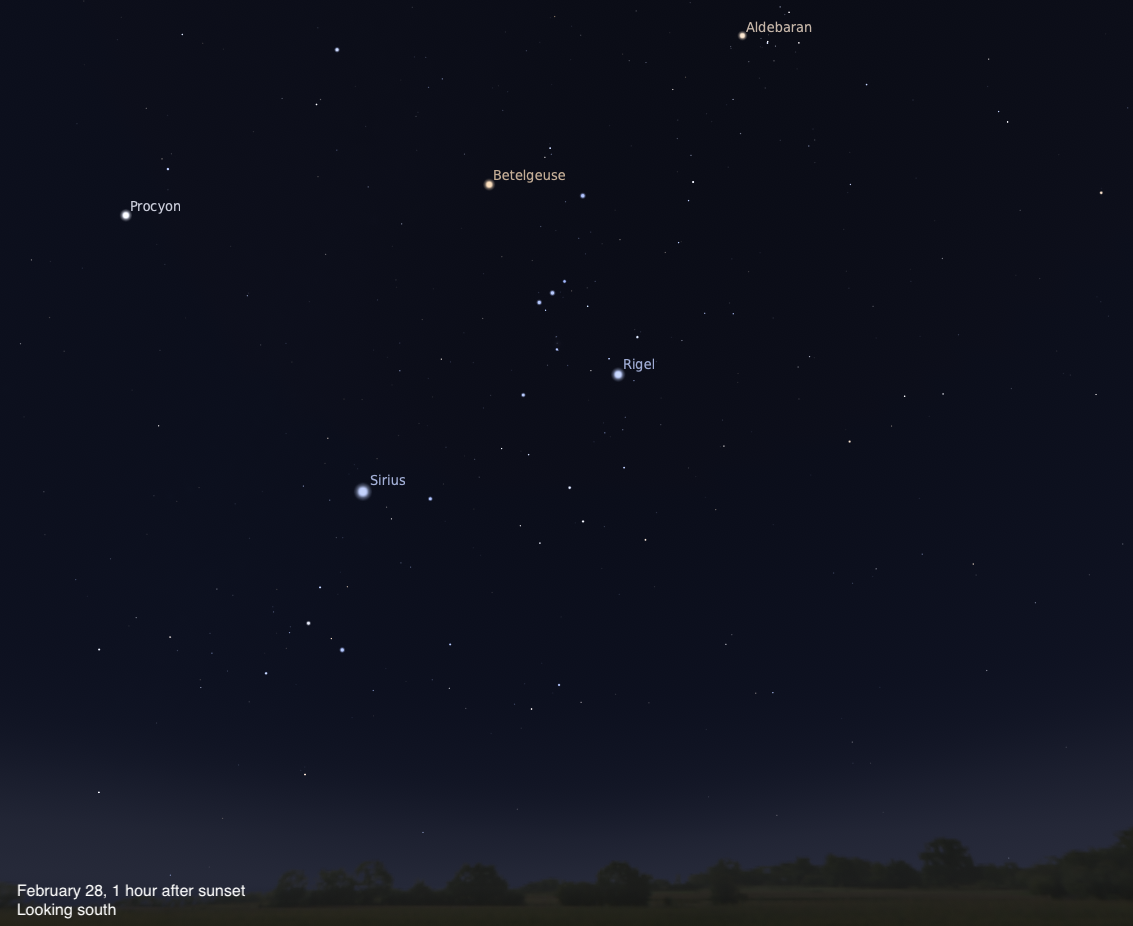
The well-known star Betelgeuse is Orion the Hunter’s alpha star. Shining at magnitude 0.5, this aging sun lies roughly 500 to 600 light-years away. It’s also one of the best candidates for the next star in our sky to go supernova, ending its life in a stupendous explosion. (Of course, we’re not sure when this will happen — it may yet be a thousand years!)
Betelgeuse is some 20 times the mass of our Sun — well over the threshold dictating whether a star is massive enough to die in a supernova blast. Although it shines many tens of thousands of times brighter than the Sun, its temperature is also cooler than that of our star, simply because of its age (stars cool over time).
An hour after sunset, Orion stands proudly upright in the south, with Betelgeuse to the upper left of the Hunter’s familiar three-star belt. Compared to those belt stars, Betelgeuse should appear distinctly orange or red even to the naked eye.
Another aging red giant star, Aldebaran, lies nearby in Taurus, located to the upper right of Betelgeuse early this evening. Shining at magnitude 0.9, Aldebaran is a much smaller star, only roughly twice the mass of the Sun. This star will not go supernova when it dies — rather, it will slip away more quietly, sloughing off its outer layers until only its white-hot core is left, called a white dwarf.
Sunrise: 6:34 A.M.
Sunset: 5:51 P.M.
Moonrise: 2:52 P.M.
Moonset: 5:08 A.M.
Moon Phase: Waxing gibbous (94%)
*Times for sunrise, sunset, moonrise, and moonset are given in local time from 40° N 90° W. The Moon’s illumination is given at 10 P.M. local time from the same location.