Looking for a sky event this week? Check out our full Sky This Week column.
January 18: Catch Caroline’s Rose
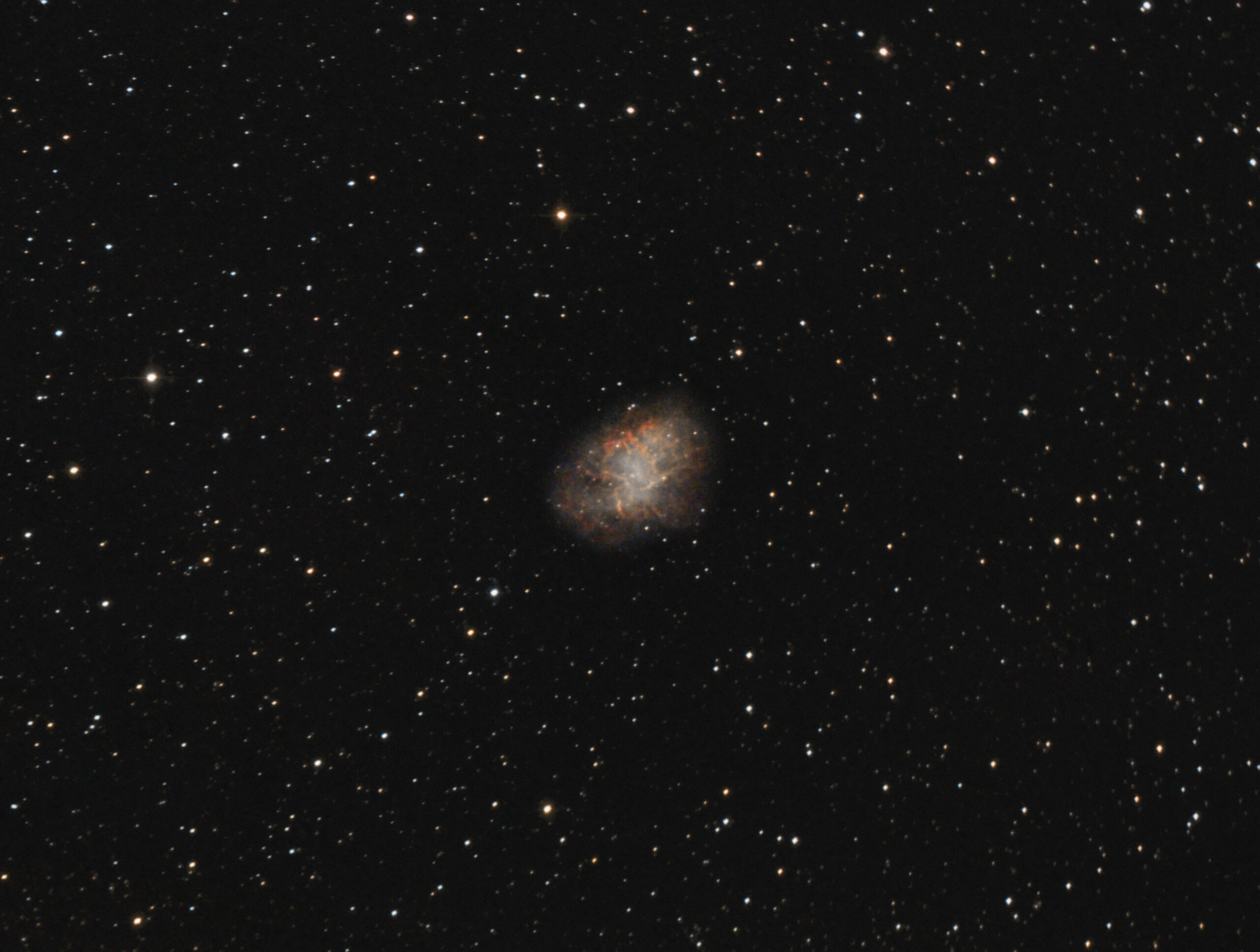
Today we’re visiting a classic: the first object on Messier’s list, the Crab Nebula (M1). Located in Taurus, this well-known supernova remnant is perfectly placed for viewing in the January evening sky.
Around 9 P.M., the V-shape of Taurus the Bull is high in the south. We are looking for the star marking the tip of the Bull’s southeastern (lower) horn, 3rd-magnitude Zeta (ζ) Tauri. From this star, it’s a very short 1.1° journey northwest to M1, making this object quite easy to find!
The trick is that M1 is also faint, requiring binoculars or a telescope to spot at magnitude 8.4. Through your optics, it will likely look like an oval-shaped gray smudge against the darker background sky. This is the glowing, expanding gas left over from the explosion of a massive star, which ended its life in a supernova seen in Earth’s skies on July 4, 1054. The glow remained visible to the naked eye during the day for nearly a month, and shone in the sky for almost two years before fading from view. Today, we know the remnant houses a pulsar — the rapidly spinning leftover core of the progenitor star — and we have even seen the gas of the nebula expanding into space over time.
While the nebula is visible in most scopes, the largest amateur instruments may also be able to pick up the 16th-magnitude pulsar at its center, though a planetarium program or star chart is essential to ensure you’re identifying the correct faint point of light.
Sunrise: 7:18 A.M.
Sunset: 5:04 P.M.
Moonrise: 8:05 A.M.
Moonset: 6:01 P.M.
Moon Phase: Waxing crescent (2%)
*Times for sunrise, sunset, moonrise, and moonset are given in local time from 40° N 90° W. The Moon’s illumination is given at 10 P.M. local time from the same location.
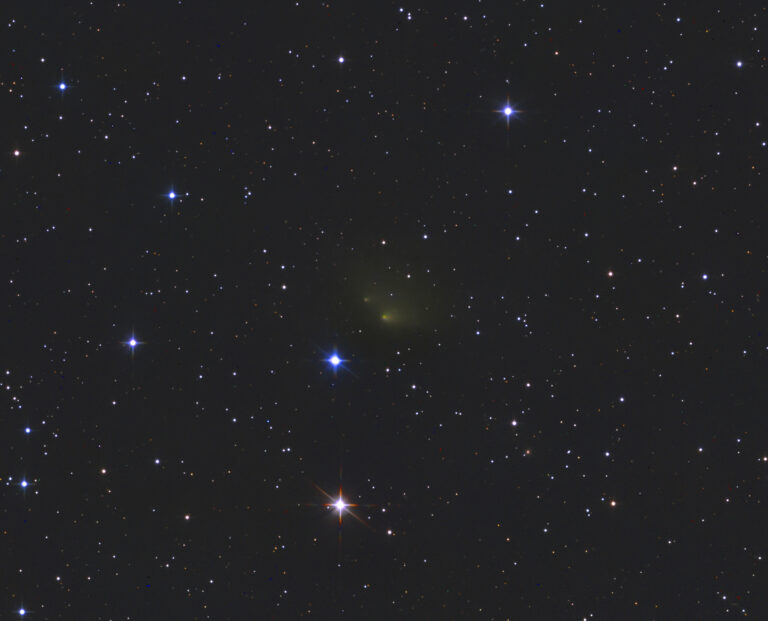
Rising shortly before local midnight, 10th-magnitude Comet 24P/Schaumasse can be viewed with optical aid or in astrophotos. It is best seen in the early-morning hours of January 20, located in southern Boötes and not far from the bright star Arcturus.
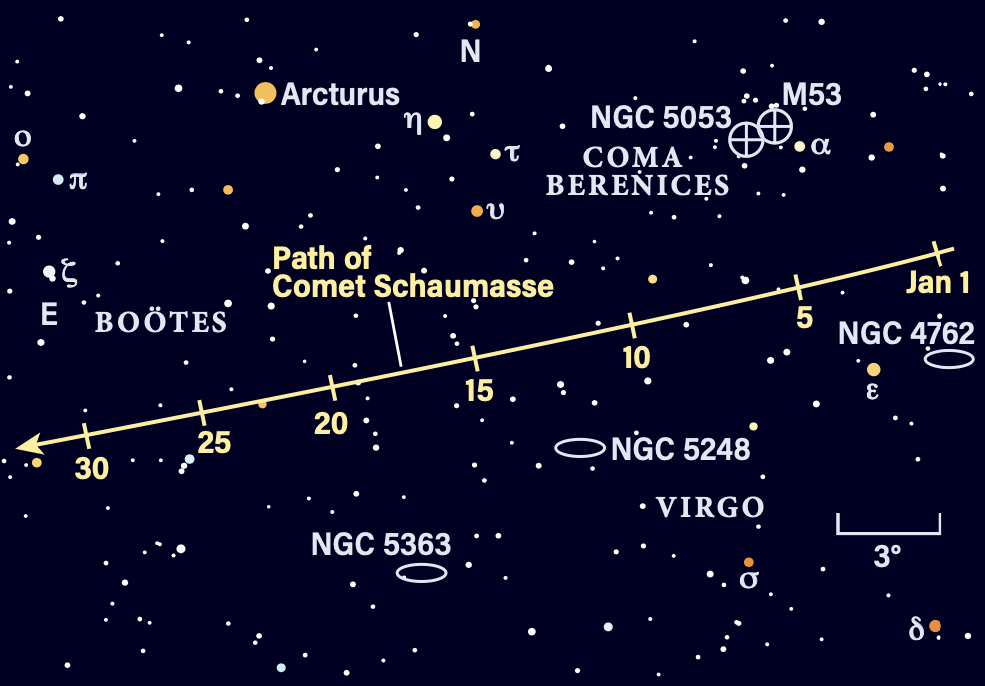
Let’s use that magnitude –0.1 luminary as our jumping-off point today. Around 4 A.M. local time, Arcturus is readily visible some 55° high in the east. Center your optics on this star, then drop about 9° south-southwest to land on Schaumasse.
Given the moonless sky, you might try observing a few nearby galaxies as well. Check out the chart above to help you find NGC 5363 and NGC 5248. Both sine at magnitude 10.2, roughly the same brightness as the comet. NGC 5363 is a lenticular galaxy in Virgo, located some 6.3° southwest of Schaumasse this morning. NGC 5248 is a spiral in Boötes, lying about 8° west of Schaumasse today. Consider the appearance of both galaxies relative to each other as well as the comet — how do they all compare?