Looking for a sky event this week? Check out our full Sky This Week column.
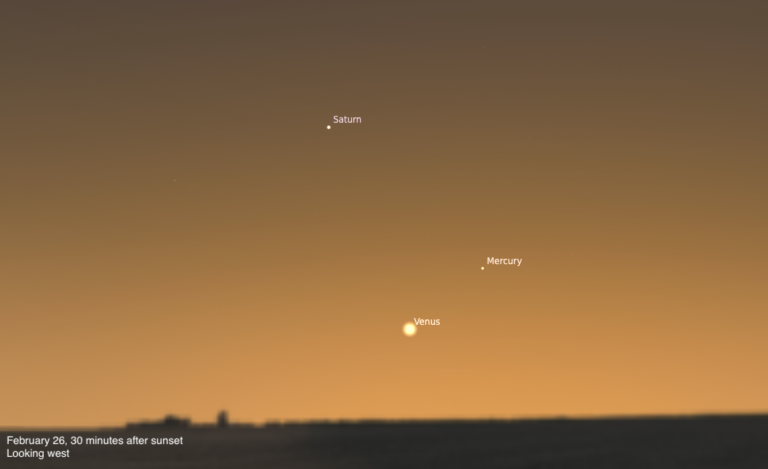
February 26: Mercury moves north of Venus
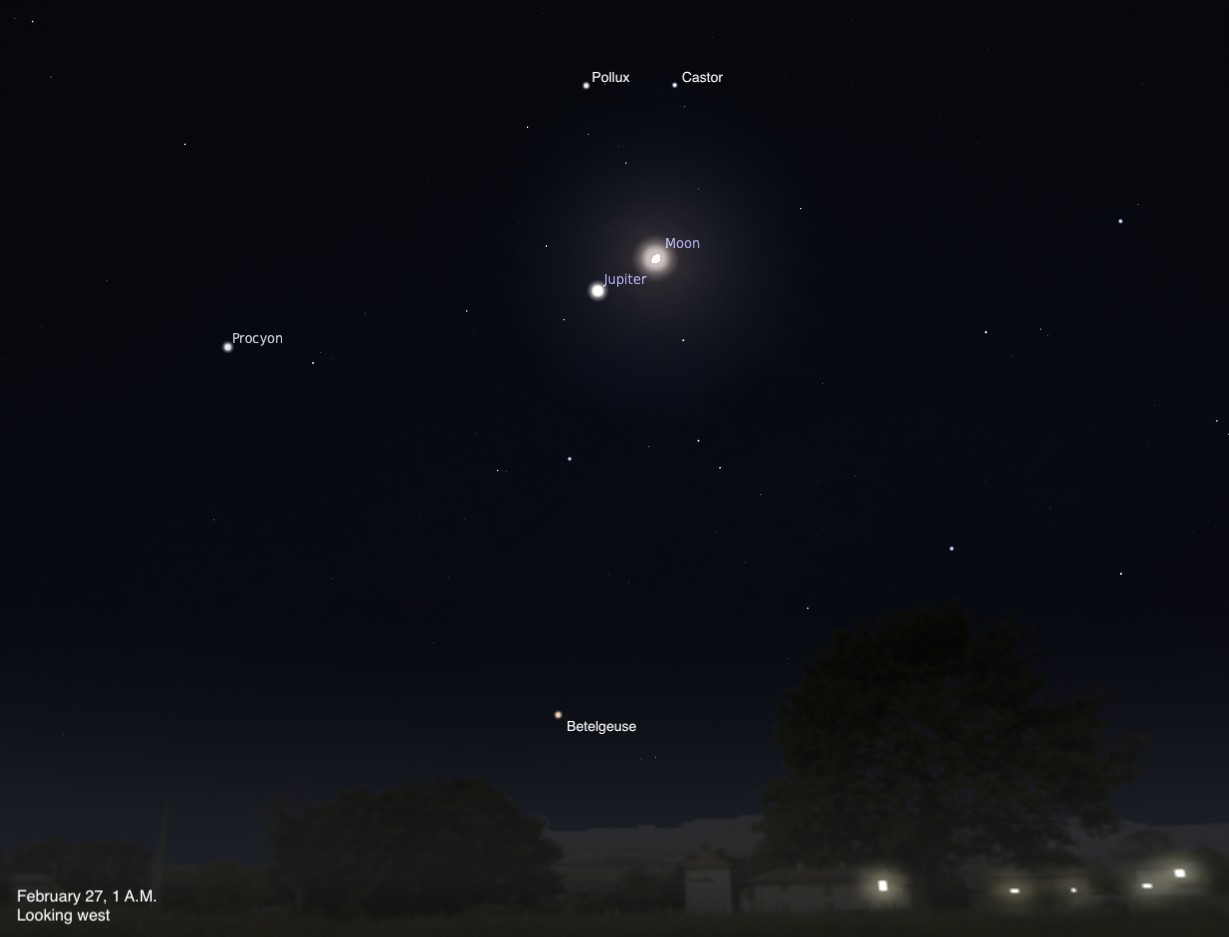
The Moon passes 4° north of Jupiter at 1 A.M. EST. Both are located in Gemini, now sinking slowly in the west.
At 1 A.M. local time, the region is still 30° high, with the 80-percent-lit Moon standing to the upper right of Jupiter. Both hang below the two brightest stars in Gemini, Castor and Pollux, which mark the Twins’ heads. Castor is the rightmost star, burning with a slightly blue-white hue. This multi-star system can be split into two in any telescope, showing a pair of A-type stars.
Pollux is located to Castor’s left as Gemini sets; a few tenths of a magnitude brighter than Castor, Pollux’s hue is more orangey-yellow. This is because Pollux is a cooler K-type giant star; it lies much closer to Earth (34 light-years) than Castor, which is 51 light-years away.
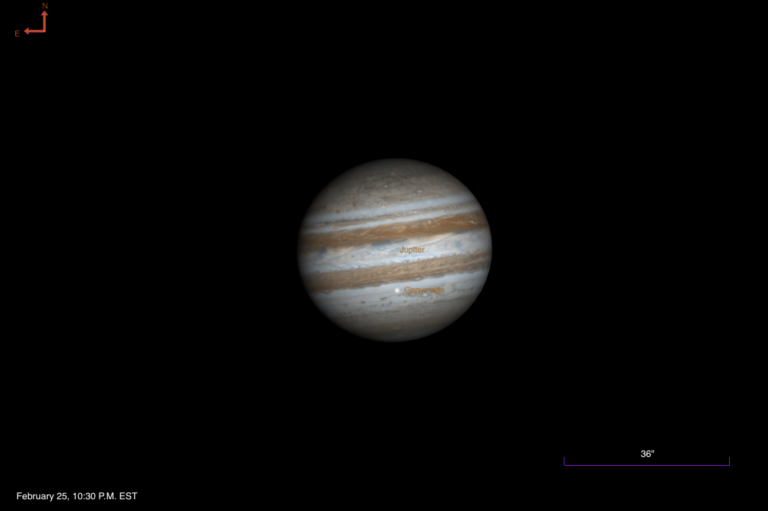
Zoom in on Jupiter and, depending on the time, you will see three or four of its Galilean moons. Throughout the morning, Ganymede and Europa lie to the planet’s west, while Callisto is off to its east. Io passes behind the planet’s disk in an occultation around midnight CST on the 26th (1 A.M. EST on the 27th in the Eastern time zone) and spends a little over two hours behind the huge world. When it emerges from behind the eastern limb, however, it is in Jupiter’s long, dark shadow, and remains invisible until about 2:20 A.M. MST (on the 27th), as Jupiter is getting quite low in the Midwest. When it reappears, Io is already some 20” east of Jupiter’s limb, showing the extent of the planet’s shadow in space.
Sunrise: 6:36 A.M.
Sunset: 5:50 P.M.
Moonrise: 1:37 P.M.
Moonset: 4:25 A.M.
Moon Phase: Waxing gibbous (87%)
*Times for sunrise, sunset, moonrise, and moonset are given in local time from 40° N 90° W. The Moon’s illumination is given at 10 P.M. local time from the same location.