

Sky This Week is brought to you in part by Celestron.
Friday, March 20
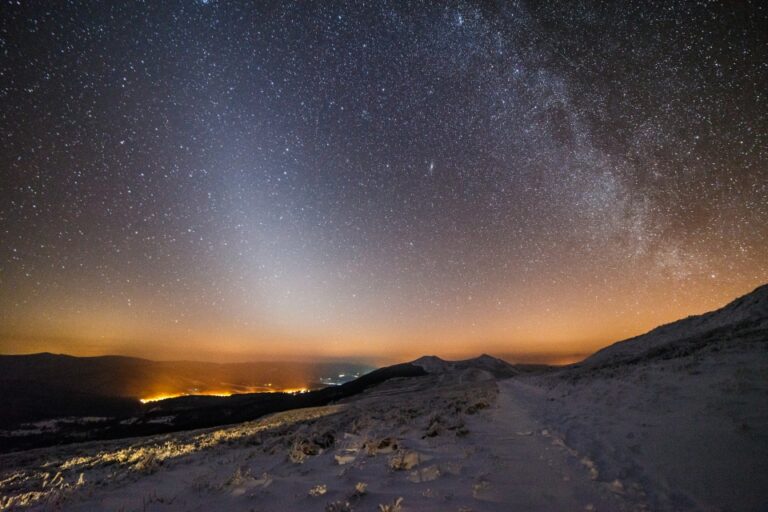
The vernal equinox occurs at 10:46 A.M. EDT, bringing astronomical spring to the Northern Hemisphere as the Sun stands directly over Earth’s equator. On this day, the Sun also sits at the celestial equator as its path takes it from south to north of this invisible line. Meteorological spring, which is measured differently, began March 1.
The equinox is well known as the date when night and day are equal lengths. But you may notice the extents of sunlight and darkness are slightly different from your location. That’s because the lengths of night and day depend on your location on Earth, coupled with the fact that the Sun appears some ½° across in our sky — far from a tiny point. So, because sunrise and sunset are typically defined as the times when the upper edge of the Sun’s disk reaches the horizon, this gives daytime’s duration a little boost. Earth’s atmosphere lends another boost, refracting the Sun’s light and making the Sun visible for a short time before it physically breaches the horizon at sunrise and after it dips below that point at sunset. This effect is further contingent on your location on Earth.
So, despite the equinox often being known as the day sunlight and darkness are balanced, in truth the daytime generally outlasts the night by at least a few minutes on the equinox.
Sunrise: 7:03 A.M.
Sunset: 7:12 P.M.
Moonrise: 7:38 A.M.
Moonset: 9:31 P.M.
Moon Phase: Waxing crescent (6%)
*Times for sunrise, sunset, moonrise, and moonset are given in local time from 40° N 90° W. The Moon’s illumination is given at 10 P.M. local time from the same location.
Saturday, March 21
The 90-mile-wide (145 kilometers) asteroid 20 Massalia reaches opposition at 11 A.M. EDT. Shining at 9th magnitude, it will be visible all night in the constellation Virgo, located 3.7° southeast of 4th-magnitude Beta (β) Virginis.
But tonight you might have other plans: This is the ideal night to run the 2026 Messier marathon. This annual event challenges observers to view every object in Charles Messier’s catalog in a single night, from sundown to sunup. According to the Students for the Exploration and Development of Space (SEDS) website, the full catalog of 109 objects (Astronomy magazine does not include M110) can be attempted by observers between 7 and 35 degrees north. Those limits are set by the visibility of M30, a globular cluster in Capricornus that rises not long before the Sun.
But even if you’re an inexperienced observer or unable to take the whole night, you can still enjoy some of the best Messier has to offer. Early in the evening, one of the most famous entries in the catalog, the Orion Nebula, is visible above the southwestern horizon. Cataloged as M42, this huge, bright star-forming nebula is visible to the naked eye, below the easternmost (leftmost) star in Orion’s Belt. Spanning roughly 85’ by 60’, the nebula glows at magnitude 4.0 and is a favorite in any telescope. Take your time examining its intricate structure, and look especially for the Trapezium Cluster of young, hot stars at its center.
Sunrise: 7:02 A.M.
Sunset: 7:13 P.M.
Moonrise: 8:06 A.M.
Moonset: 10:48 P.M.
Moon Phase: Waxing crescent (12%)
Sunday, March 22
Neptune reaches conjunction with the Sun at 7 A.M. EDT; it will reappear in mid-April in the morning sky.
The Moon reaches perigee, the closest point to Earth in its orbit, at 7:40 A.M. EDT, when it will be 227,954 miles (366,856 km) away.
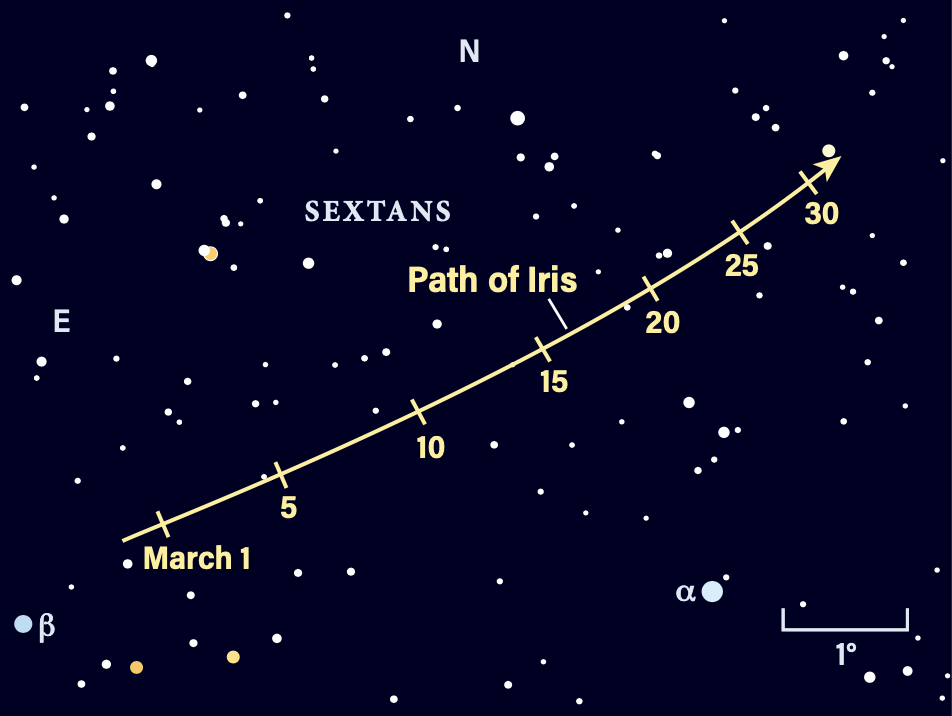
Asteroid 7 Iris is drifting through Sextans, passing close to a close pair of stars that provides an anchor for those looking to watch the space rock’s movement across the sky. Step outside early this evening and look southeast to find the constellation Sextans, located just to the lower right of the lounging figure of Leo the Lion as it rises in the sky. Today, Iris is 2.6° north of mid-4th-magnitude Alpha (α) Sextantis, and about ¼° southwest of an uneven doublet of stars (these require optical aid to spot). Sitting in roughly an east-west line, the brighter of these suns is 7th magnitude, while the fainter is 8th magnitude. Iris, now magnitude 9.4, is fainter than either of these, but closer to them than any background stars. Use this pairing as an anchor point and you may be able to see Iris’ slow drift across the sky over the course of three or so hours.
Sunrise: 7:00 A.M.
Sunset: 7:14 P.M.
Moonrise: 8:40 A.M.
Moonset: —
Moon Phase: Waxing crescent (21%)
Monday, March 23
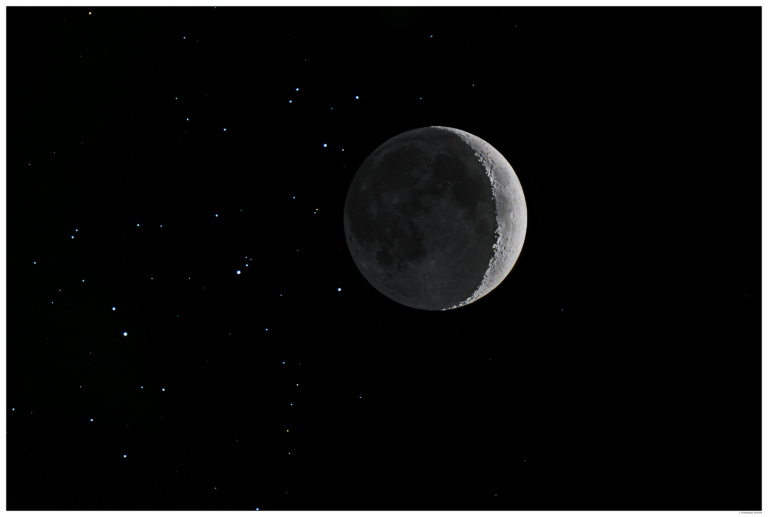
The waxing Moon passes 5° north of Uranus in Taurus at 4 A.M. EDT. By evening, our satellite is still within the bounds of the Bull, now nearly 13° from the distant ice giant. The Moon also sits above the bright Pleiades cluster as the region slowly sinks in the west; many observers likely visited here just a few days ago to catch the group of young suns as object no. 45 on Messier’s famous list.
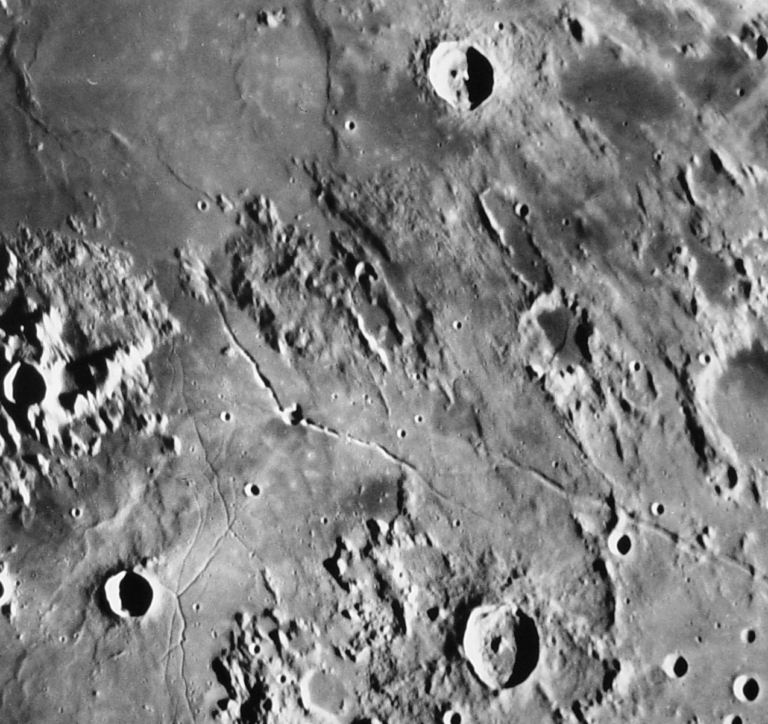
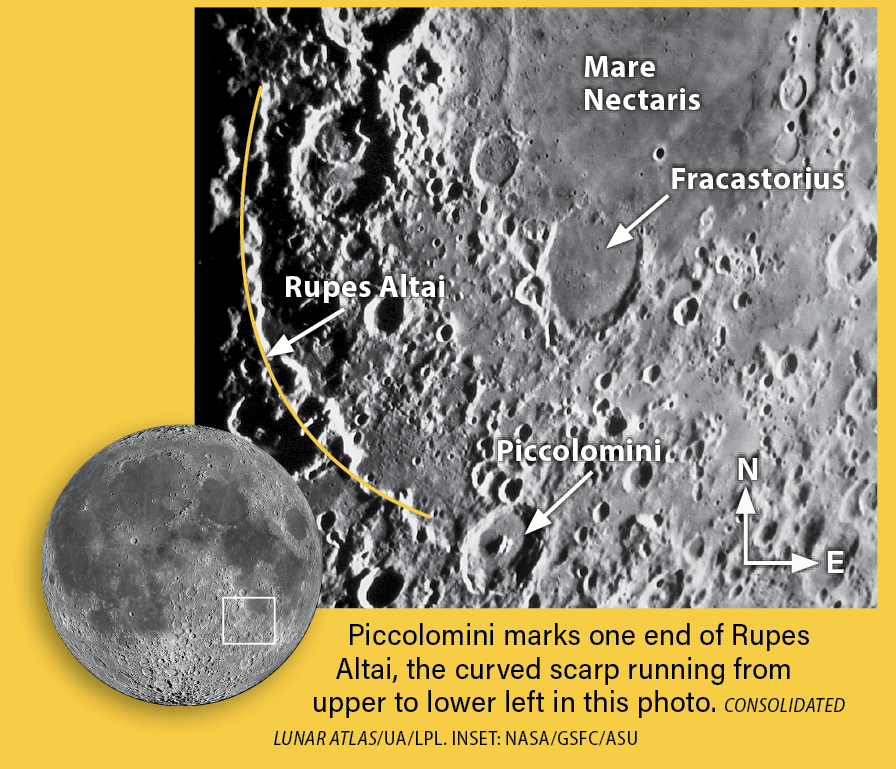
Dawn is slowly breaking across the lunar nearside. By now, all of Mare Nectaris — the Sea of Nectar — is bathed in sunlight. Look to the mare’s southwestern side to see the circular crater Piccolomini, with its central peak standing tall. This crater marks the end of the Altai Scarp (also called Rupes Altai), the most prominent scarp visible on our satellite from Earth. Piccolomini is a young crater that formed after the scarp, essentially coming on top of its lower end sometime 3.2 million to 3.8 million years ago.
Scarps are steeply sloped features that scientists believe formed as the Moon cooled. The ground level on each side of a scarp is at a different height, typically by several yards or more.
Sunrise: 6:58 A.M.
Sunset: 7:15 P.M.
Moonrise: 9:22 A.M.
Moonset: 12:05 A.M.
Moon Phase: Waxing crescent (31%)
Tuesday, March 24
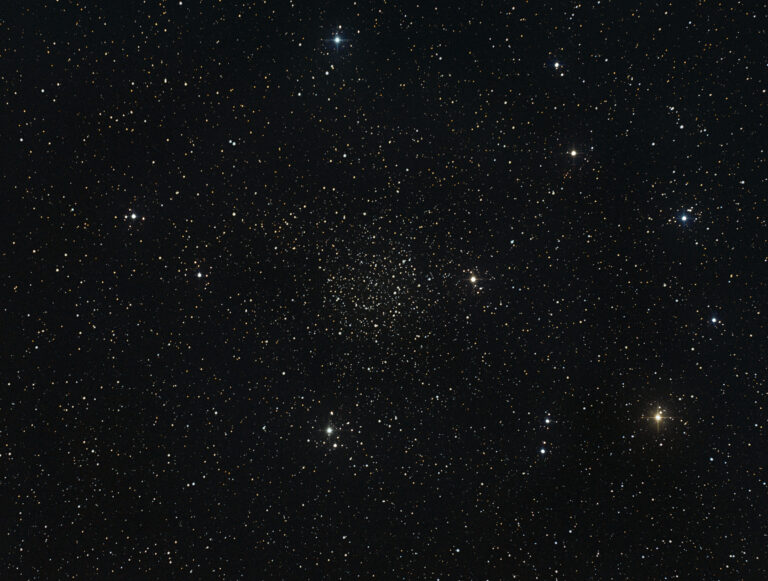
Today’s target is for the early risers: Open cluster M18 in Sagittarius.
Rising around 2 A.M. local daylight time, by 4:30 A.M. the cluster has reached 20° in altitude above the southern horizon. It sits above the famous Teapot asterism, some 8.5° north-northeast of Lambda (λ) Sagittarii, the top of the Teapot’s lid, and near Sagittarius’ border with Scutum and Serpens Cauda.
A nearer jumping-off point is magnitude 3.8 Mu (μ) Sag; from this star, scan just over 4° north-northeast to land on magnitude 6.9 M18. Spanning just under 10’, M18 is a scattered grouping of young stars containing somewhere between one dozen and two dozen stars. 100x or so is the best magnification, according to Contributing Editor Michael E. Bakich, who notes that higher magnifications spread out the cluster’s stars too much for easy identification, mixing them in with the many background stars in this rich region of the Milky Way.
Sunrise: 6:57 A.M.
Sunset: 7:17 P.M.
Moonrise: 10:14 A.M.
Moonset: 1:21 A.M.
Moon Phase: Waxing crescent (42%)
Wednesday, March 25
Saturn now reaches conjunction with the Sun at 5 A.M. EDT. Like Neptune, it will return to visibility in mid-April, when it will be in the predawn sky.
First Quarter Moon occurs at 3:18 P.M. EDT this afternoon.
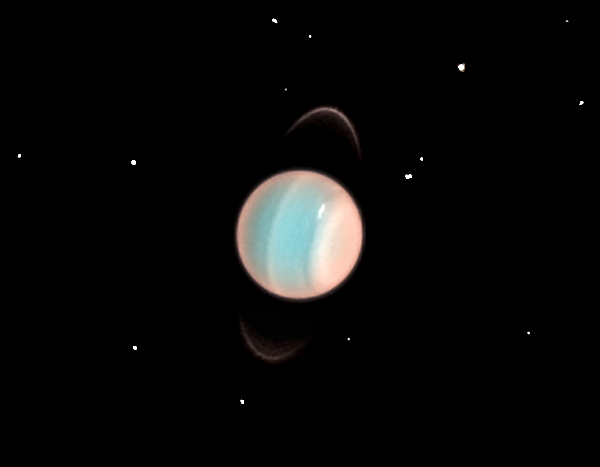
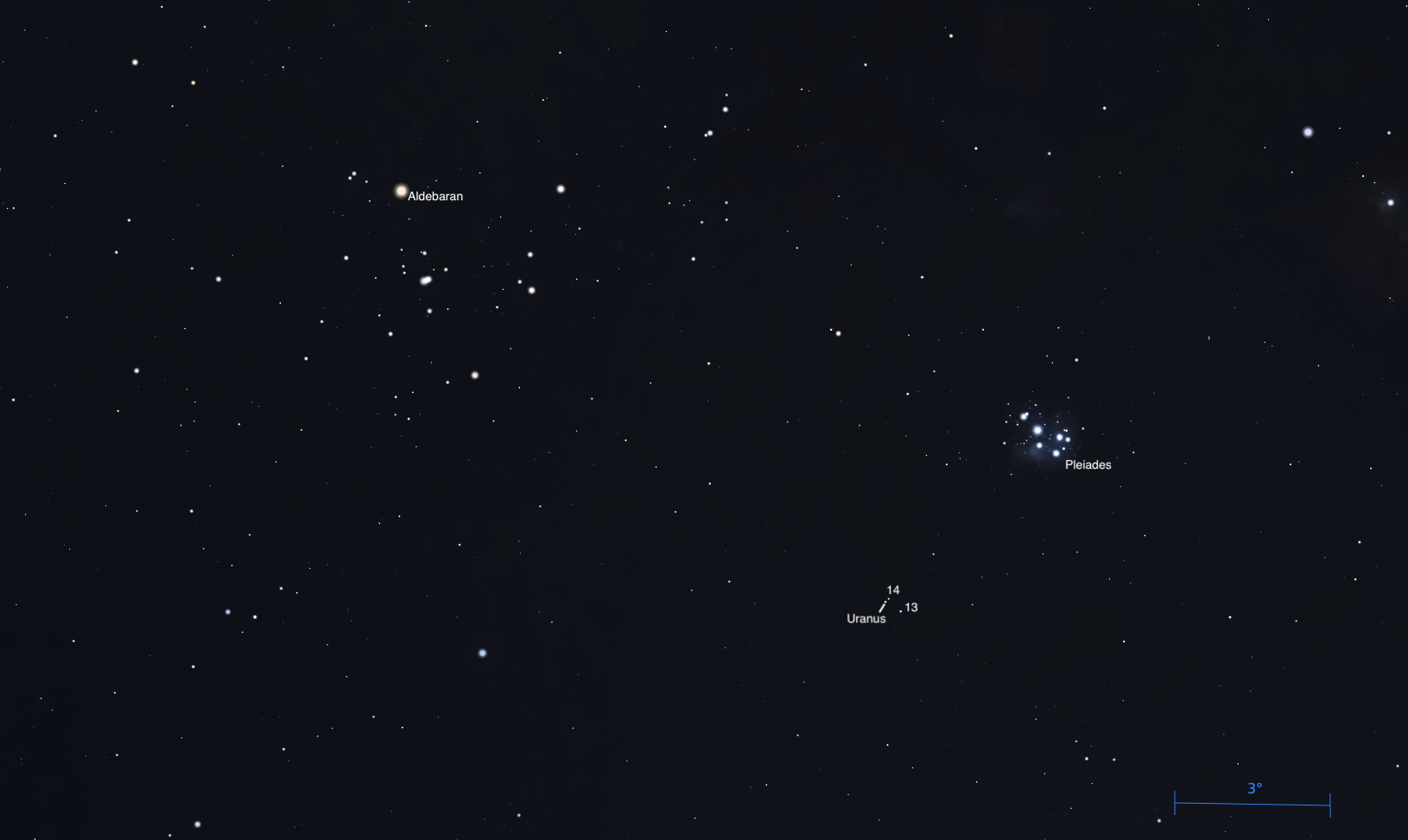
Although Uranus was difficult to spot earlier in the week with a waxing Moon nearby, now is a great time to take a peek at the distant world. After dark, you’ll find Taurus the Bull still about 30° high in the west. Easy to find is the Pleiades star cluster near Taurus’ northeastern corner, and this is our starting point tonight.
About 4.5° south-southwest (to the lower left this evening) of the Pleiades is a pair of stars that should pop into view in binoculars or any small scope. Sitting just 20’ apart in an east-west line, these are magnitude 6.1 14 Tauri and magnitude 5.7 13 Tauri. The fainter of the two, 14 Tau, sits just 5’ due north of Uranus this evening.
Uranus is slightly brighter than 14 Tau — at magnitude 5.8, it will more closely match the brightness of 13 Tau nearby. But Uranus will look like a somewhat “flat,” grayish star, rather than a pinprick of light. Its tiny disk spans just 3”, but may appear circular under good conditions and especially in larger scopes.
Sunrise: 6:55 A.M.
Sunset: 7:18 P.M.
Moonrise: 11:17 A.M.
Moonset: 2:27 A.M.
Moon Phase: Waxing gibbous (54%)
Thursday, March 26
Mars reaches perihelion, the closest point to the Sun in its orbit, at 3 A.M. EDT. The Red Planet then stands 128 million miles (206 million km) from our star. It’s difficult to observe Mars right now, as it is also close to the Sun in our sky. Over the next few weeks, it will begin rising earlier and earlier, and should be more easily visible before sunrise soon.
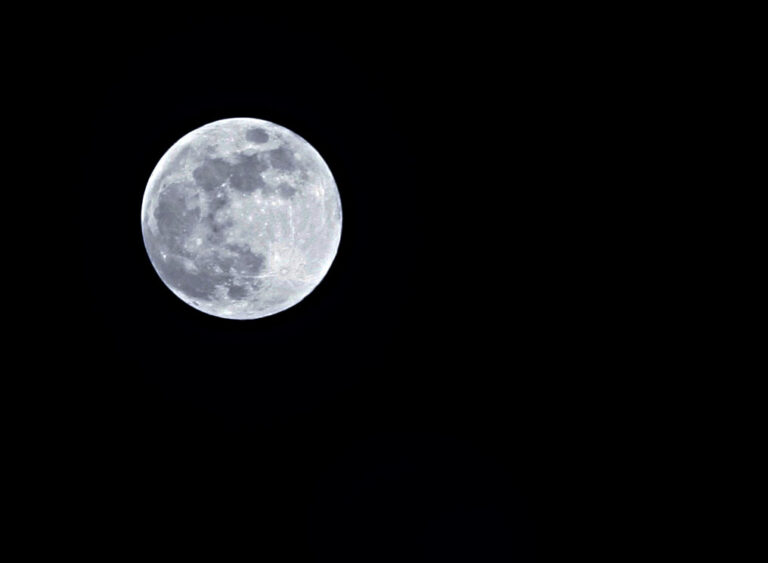
The Moon passes 4° north of Jupiter at 8 A.M. EDT. By evening, they are high overhead in Gemini the Twins, now nearly 8° apart as the Moon sits near Pollux, the slightly brighter of the two brothers’ heads. Many observers will see the Moon pass in front of magnitude 3.6 Kappa (κ) Geminorum in an occultation this evening. From Kansas City, the star winks out behind the dark leading limb of our satellite at 11:09 P.M. CDT. If you want to check whether the occultation is visible from your location as well as the time of disappearance, visit the International Occultation Timing Association’s webpage for 2026 bright star occultation predictions and find the city nearest yours.
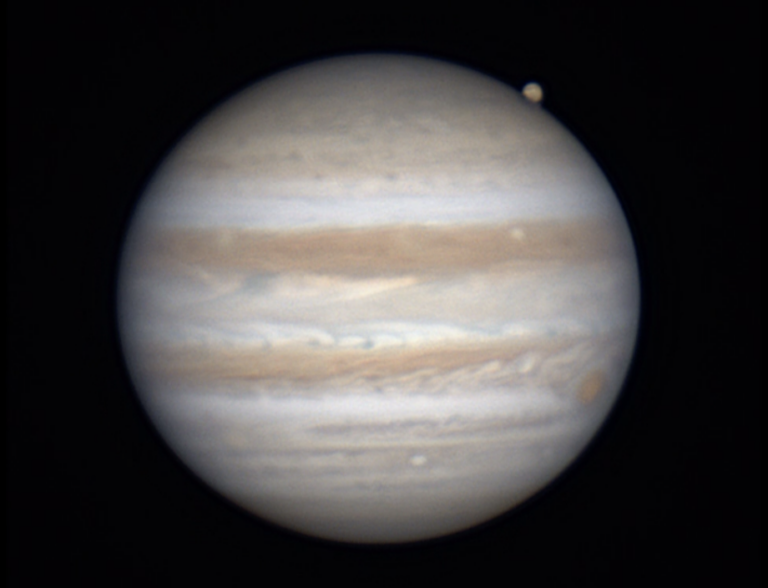
Earlier in the evening, as darkness falls over the eastern half of the U.S., the large, dark blot of Ganymede’s shadow can be seen on the jovian cloud tops if you’re observing Jupiter with a telescope. The Galilean moon itself is west of Jupiter, closer than Io, also west of the planet. East of Jupiter are Europa (closer) and Callisto. The shadow transit ends shortly before 9:25 P.M. EDT.
But the action isn’t over yet. Watch over the next few hours as Europa closes in on Jupiter from the east. The icy moon finally begins a transit around 1:45 A.M. CDT on the 27th— note the time change, as Jupiter is very low (4° or so) for those along the East Coast. Europa’s transit takes nearly three hours, and its shadow finally appears around 2:20 A.M. PDT on the 27th, after the planet has set for most of the U.S.
Sunrise: 6:53 A.M.
Sunset: 7:19 P.M.
Moonrise: 12:27 P.M.
Moonset: 3:21 A.M.
Moon Phase: Waxing gibbous (65%)
Friday, March 27
The Moon is now in central Cancer, passing near the outskirts of the Beehive Cluster (M44) tonight.
An hour after sunset, this region is some 65° above the southeastern horizon. M44 sits just southeast of the Moon, the center of the cluster less than 2° from our satellite. Binoculars or a small telescope should show both in the same field of view, although the bright Moon will wash out fainter cluster stars. The Beehive covers an area about 95’ across, about three times the width of the Full Moon. It is easily visible with unaided eyes, although the nearby Moon will again hinder the view without optical aid. In all, this young cluster of stars contains about 350 members between 700 million and 800 million years old.
Overnight, the Moon will track southeast across the sky, passing through the very outskirts of the cluster. Around midnight Eastern time, the Moon sits due north of the Beehive’s center. Our satellite will then continue to move away from the cluster in the early-morning hours of the 28th as the region sinks into the west a few hours before sunrise.
Sunrise: 6:52 A.M.
Sunset: 7:20 P.M.
Moonrise: 1:41 P.M.
Moonset: 4:08 A.M.
Moon Phase: Waxing gibbous (75%)