
Sky This Week is brought to you in part by Celestron.
Friday, February 6
The bright star Sirius dominates the southern sky late this evening, blazing high in the south around 10 P.M. local time. You can use this sparkling star to point your way to the open cluster M47 in Puppis the Stern, best seen in the dark moonless window that lasts until nearly 11 P.M.
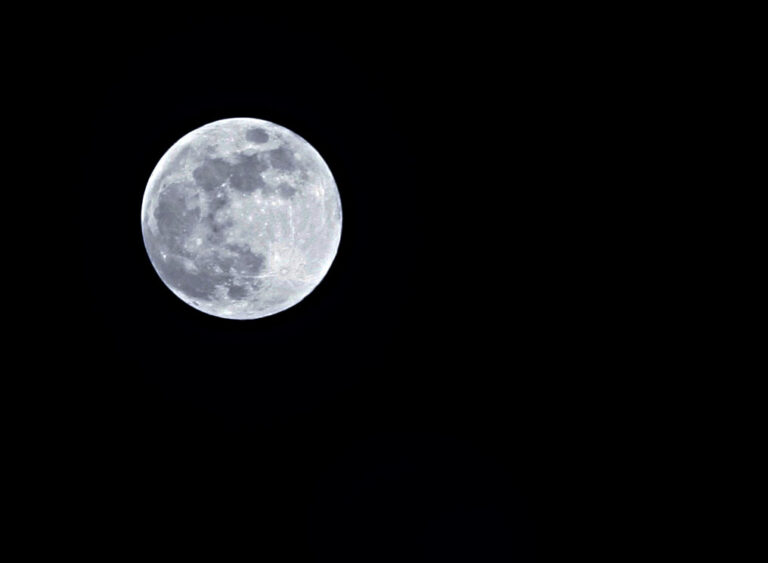
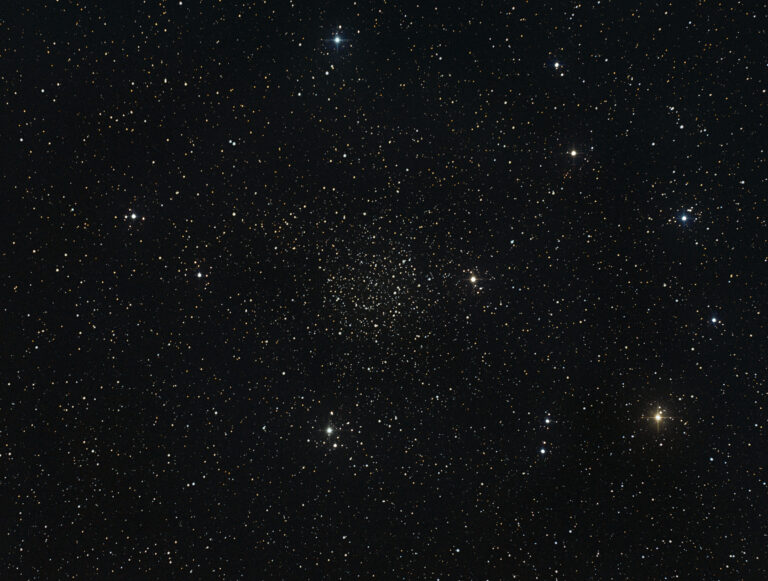
From Sirius this evening, M47 lies about 12.4° east-northeast, or to the left in the sky as you face south around 10 P.M. If your southern sky is dark and free of light pollution, you may just be able to make out the 4th-magnitude cluster as a soft glow with the naked eye. In all, M47 spans about the same size as the Full Moon on the sky (0.5°) and has several bright stars near its center, making it somewhat resemble the more famous Pleiades (M45) in Taurus. Overall, M47 contains about 50 stars and is roughly 78 million years old.
Note that because it is both large and has only a few dozen stars, M47 looks best at low powers, such as through binoculars or even your telescope’s finder. Zooming in on it with a telescope at higher magnification will be somewhat disappointing, as it’s best viewed in its entirety.
Sunrise: 7:03 A.M.
Sunset: 5:26 P.M.
Moonrise: 10:51 P.M.
Moonset: 9:14 A.M.
Moon Phase: Waning gibbous (72%)
*Times for sunrise, sunset, moonrise, and moonset are given in local time from 40° N 90° W. The Moon’s illumination is given at 10 P.M. local time from the same location.
Saturday, February 7
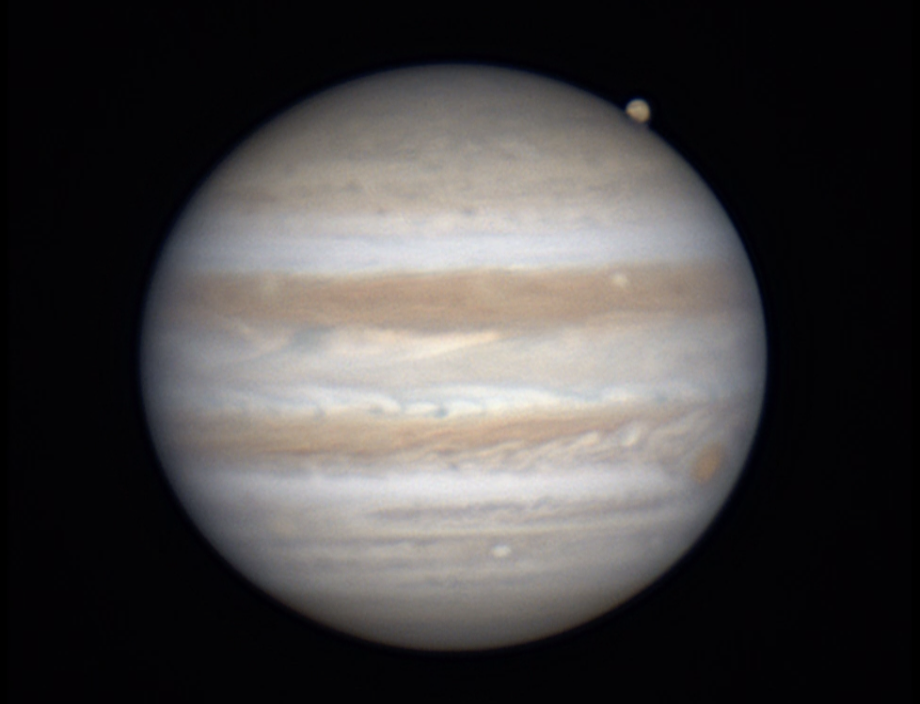
Jupiter still dominates the constellation Gemini, visible all night and into the early-morning hours, setting only shortly before dawn begins to color the sky.
Jupiter is now highest in the southern sky around 10 P.M. local time; after that, it begins to sink slowly toward the western horizon, hanging beneath (and outshining) the bright stars Pollux and Castor. Through a telescope, all four of Jupiter’s Galilean moons are visible early this evening: Ganymede sits alone to the west, with the other three (Io, Europa, and Callisto, in that order from nearest to farthest from the planet) visible to the east.
But Ganymede is closing in on Jupiter’s northwestern limb and shortly after midnight in the Eastern time zone (12:02 A.M. EST), it disappears behind the planet in an occultation visible across the continental U.S. Because Ganymede is so large, the disappearance can take several minutes; make sure you have your telescope set up well beforehand to catch the show.
The moon takes more than three hours to cross behind the planet, but when it finally emerges, it remains hidden from view by Jupiter’s long, dark shadow. Ganymede doesn’t reappear until about 4:15 A.M. MST on February 8th, after the planet has set for the eastern half of the U.S. and when it is starting to sink low even in the Mountain time zone. The reappearance, which occurs some 20” from Jupiter’s northeastern limb, is best seen from the West Coast.
Sunrise: 7:02 A.M.
Sunset: 5:27 P.M.
Moonrise: 11:55 P.M.
Moonset: 9:37 A.M.
Moon Phase: Waning gibbous (63%)
Sunday, February 8
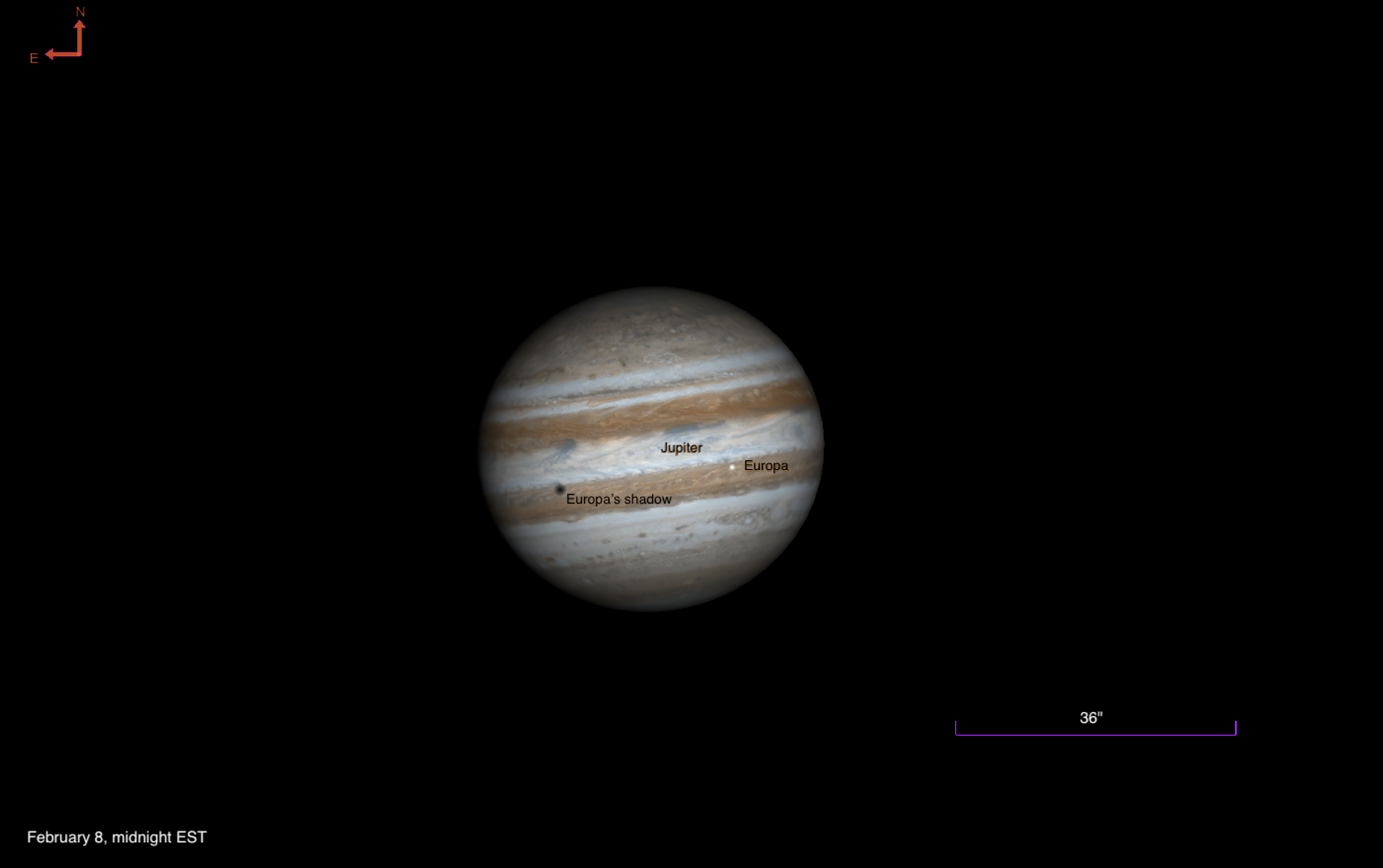
Last night, Ganymede passed behind Jupiter in an occultation. Tonight, the smaller moon Europa passes in front of Jupiter in a transit, bringing with it its dark shadow, visible on the cloud tops.
The transit begins shortly before 10 P.M. EST, with Jupiter still high in the sky. Once again, look for the bright gas giant (magnitude –2.6) hanging below Castor and Pollux in Gemini the Twins. Zoom in with a telescope before the event begins and, like last night, you’ll see three moons on one side of the planet and one on the other. Now it’s Io alone on the western side, with Europa closing in on the east. Ganymede lies farther east, and Callisto beyond it.
Europa finally moves in front of the disk at 9:54 P.M. EST. It takes nearly an hour and a half for its shadow to follow, appearing around 11:20 P.M. EST. By then Europa is roughly halfway across the disk. An hour later, both Europa and its shadow are clearly visible, straddling the central meridian with Europa approaching the western limb and the shadow now well separated from the eastern limb. Europa’s transit ends around 12:45 A.M. EST (now the 9th in the Eastern time zone only), and its shadow again follows suit almost an hour and a half later, disappearing shortly before 1:15 A.M. EST (now the 9th for the eastern half of the U.S.).
The time between moons and their shadows crossing has been increasing since Jupiter’s opposition last month and will continue to do so as we move farther from that date.
Sunrise: 7:01 A.M.
Sunset: 5:28 P.M.
Moonrise: —
Moonset: 10:02 A.M.
Moon Phase: Waning gibbous (54%)
Monday, February 9
Last Quarter Moon occurs at 7:43 A.M. EST. This phase is best viewed in the early-morning hours; early risers can catch it before dawn, and our satellite remains visible in the sky even after the Sun has risen.
An hour before dawn this morning, the Moon floats high in the south, amid the stars of Libra and to the right of the claws of Scorpius. (We’ll return here tomorrow morning as well, as the Moon moves into Scorpius in preparation for a close pass of the bright star Antares tomorrow night.)
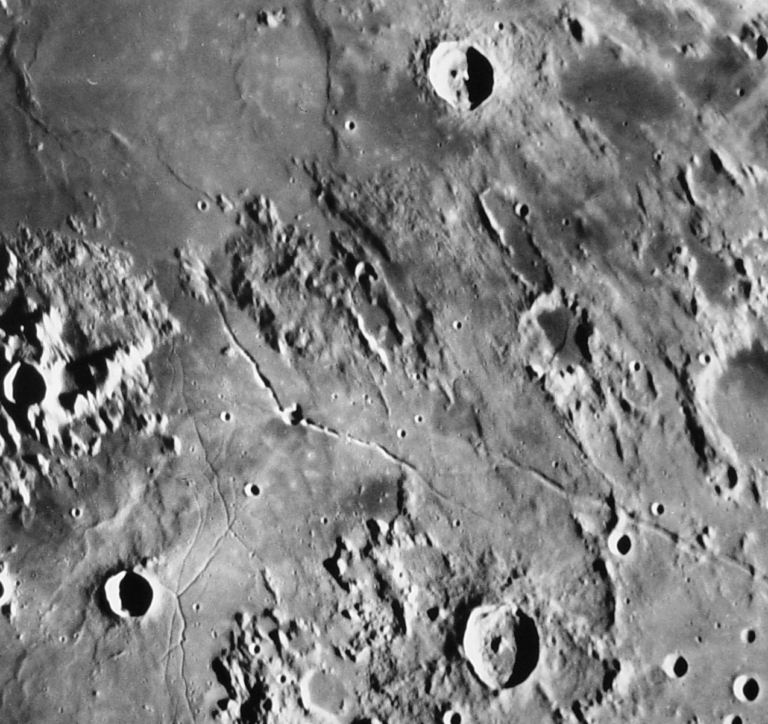
The Last Quarter Moon is lovely to view through binoculars or a small scope. Night has reached midway across the nearside, cloaking half in darkness while half remains in sunlight. Still visible this morning in the lunar north just on the sunward side of the terminator dividing night and day are the Apennine Mountains, curving gently along the edge of Mare Imbrium (the Sea of Rains). Just below Imbrium is a bright, round crater with a large, tangled set of rays stretching outward in all directions like a cartoon Sun. This is Copernicus, some 58 miles (93 kilometers) across and less than a billion years old. Those rays reach outward some 500 miles (800 km) across the surrounding terrain, visible because they are the lighter material from beneath the surface excavated during the impact that formed the crater.
Sunrise: 7:00 A.M.
Sunset: 5:29 P.M.
Moonrise: 12:58 A.M.
Moonset: 10:30 A.M.
Moon Phase: Waning crescent (44%)
Tuesday, February 10
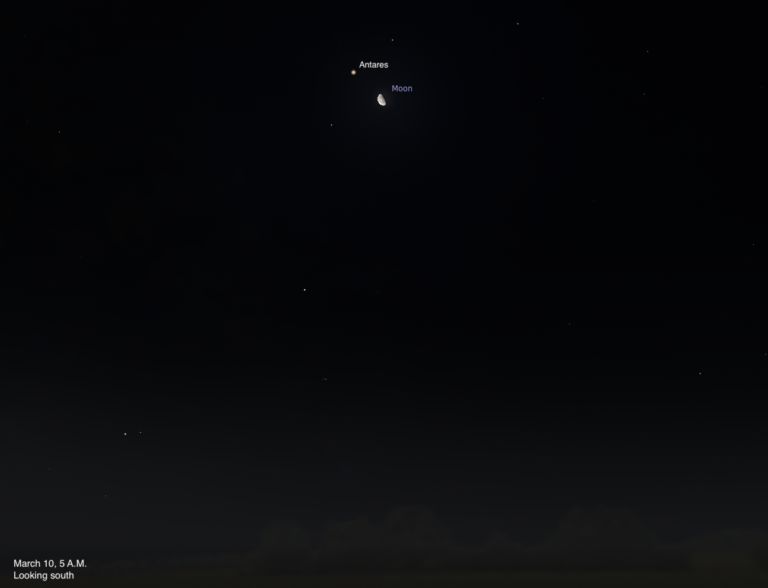
Let’s return to the early-morning sky an hour before dawn to check on the Moon’s progress. Now in Scorpius, our waning satellite is close to the 3rd-magnitude star Pi (π) Scorpii and less than 8° from Antares, the Scorpion’s bright red heart. The Moon will pass 0.7° south of Antares late tonight at 11 P.M. EST, when both are below the horizon.
While your gaze is on this region of the sky this morning, point your telescope over to Antares itself. Just 0.6° northwest of this magnitude 1.1 star is the globular cluster NGC 6144. Both are visible together at low powers, but Antares is so much brighter than the cluster that NGC 6144 itself can be better seen by zooming in on this object alone. You can simply adjust the view so Antares falls out of your field, or switch to higher magnification or a larger scope. NGC 6144 is nearly 30,000 light-years away. Spanning just under 10’, its center is tightly packed and difficult to resolve in smaller scopes, but you may be able to pick out member stars around its outer edges.
The Moon reaches apogee, the farthest point from Earth in its orbit, at 11:52 A.M. EST. At that time, our satellite will be 251,392 miles (404,576 km) away.
Sunrise: 6:59 A.M.
Sunset: 5:30 P.M.
Moonrise: 2:00 A.M.
Moonset: 11:05 A.M.
Moon Phase: Waning crescent (35%)
Wednesday, February 11
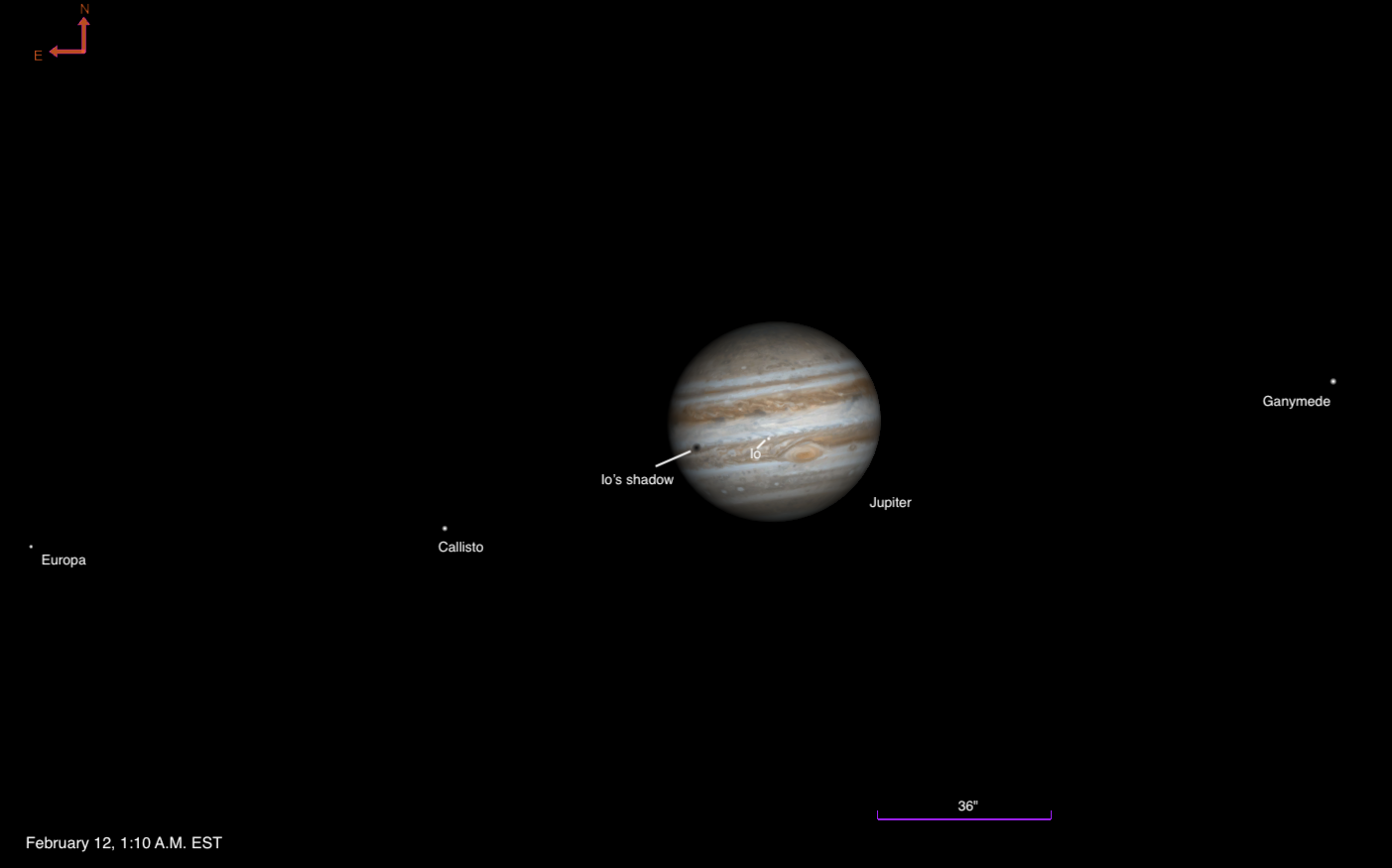
Observers in the eastern half of the U.S. can catch the large blot of Ganymede’s shadow sliding across the cloud tops of Jupiter as darkness falls this evening. The shadow is already transiting at sunset in the Eastern and Central time zones, with Ganymede itself just west of Jupiter, having recently completed its own transit.
Ganymede’s shadow disappears just after 8:15 P.M. EST, but the jovian show isn’t over yet. East of Jupiter, Io is visible closest to the planet; Callisto is visible just to Io’s east, with Europa farther east of them both. Over the next few hours, as Ganymede moves farther west, away from Jupiter, the other three moons are also moving west, closer to the planet.
Io finally reaches the limb and begins a transit at 12:06 a.m. EST (the 12th in EST only), followed by its shadow roughly 50 minutes later. By 1:30 A.M. EST (now the 12th for the Eastern and Central time zones), both are readily visible in front of the planet, moving from east to west. Io ends its transit just before 2:25 A.M. EST, with its shadow continuing until about 3:10 A.M. EST.
Sunrise: 6:58 A.M.
Sunset: 5:32 P.M.
Moonrise: 3:01 A.M.
Moonset: 11:48 A.M.
Moon Phase: Waning crescent (26%)
Thursday, February 12
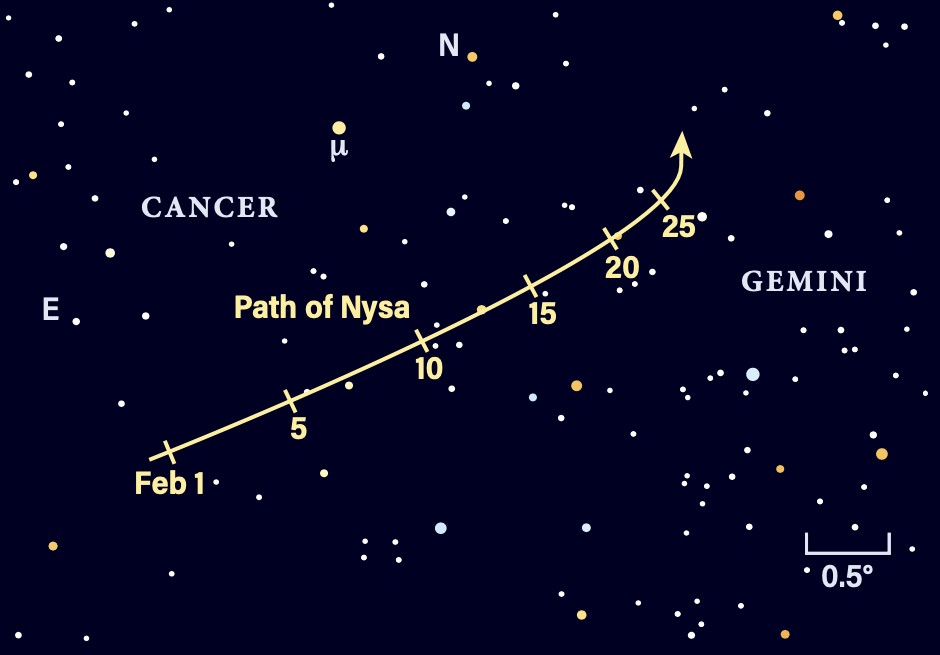
Asteroid 44 Nysa may be just past opposition, but it’s still placed perfectly for evening viewing in Cancer the Crab. Wait until a few hours after sunset, when Cancer is high in the eastern sky, and swing your telescope over to its western reaches, near the Crab’s border with Gemini the Twins. Ninth-magnitude Nysa is 3.3° northwest of Zeta (ζ) Cancri, also called Tegmine, a magnitude 4.6 multiple star system that can be easily split into two with a telescope.
Nysa is particularly close to a 7th-magnitude field star, which tonight lies only about 8’ northwest of the main-belt world. You can use this star as a signpost to watch Nysa’s motion over the next few nights. Spanning about 70 miles (113 km) along its longest axis, this oblong space rock is one of the brightest asteroids in our sky right now, currently only fainter than 4 Vesta and even outshining 1 Ceres at the moment, thanks to the difference in their distances from Earth as we all orbit the Sun.
Sunrise: 6:56 A.M.
Sunset: 5:33 P.M.
Moonrise: 3:57 A.M.
Moonset: 12:37 P.M.
Moon Phase: Waning crescent (18%)
Friday, February 13
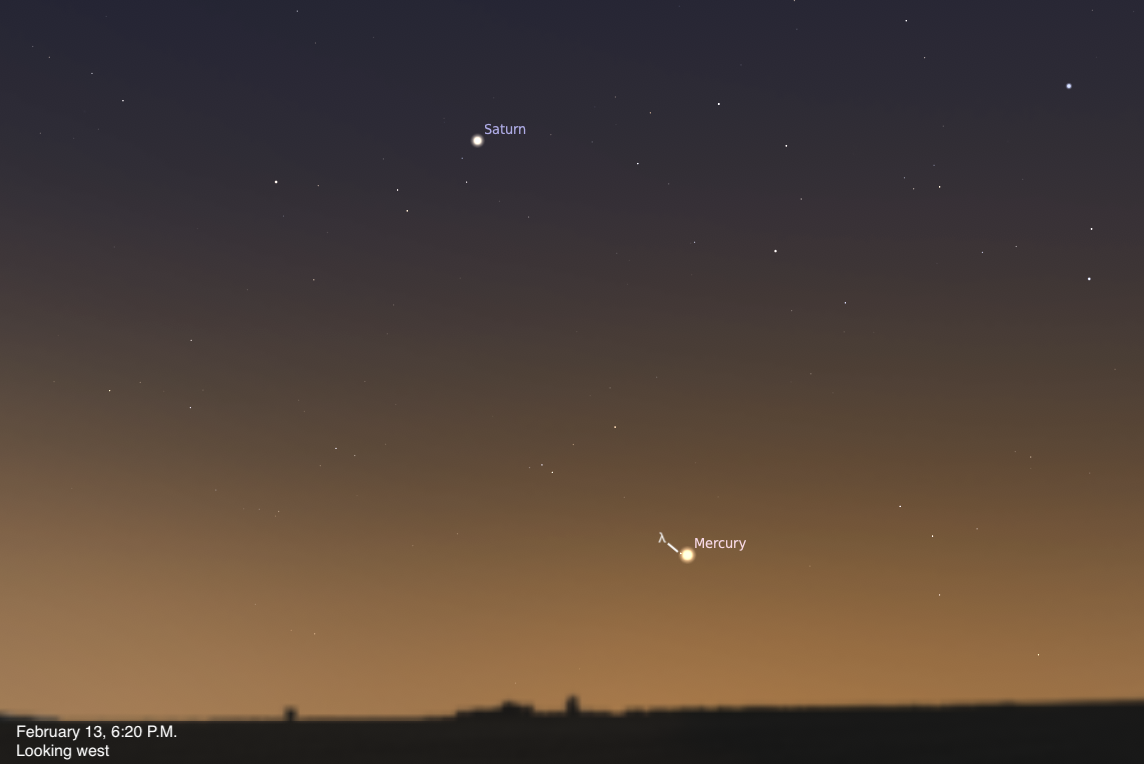
Mercury passes close to the star Lambda (λ) Aquarii in the evening sky tonight, visible for a short time after sunset.
Half an hour after the Sun goes down, bright Venus blazes at magnitude –3.9 just above the western horizon. About 7.5° above it, Mercury also shines brightly, though it is three full magnitudes fainter, at magnitude –0.9. After Venus, it should be the next point of light you see appear in the darkening sky.
Wait another half hour, and although Venus has disappeared, you might now catch Lambda Aqr, shining at magnitude 3.7 just ¼° southeast (to the upper left) of Mercury. They’re easy to catch together in the same field of view of any optics. Sometimes called Hydor (though this name is not officially recognized by the International Astronomical Union), Lambda Aqr is located nearly on the ecliptic, the plane of the solar system and the line in the sky along which the planets appear. This aging star is roughly 100 times the width of the Sun and has about three times our star’s mass.
Through a telescope, you’ll see that Mercury’s 6”-wide disk shows off a gibbous phase, now 73 percent lit. Compare that to Venus (which you’ll have to observe first, as it sets shortly after 6 P.M. local time), which is 10” wide and virtually full at 99 percent lit.
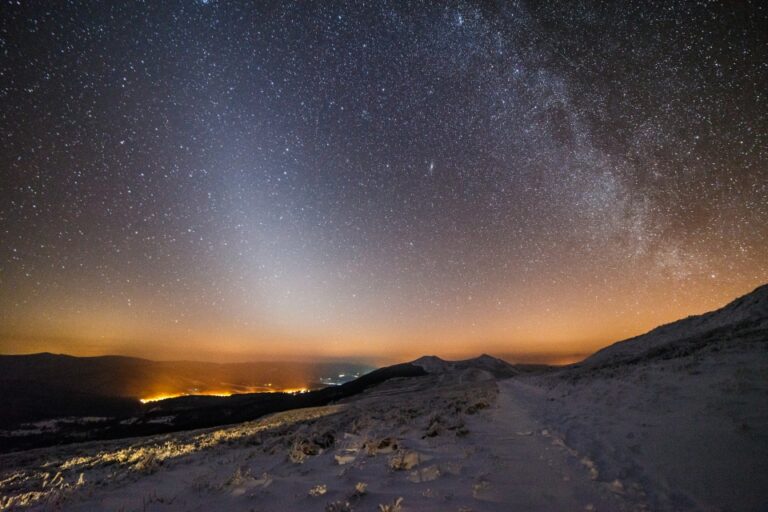
About 18° above Mercury is 1st-magnitude Saturn. A line drawn between these two planets shows the rough location of the ecliptic; we’ll use these planets and the ecliptic as guides next week to observe the zodiacal light, so stay tuned!
Sunrise: 6:55 A.M.
Sunset: 5:34 P.M.
Moonrise: 4:46 A.M.
Moonset: 1:36 P.M.
Moon Phase: Waning crescent (11%)