Credit: Chris Schur
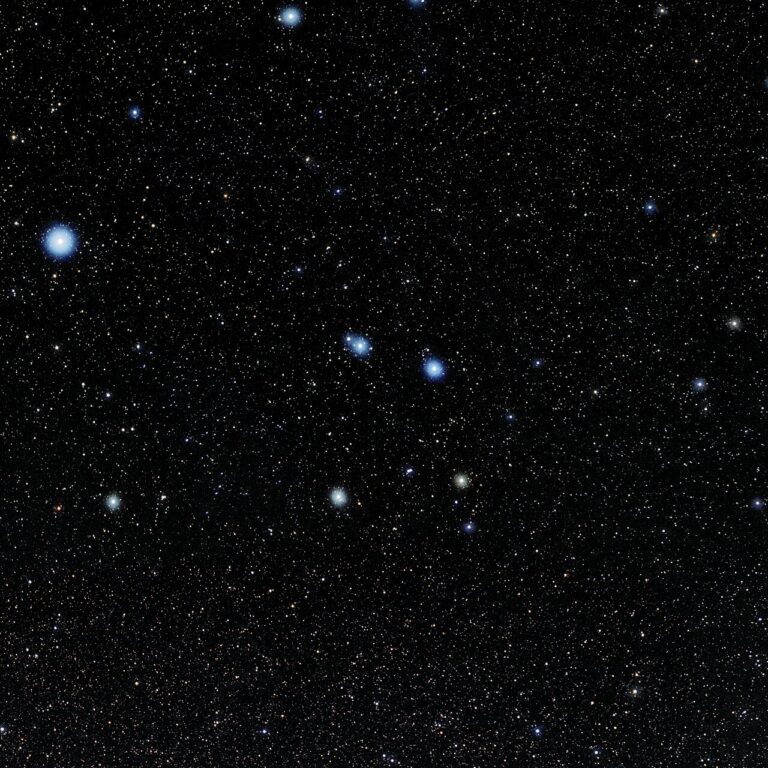
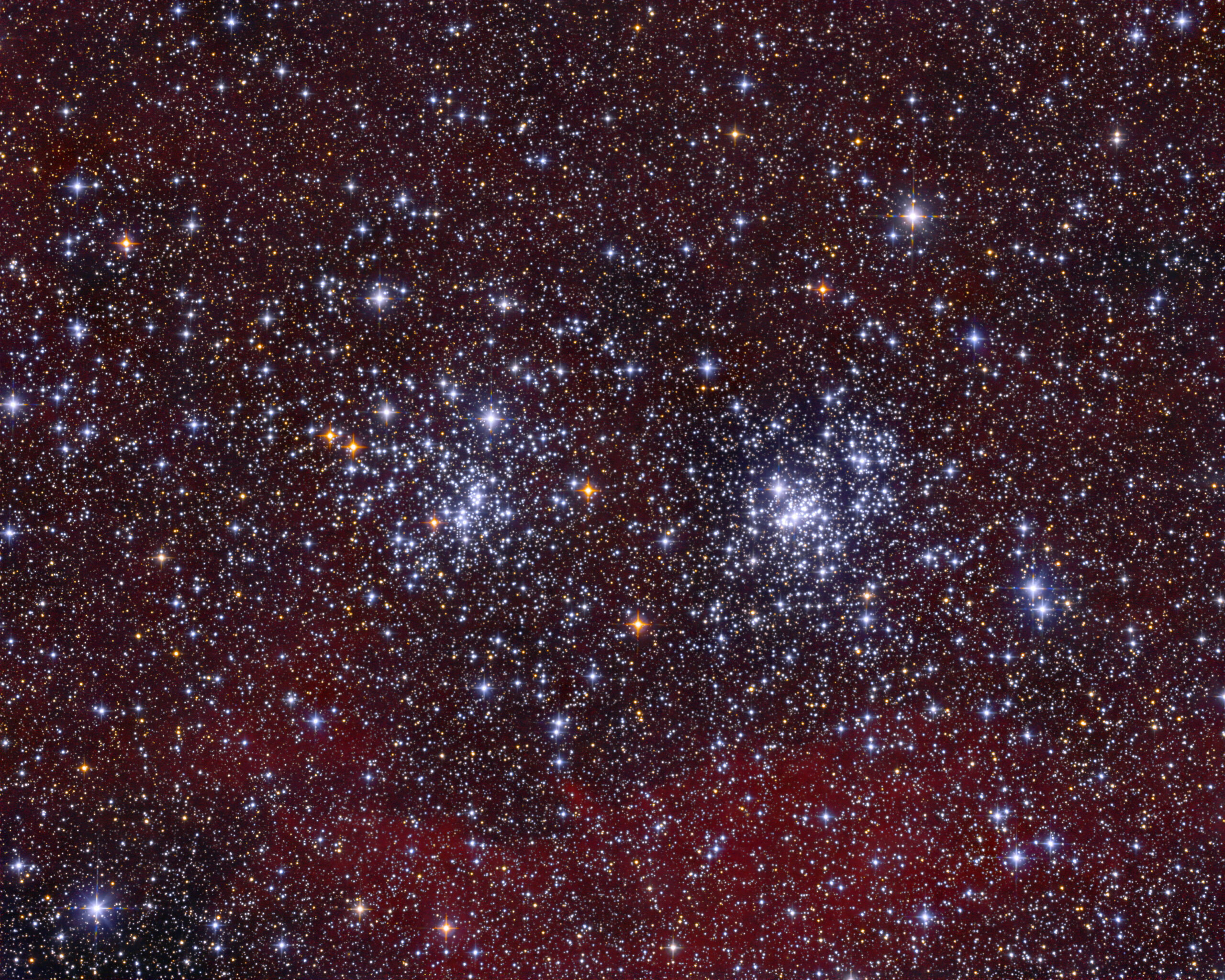
A few days ago, longtime Astronomy magazine contributor Chris Schur sent me the image you see here. It shows the famous Double Cluster in Perseus, also known as NGC 869 and NGC 884.
Most images of this pair of open clusters combine 20 or 30 minutes of exposure. For this one, Schur collected a whopping 15 hours through a 10-inch f/3.9 Newtonian astrograph. He noted that the reward was the beautiful red wall of hydrogen nebulosity at the bottom (south) end of the frame.
This rich assemblage of golden and sapphire blue supergiant suns combined with the glowing embers of hydrogen gas in the same image forms this dazzling portrait of one of the Milky Ways finest gems. As often as this target is imaged, nearly none of them is deep enough to show this depth and color.
NGC 869 lies at a distance of 7,460 light-years and glows at magnitude 3.7. NGC 884 is a bit farther away, about 7,640 light-years distant. It glows a tiny bit fainter at magnitude 3.8. Astronomers estimate that both clusters are around 14 million years old. Each cluster appears to have a diameter roughly the same as the Full Moon, about ½°.
And even though no amateur telescope will reveal such glory in the Double Cluster, this image still makes me want to go out and observe it. How about you? Thanks, Chris, for sending it!