Credit: Anthony Ayiomamitis
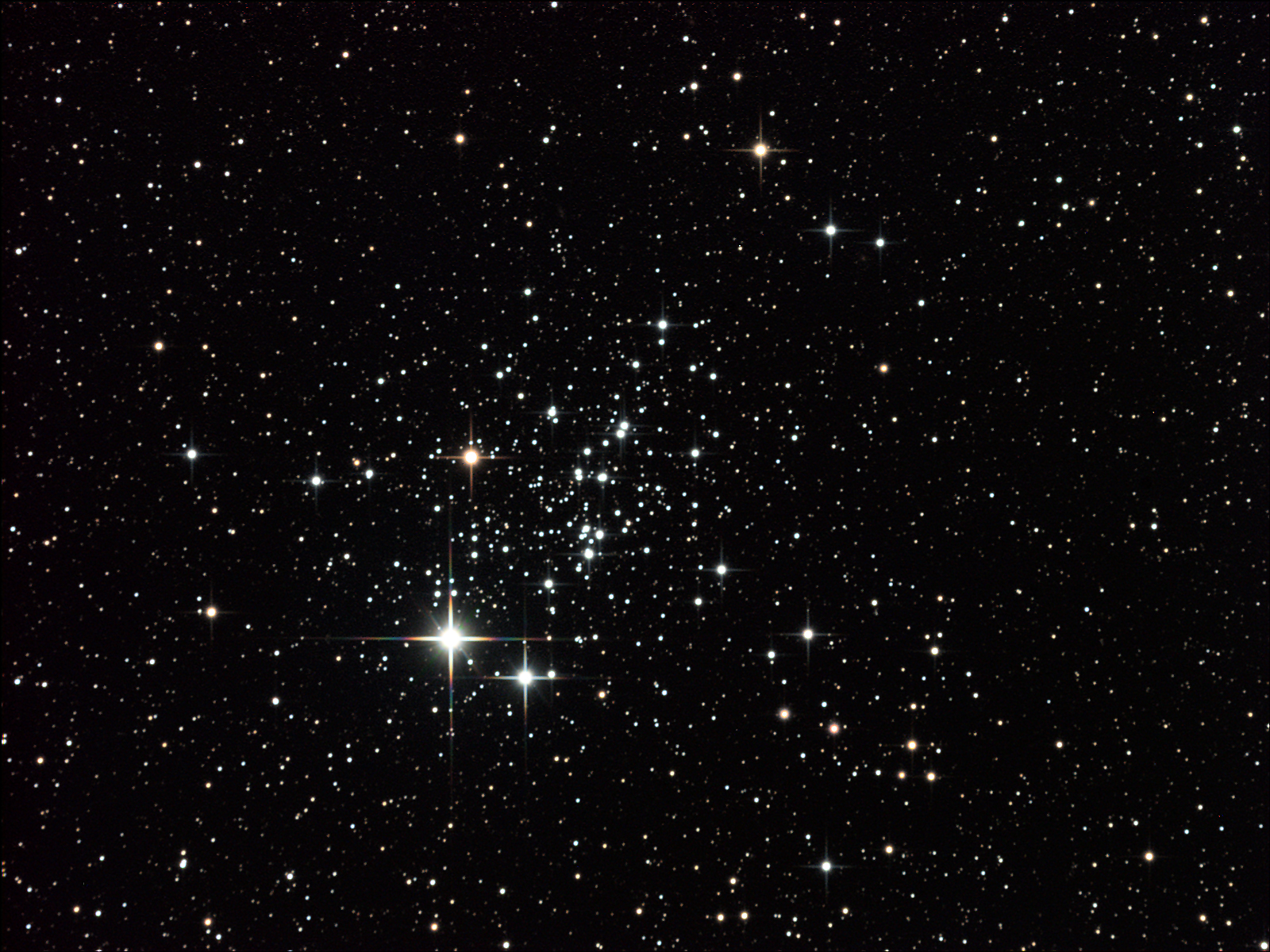
One of the sky’s two celestial owls (the other is the Owl Nebula [M97]) takes silent flight in Cassiopeia’s rich star fields. The one I’m talking about is an open cluster usually called the Owl Cluster, also known as NGC 457 and the Phi Cassiopeiae Cluster. And while the 5th-magnitude star Phi Cassiopeiae lends its name to this object, it doesn’t travel with it through space.
German-born English astronomer Sir William Herschel discovered NGC 457 in 1787. Messier missed this cluster, although it outshines the two objects he included from this constellation—magnitude 6.9 M52 and magnitude 7.4 M103.
While observing this cluster in 1977, Astronomy magazine Editor Emeritus David J. Eicher saw an owl figure made of the two brightest stars and the cluster’s overall shape. He dubbed it the Owl Cluster, and it’s carried that name ever since. Five years later, Universal Pictures released the movie E.T.: The Extra-Terrestrial. Some observers saw a resemblance between the alien character in the film and NGC 457, and they subsequently dubbed it the E.T. Cluster. I’ve never been able to see the resemblance there, so I stick to calling it the Owl.
NGC 457 glows at magnitude 6.4. (I’m not counting Phi Cassiopeiae.) It contains 25 stars brighter than 12th magnitude that cover a diameter of 13′. Its most luminous star shines at magnitude 8.6. A 6-inch telescope at 50 shows nearly 75 cluster stars. Note the uniform background glow caused by distant, unresolved Milky Way stars.
So, some clear night soon when the Moon isn’t too bright, head out, set up your scope, and take a look at the celestial Owl. Good luck!