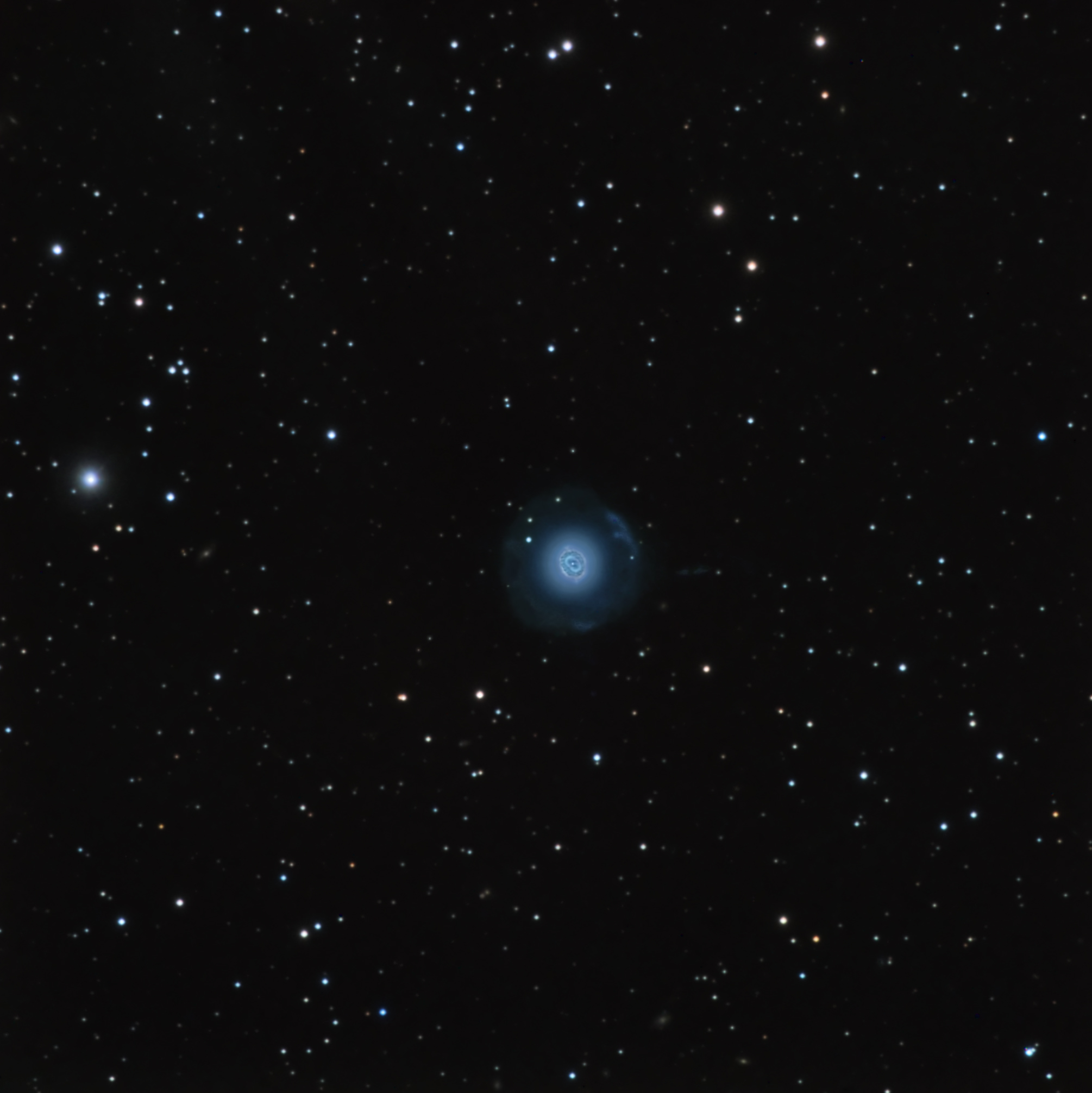
Credit: Derek Santiago
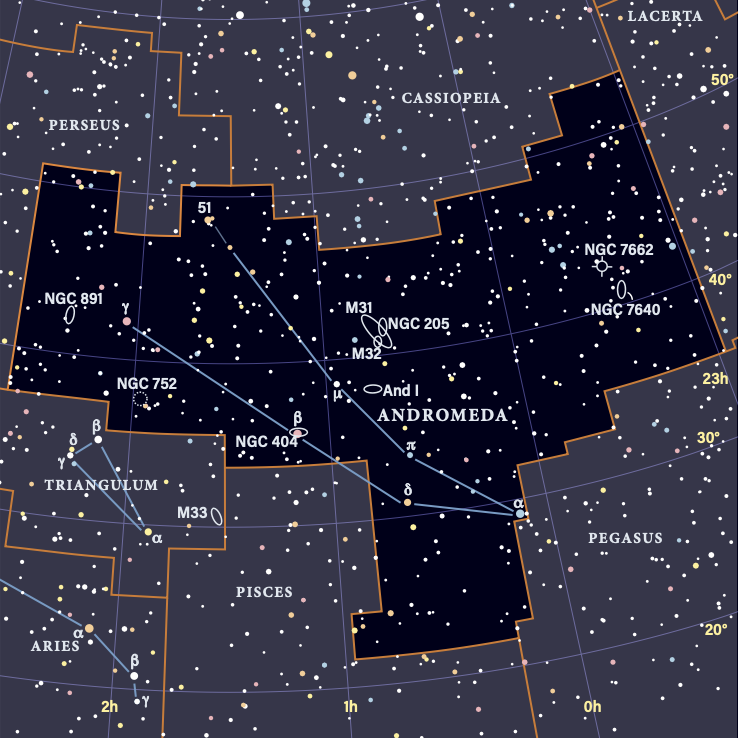
If you have access to an 8-inch or larger telescope, look in the northern part of the constellation Andromeda the Princessfor a planetary nebula called the Blue Snowball. Insert an eyepiece that will give you a magnification around 100x, and you’ll see immediately why astronomers gave it that name. Specifically, point your scope roughly 4½° east of the magnitude 3.6 star Omicron Andromedae.
German-born English astronomer William Herschel discovered this object October 6, 1784. He used what he normally called his 7-foot reflector, which was a Newtonian reflecting telescope with an aperture of 6.3 inches.
The Blue Snowball shines at magnitude 8.3, which is reasonably bright for a celestial object. Luckily, its light isn’t spread out over a large area. NGC 7662 — another designation for this object — measures only 2.2′ across. This small size concentrates the planetary’s light, allowing it to trigger your eyes’ color receptors. If you’re looking for (or wanting to show somebody) color in a deep-sky object, look no further than the Blue Snowball.
That being said, different observers have described it as pale blue, faint blue, light blue, Robin’s-egg blue, slightly blue, whitish-blue, and, occasionally, various shades of light green. What’s more, nobody’s wrong. Each of us has our own sense of color perception, and it may differ a little or a lot from the observer next in line.
Through an 8-inch scope, the Blue Snowball appears as a small, evenly illuminated disk. You won’t see the 13th-magnitude central star in anything less than a 16-inch scope, so search for other details, like the nebula’s rich inner structure.
Look for a bright ring of gas surrounding NGC 7662’s hollow center. A fainter gas shell — tough to see — encompasses the ring. The ring’s brightest areas lie to the northeast and southwest. At magnifications above 300x, the brightness of the shell drops quickly near its edge.