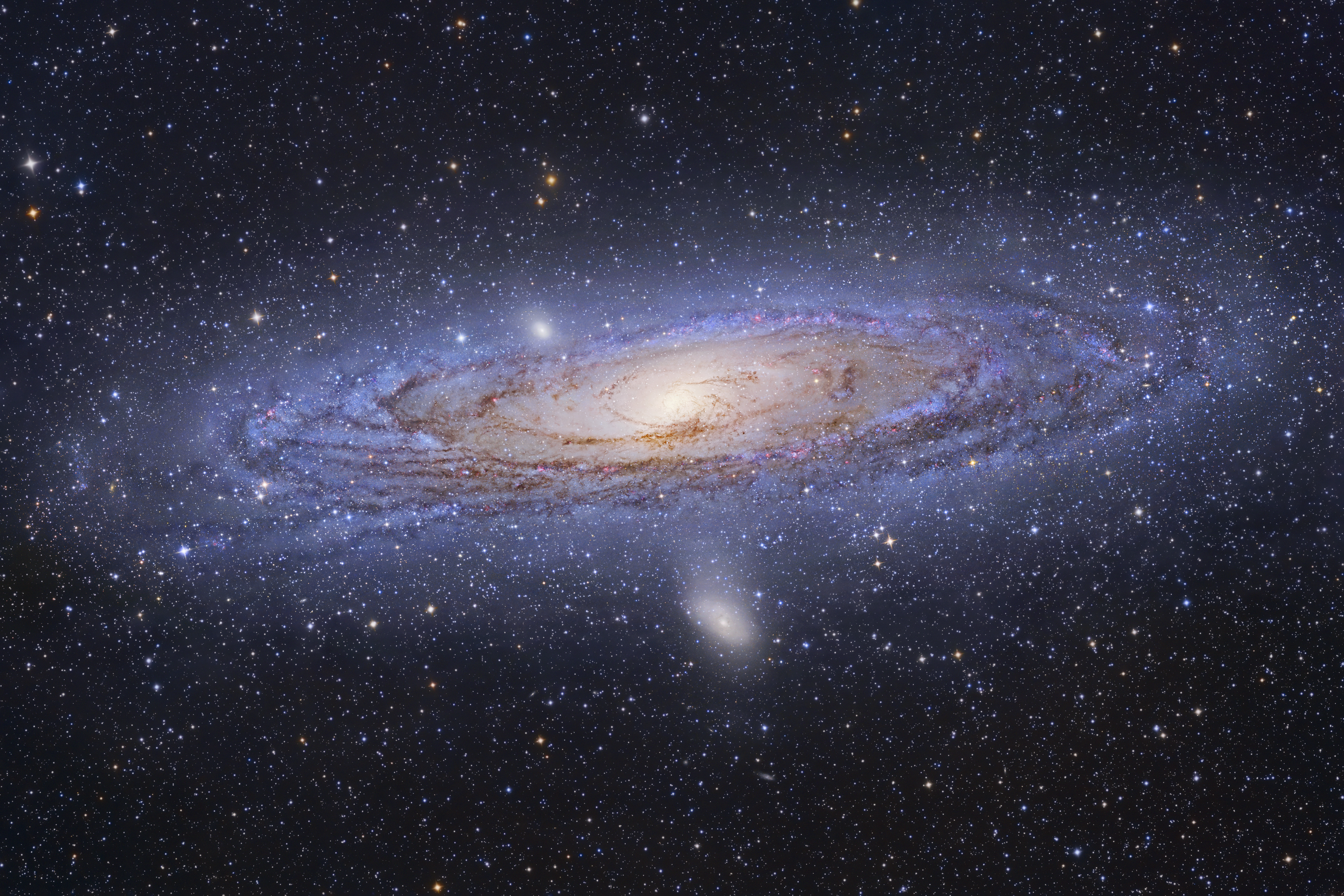
Credit: Tony Hallas
The northern sky’s greatest galaxy gets its familiar name from the northern constellation where it resides, Andromeda the Princess. This star system is our nearest large spiral galaxy, and it sits at the far end of the Local Group of galaxies.
Observations
Observers have described M31 as something other than starlike as far back as 964. In that year, Persian astronomer Abdal-Rahman Al-Sufi called it a ‘‘little cloud’’ in his Book of Fixed Stars.
German astronomer Simon Marius was the first to study it telescopically. In the beginning of the 17th century, he described it, ‘‘Like the flame of a candle seen through horn, and like a cloud consisting of three rays; whitish, irregular and faint; brighter toward the center.’’
Charles Messier made it number 31 in his catalog August 3, 1764: ‘‘The beautiful nebula of the belt of Andromeda, shaped like a spindle; it resembles two cones or pyramids of light, opposed at their bases.’’
In 1888, British astronomer Isaac Roberts became the first to photograph spiral structure in M31.
American astronomer Vesto M. Slipher first measured M31’s radial velocity (the speed of a celestial object toward or away from us) in 1912. Slipher found that its velocity far surpassed any other object, and his measurement helped prove M31 lay far from the Milky Way. In 1923, Edwin Hubble measured Cepheid variable stars in M31 and confirmed its extragalactic nature.
See for yourself
On a clear dark night, most people can spot this wonderful object without optical aid. I think it looks like a small piece of the Milky Way that’s broken off the main section. In reality, it’s a separate “Milky Way” all on its own. It lies some 2.5 million light-years away and glows (if you could concentrate all of its light into a point) as brightly as a star of magnitude 3.4.
As an observer using a telescope, you can approach the Andromeda Galaxy in one of two ways. You can use low-power optics for an overall view, which includes M31’s nucleus, dust lanes, and two companion galaxies, M32 and NGC 205. If this is your approach, try 20-power (or similar) binoculars from a dark site. See if you can trace M31’s full length, which equals six Full Moons side by side.
Another strategy some amateur astronomers use is to eschew wide-field views of the Andromeda Galaxy in favor of greatly magnified looks at small regions through medium-to-large telescopes. If this plan appeals to you, use an 11-inch or larger scope and crank up the magnification to 300x and more, if your sky conditions allow such powers. Scan M31’s spiral arms for bright clumps, which indicate star-forming regions.
However you choose to view it, you will not be disappointed in what you see. Good luck!