Credit: Tony Hallas

Key Takeaways:
- Stephan's Quintet, discovered in 1877 by French astronomer Edouard Stephan in the constellation Pegasus, exemplifies the enhanced detail observable through larger astronomical apertures.
- The group consists of five galaxies: NGC 7317 (magnitude 14.6), NGC 7318A (magnitude 14.3), NGC 7318B (magnitude 13.9), NGC 7319 (magnitude 14.1), and NGC 7320 (magnitude 13.2).
- Four of these galaxies (NGC 7317, NGC 7318A, NGC 7318B, NGC 7319) constitute the first compact galaxy group ever discovered, while NGC 7320 is affiliated with the Pegasus Spur galaxy group.
- While a 6-inch telescope reveals only a faint, clumpy glow, an 11-inch instrument is necessary to identify individual members, with magnifications exceeding 200x recommended to resolve the colliding pair NGC 7318A and NGC 7318B.
One of the mantras of amateur astronomy is ‘‘aperture rules.’’ This means you’ll see more detail as you observe through ever-larger telescopes. Few celestial objects demonstrate this better than Stephan’s Quintet. So, fair warning, this post is directed to those of you with access to large amateur instruments.
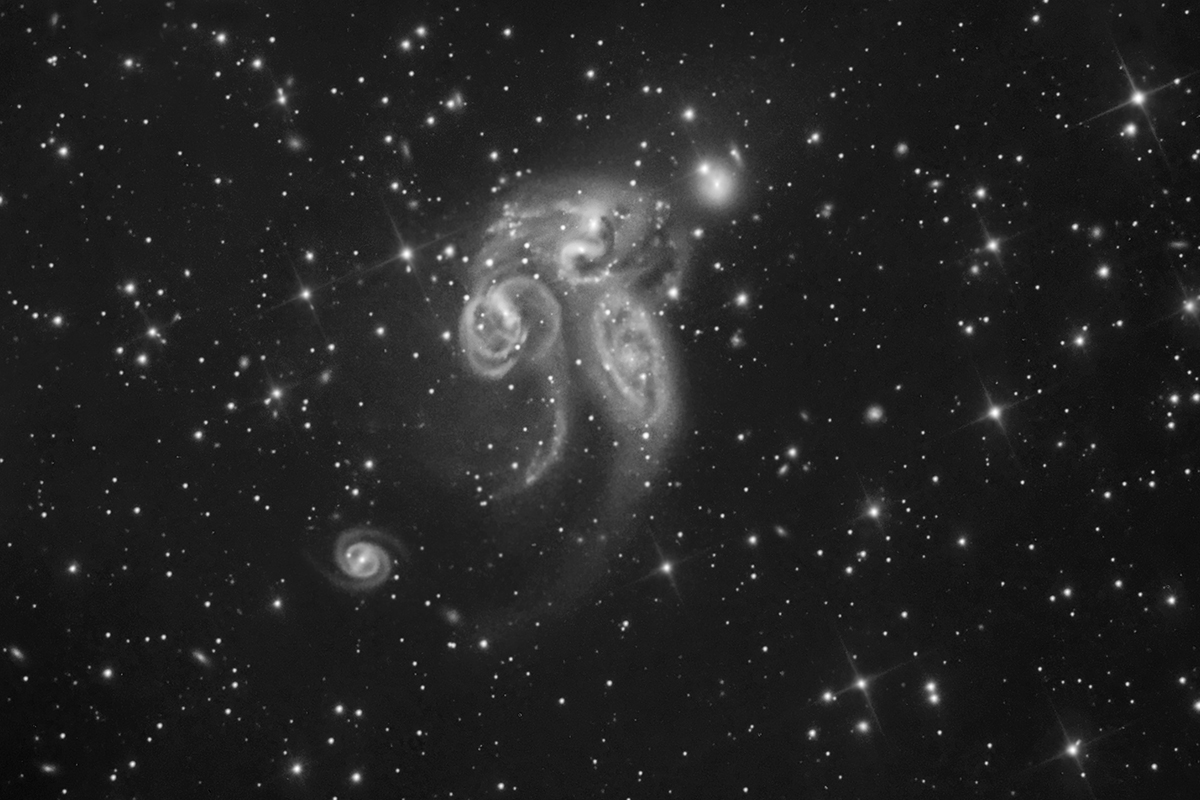
French astronomer Edouard Stephan discovered this group in 1877 in the constellation Pegasus the Winged Horse. The five galaxies now carry the designations NGC 7317 (magnitude 14.6), NGC 7318A (magnitude 14.3), NGC 7318B (magnitude 13.9), NGC 7319 (magnitude 14.1), and NGC 7320 (magnitude 13.2).
Four of these galaxies — the exception is NGC 7320 — form a compact galaxy group, the first ever discovered. NGC 7320 belongs to the Pegasus Spur, a group of about three dozen galaxies, the brightest of which is magnitude 9.5 NGC 7331.
Although you can ‘‘see’’ Stephan’s Quintet through a 6-inch scope, a magnification of 50x will show you only a faint, clumpy glow 30 across. An 11-inch telescope, on the other hand, lets you identify the individual members.
At the Quintet’s southwestern edge is NGC 7317, which lies next to a 13th-magnitude foreground star. The colliding pair NGC 7318A and NGC 7318B lies 2′ to the east. You’ll need high magnification — above 200x — to ‘‘unmerge’’ them.
The brightest and largest member, NGC 7320, lies to the southeast and contains a 13th-magnitude foreground star in its halo. This galaxy shines at magnitude 12.5. NGC 7319, which sits at the group’s northeastern edge, is another test for visual observers.
Pick a moonless night with steady air, get comfortable, and be patient. Good luck!