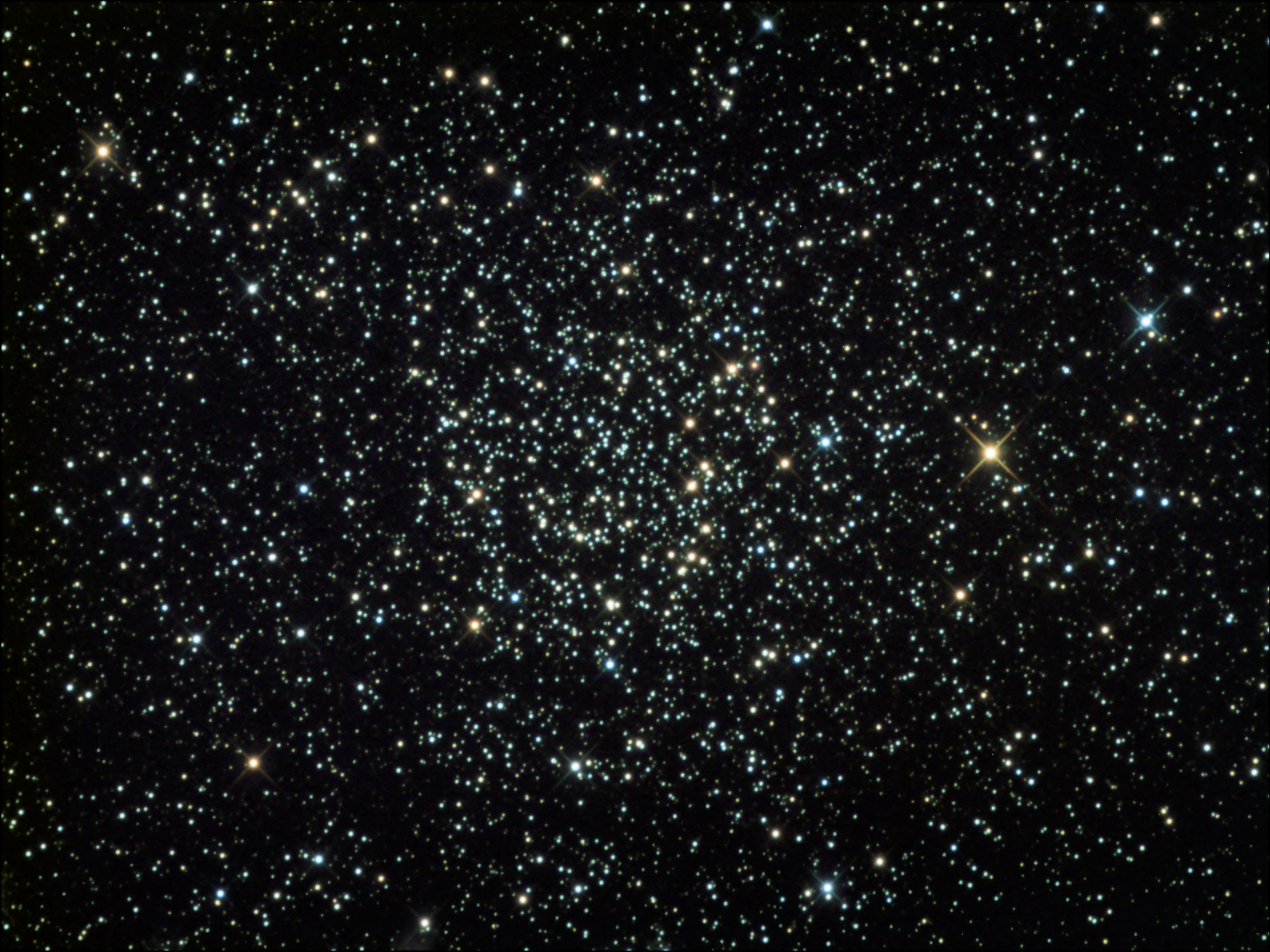
Credit: Anthony Ayiomamitis
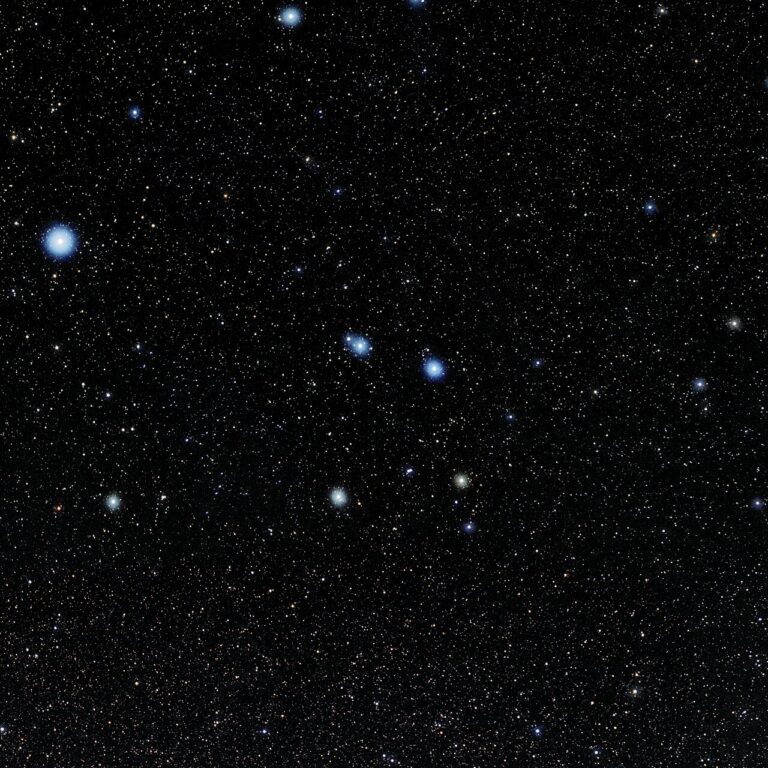
You’ll find this terrific open cluster midway between 5th-magnitude Sigma Cassiopeiae and 6th-magnitude Rho Cas. This group glows at magnitude 6.7, so even through a 4-inch telescope, you’ll see 50 stars evenly spread across this rich cluster’s face. An 8-inch telescope shows more than a hundred members and the number just keeps increasing with aperture. But it’s also collected the names the Crab Cluster and the Screaming Skull. I never could see the reason it got that last one.
Because so many equally bright stars occupy your view, your eyes will have a tendency to create patterns. Some observers see dark lanes between lines of stars. I see a stellar pattern that resembles a pinwheel, or a face-on spiral galaxy with four distinct arms. Some observers note the apparent counterclockwise spiral pattern of the stellar ‘‘arms’’ of this cluster. Because British astronomer Caroline Herschel discovered this object in 1783, this feature led to the nickname Herschel’s Spiral Cluster.
NGC 7789 (long before it had an NGC number) was the last deep-sky object Admiral William H. Smyth described in his 1844 epic two-volume work, Cycle of Celestial Objects. He said, ‘‘It is, indeed, a very glorious assemblage, both in extent and richness, having spangly rays of stars which give it a remote resemblance to a crab, the claws reaching the confines of the space in view, under an eyepiece magnifying 185 times. With this form in the mind’s eye, the imagined head will be in the np [north preceding, i.e. northwest], the tail in the sf [south following, i.e. southeast], and where the eyes would be, is the minute close double star of the 11th and 12th magnitudes, above estimated. There are several other pairs in the figure, especially towards the tail. The crab itself is but a mere condensed patch in a vast region of inexpressible splendour, spreading over many fields.’’
So, go out sometime soon and take a look at this great object. Good luck!