Credit: M. Zastrow/Stellarium
OK, we’ve all probably taken a few days off from trying to spot Comet C/2025 A6 (Lemmon) because of how much light the Moon was casting in our sky after sunset. Old Luna will still be bright for a while, but luckily it rises about an hour later each night. That gives us enough of a window to look for the comet as twilight is fading.
Comet Lemmon is still on its inbound journey right now before it swings around the Sun and heads back out. So, it’s getting brighter as it receives more solar energy, but it’s also fading because it’s moving away from Earth. We hope that the increase in energy more than makes up for the increasing distance, but comets are like cats. They both have tails and they do what they want. That’s why we have to keep watching it.
Observe it
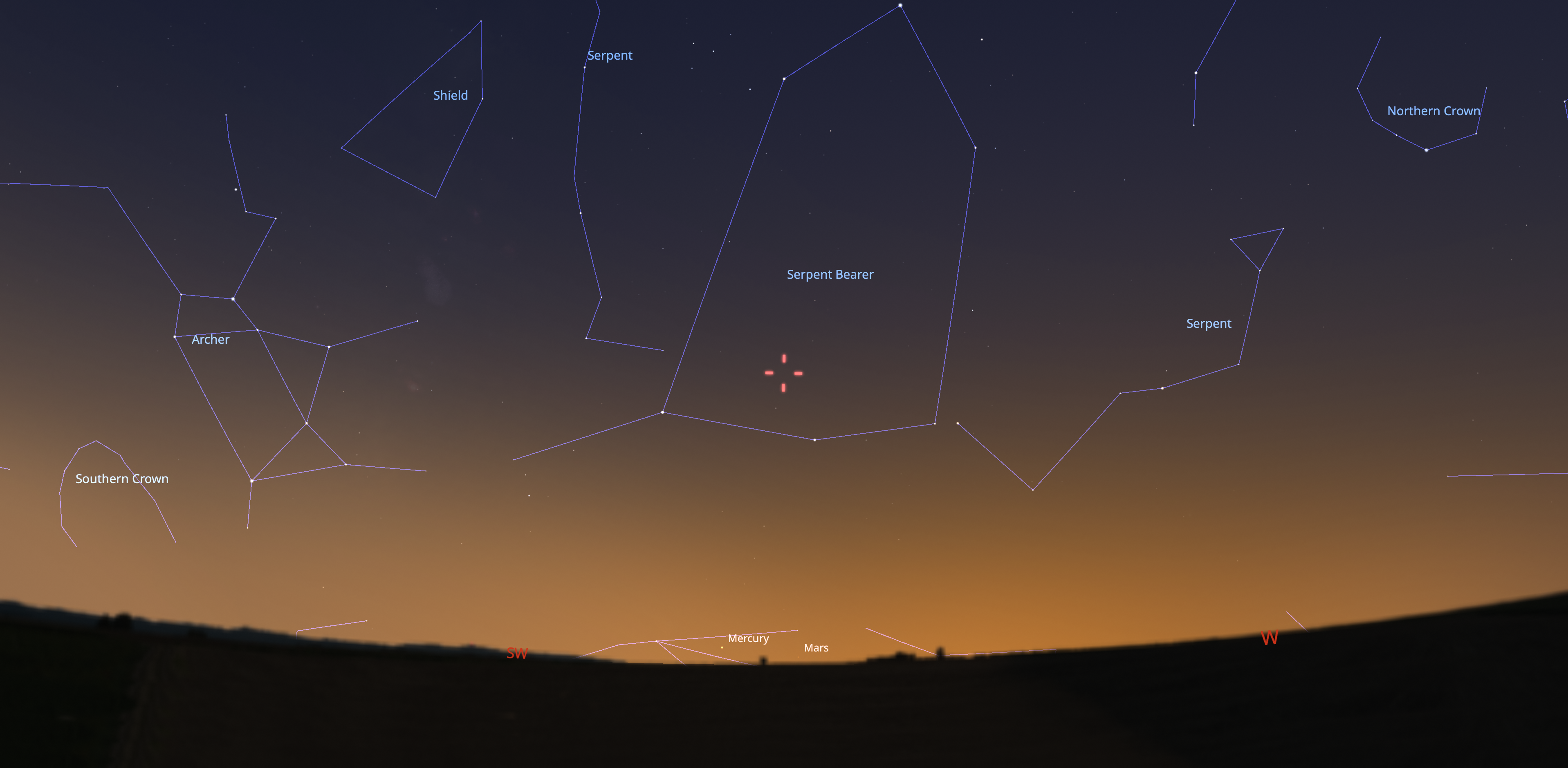
First, find the time the Sun sets at your location. A quick Google search for, “When is sunset at [location]” will do it. Then, head out 45 minutes later than your sunset time and face a bit south of west. Use the finder chart here to identify some of the visible stars, and then point binoculars toward the comet’s location and try to see it.
Lemmon is currently passing in front of the stars of the constellation Ophiuchus the Serpent-bearer. That’s a problem for people who don’t know the sky because there aren’t any bright stars near the comet. Well, we just have to be patient and persistent.
If you’re going to search for Comet Lemmon with a telescope, start viewing the area it’s in with your lowest power eyepiece. Even during the last remnants of evening twilight, you might sweep it up into your field of view. Depending on the length of the tail, you might be able to see the whole comet. Then, step by step, increase the magnification and scan the comet’s length for details. Can you see a single tail, or are there two? Are any parts of the tail brighter than others? Does the tail look disconnected at any point? Take your time.
More details
Comet Lemmon was discovered January 3, 2025, as part of the Mount Lemmon Survey, which uses a 60-inch telescope at Mt. Lemmon, Arizona (a scant 15.5 miles north of the author’s home). The camera attached to the telescope’s prime focus captures images that are 5° square.
Interestingly, the comet’s current orbital period is approximately 1,350 years. But after its perihelion passage (its closest approach to the Sun) on November 8, our star’s gravity will reduce that to 1,150 years. So, the next chance for earthbound observers to see this occasional visitor will be around the year 3175.
So, take a few minutes in the evening and try and spot Comet Lemmon — a ball of frozen gases currently speeding near the Sun at 130,000 miles per hour (209,000 kilometers per hour). Now may be your last chance to spot it, or it could be visible for weeks. We’re hoping for the latter, but we just don’t know. Good luck!