Credit: NASA/ESA/CSA/STScI/A. Levan (IMAPP)/Image Processing: A. Pagan (STScI)
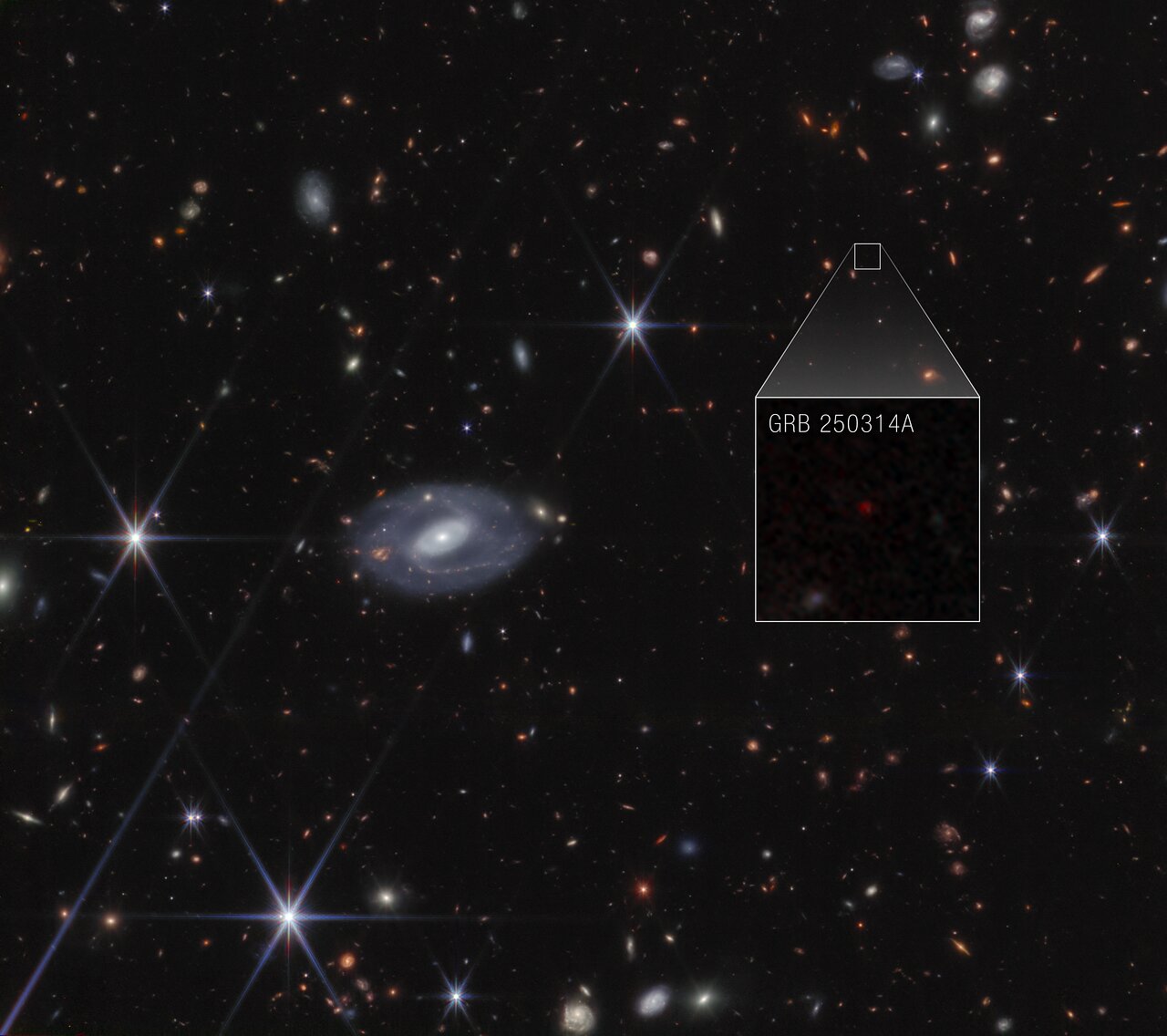
Using the James Webb Space Telescope (JWST), a team of astronomers has found the earliest known supernova, one which exploded when the universe was just 730 million years old. This observation shattered JWST’s previous record, a supernova that occurred when the universe was 1.8 billion years old. The team was following up on a gamma ray burst, designated GRB 250314A, detected by the Space-based multi-band astronomical Variable Objects Monitor (SVOM) mission, a Franco-Chinese telescope that launched in 2024 designed to detect transient events.
“Only Webb could directly show that this light is from a supernova — a collapsing massive star,” said Andrew Levan, the lead author of one of two new papers in Astronomy and Astrophysics Letters and a professor at Radboud University in Nijmegen, Netherlands, and the University of Warwick in the United Kingdom. “This observation also demonstrates that we can use Webb to find individual stars when the universe was only 5 percent of its current age.”
A gamma-ray burst created when two neutron stars or a neutron star and a black hole collide typically lasts for seconds. This one, created by the death of a massive star, lasted for 10 seconds. A supernova typically brightens rapidly over several weeks before it slowly dims. This supernova, however, took months to brighten. So, JWST’s observations were taken three and a half months after the gamma-ray burst because that’s when astronomers predicted the supernova would be brightest.
“Webb provided the rapid and sensitive follow-up we needed,” said Benjamin Schneider, a co-author and a postdoctoral researcher at the Laboratoire d’Astrophysique de Marseille in France.
Fast action
Within an hour and a half of the gamma-ray burst’s detection, NASA’s Neil Gehrels Swift Observatory pinpointed the source’s location. Eleven hours later, the Nordic Optical Telescope on the Canary Islands in Spain revealed an infrared-light gamma-ray burst afterglow, which indicate the burst might have come from a distant object. Four hours later, the European Southern Observatory’s Very Large Telescope in Chile estimated the object existed 730 million years after the big bang.
“There are only a handful of gamma-ray bursts in the last 50 years that have been detected in the first billion years of the universe,” Levan said. “This particular event is very rare and very exciting.”
No different that nearby supernovae
Because this supernova is the earliest and farthest, researchers compared it to modern, nearby supernovae. The two turned out to be very similar. This was a surprise to some on the team who expected such early events, created by more massive stars with fewer heavy elements, to look different.
“We went in with open minds,” said Nial Tanvir, a co-author and a professor at the University of Leicester in the United Kingdom. “And lo and behold, Webb showed that this supernova looks exactly like modern supernovae.” Before researchers can determine why such an early supernova is similar to nearby supernovae, more data is needed to pinpoint tiny differences.
First look at a supernova’s host galaxy
“Webb’s observations indicate that this distant galaxy is similar to other galaxies that existed at the same time,” said Emeric Le Floc’h, a co-author and astronomer at the CEA Paris-Saclay (Commissariat à l’Énergie Atomique et aux Énergies Alternatives) in France. Because the galaxy’s light is blended into only a few pixels, which made the galaxy look like a red smudge, what we can learn about it is limited. But just seeing it was the breakthrough.
The team already has formulated plans to use JWST to learn more about gamma-ray bursts in the early universe. The researchers will use the space telescope to capture the afterglow of the gamma-ray bursts themselves. “That glow will help Webb see more and give us a ‘fingerprint’ of the galaxy,” Levan said.