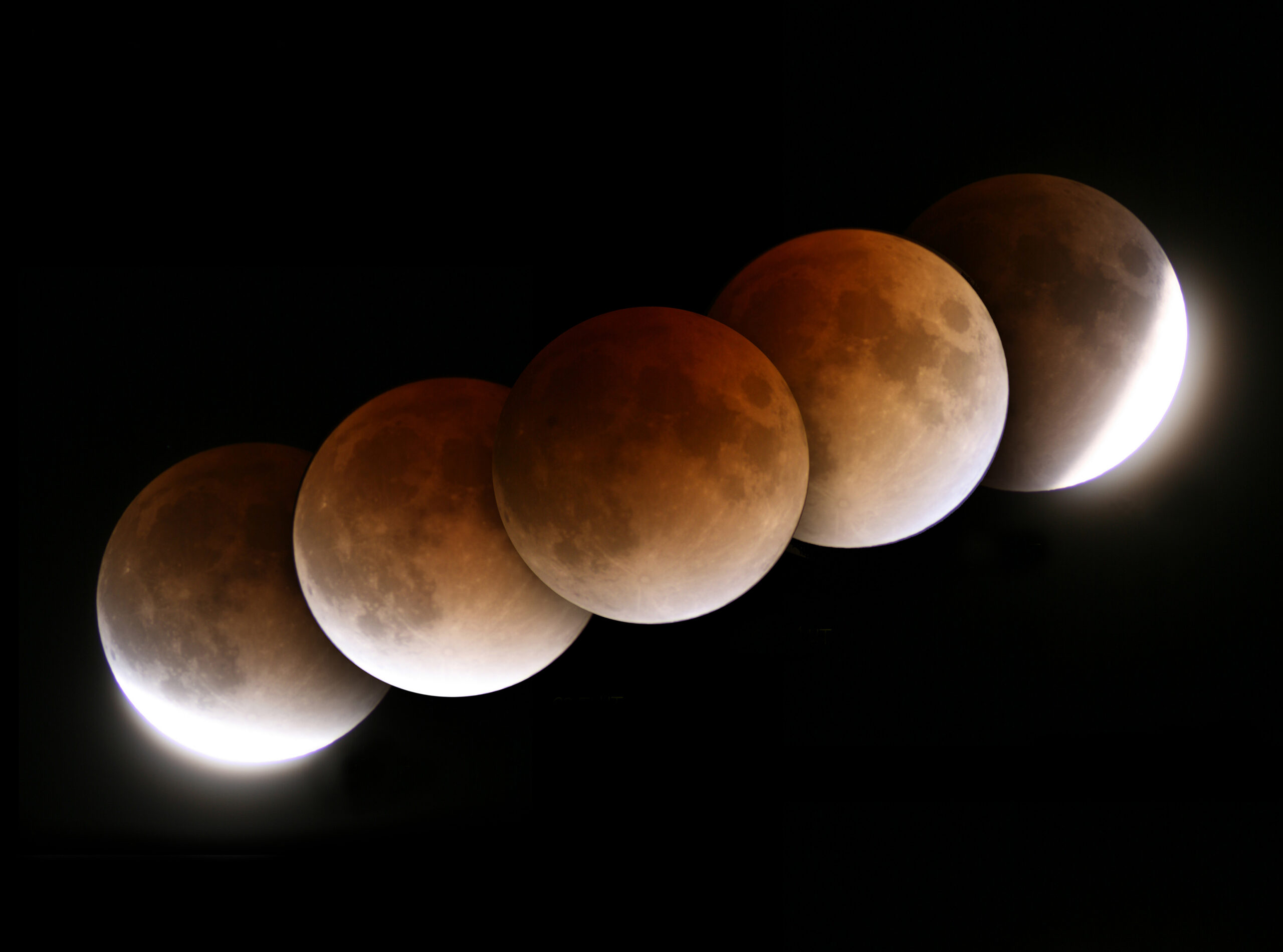
Credit: Phil Harrington
If you live in the United States, mark your calendars for Tuesday, March 3. That’s when a total lunar eclipse will occur above the contiguous states, although the farther west you are, the more of it you’ll be able to see.
Lunar eclipses happen when the Sun, Earth, and the Moon align — in that order — and when Earth’s shadow falls on the Moon. This doesn’t happen every month, because the Moon’s orbit is tilted to that of the Earth-Sun plane. So, most months our satellite is either above or below the point where an eclipse can occur.
What’s happening
A lunar eclipse has several phases, each marked by specific contact times with Earth’s shadow. To complicate things, our planet’s shadow has two parts: the penumbra, which is the fainter, outer part where Earth partially blocks the Sun’s light; and the umbra, the darker, central part where Earth completely blocks sunlight. So for this event, the penumbral phase is the first part, then the partial phase, then totality, and then everything plays out in reverse order.
The penumbral eclipse will start at 3:43 a.m. EST. At this moment, the Moon will contact the outer part of Earth’s shadow. You won’t see it because the darkening of the Moon during the early penumbral phase is tough to see. Eventually, however, you’ll see the Moon dim as it moves deeper into this region. It’ll take 1 hour 6 minutes until the next part of the eclipse starts.
The next phase, the partial eclipse, begins when the Moon makes contact with Earth’s umbra. This will happen at 4:49 a.m. EST. As the Moon continues through the umbra, more of its surface will turn dark. This first half of the partial eclipse (the second half comes after totality) will last for 1 hour 14 minutes.
A colorful Moon
Totality — the most visually striking part of the eclipse — begins at 6:03 a.m. EST. At this instant, the trailing edge of the Moon enters the umbra, so the whole disc will be covered by Earth’s deepest shadow. Despite this, the Moon won’t disappear entirely from view. Instead, it typically takes on a reddish hue, a phenomenon commonly referred to as a Blood Moon.
This reddish coloration is a result of sunlight being refracted and scattered by Earth’s atmosphere. While Earth blocks direct sunlight from reaching the Moon, a small amount of light manages to bend around and pass through our planet’s atmosphere. Shorter wavelengths, mainly blue and green, are scattered by the air, but longer wavelengths, mainly red and orange, continue through the atmosphere. This reddish light then hits the Moon, producing its characteristic bloody tint.
The point of greatest eclipse, when the Moon is closest to the center of Earth’s shadow, will happen at 6:33 a.m. EST. Then totality ends at 7:02 a.m. EST. The Moon will rapidly lose its color as direct sunlight falls on its visible surface, creating a sharp contrast with the remaining shadowed portion. Lunar totality, however, will last a worthy 59 minutes.
Part two
Once totality ends, most Moon watchers will head for bed. That’s understandable. But if you’re photographing the event, or just want to keep watching, the second half of the partial eclipse begins at 7:02 a.m. EST (the moment totality ends) and concludes at 8:17 a.m. EST.
Finally, the penumbral eclipse will end at 9:23 a.m. EST. The Moon is once again fully illuminated by direct sunlight — a Full Moon in the sky.
Observe this eclipse
Here’s the good news: You don’t need any equipment or eye protection to view a lunar eclipse. The Full Moon is always easy to see and the light striking your eyes is just reflected — not direct — sunlight. That said, most observers agree that the most pleasing views of an eclipse are through binoculars. Models marked 7×50 or 10×50 will serve well.
My advice always is that you experience this (and every other) sky event, even if you can only see part of it. But this time if you don’t you’ll have to wait until New Year’s Eve 2028 for the next one, and it’s not favorable here in the U.S. A slightly better one, mainly for the eastern U.S., will happen June 25, 2029.
So, set up a lawn chair, make a warm (non-alcoholic) drink, grab a blanket or two, and experience what I like to call sublime celestial geometry. Good luck!