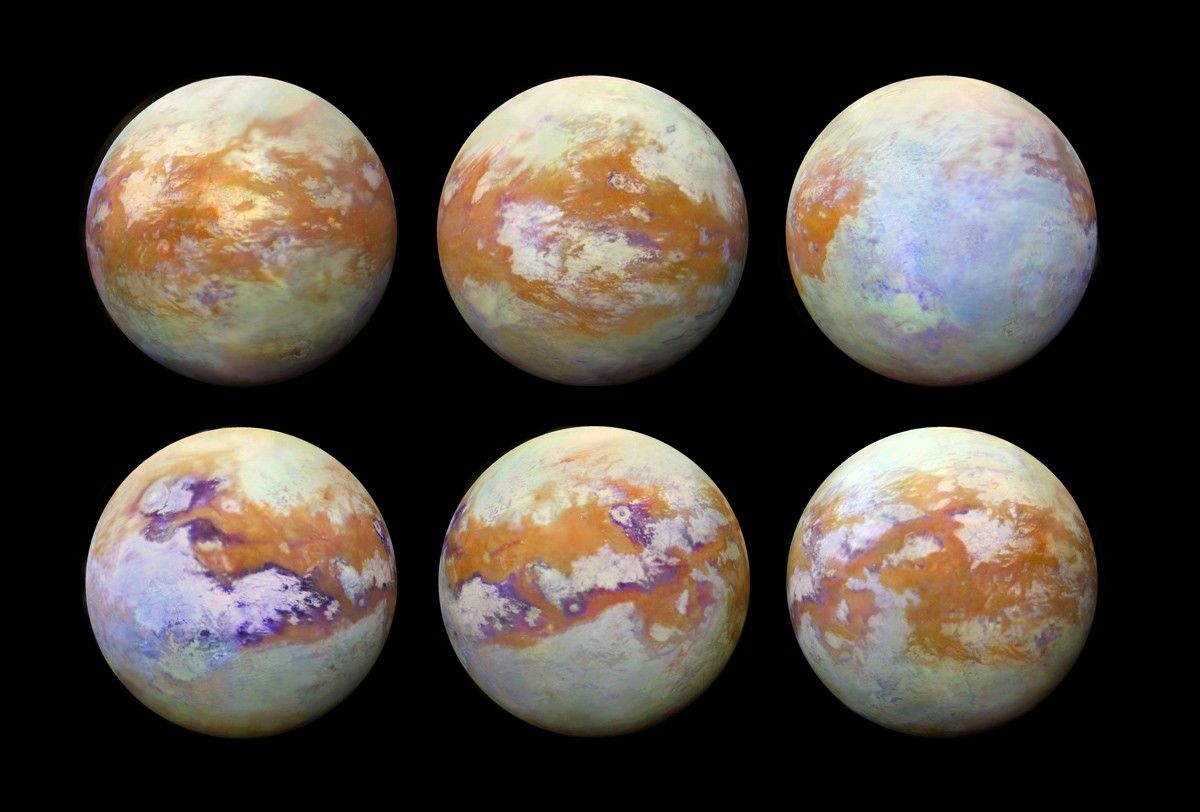
Credit: NASA/JPL-Caltech/Stéphane Le Mouélic, University Of Nantes/Virginia Pasek, University Of Arizona
The Cassini-Huygens mission, which launched in 1997 and arrived at Saturn in 2004, sent back lots of data. Some of it led scientists to think that Titan, the Ringed Planet’s largest moon, had a large underground ocean of liquid water. But recent reanalysis of the data indicates that under its surface ice, Saturn instead hosts a large region of slush. This discovery may lead researchers to take a new look at other solar system moons. It also could focus the search for life within Titan.
“Instead of an open ocean like we have here on Earth, we’re probably looking at something more like Arctic sea ice or aquifers, which has implications for what type of life we might find, but also the availability of nutrients, energy and so on,” said Baptiste Journaux, a University of Washington assistant professor of Earth and space sciences.
The study was led by NASA with collaboration from Journaux and Ula Jones, a UW graduate student of Earth and space sciences in his lab.
Top of the heap
Currently, we know that Saturn has 274 moons orbiting it. The biggest, Titan has a hazy atmosphere and liquid on its surface. In fact, it even rains there. Unlike Earth, however, the “rain” is liquid methane. Temperatures on the moon’s surface average –297 degrees Fahrenheit (–183 degrees Celsius).
Images sent back by Cassini showed Titan stretching and compacting as it orbited Saturn. In 2008, researchers proposed the reason for such changes was a huge ocean beneath the surface.
“The degree of deformation depends on Titan’s interior structure. A deep ocean would permit the crust to flex more under Saturn’s gravitational pull, but if Titan were entirely frozen, it wouldn’t deform as much,” Journaux said. “The deformation we detected during the initial analysis of the Cassini mission data could have been compatible with a global ocean, but now we know that isn’t the full story.”
Timing is the key
Titan’s shape changes because of Saturn’s gravitational pull. But the study showed a delay of about 15 hours compared to when the Ringed Planet’s gravity is strongest. The team realized that it would take more energy (and, therefore, time) to move a thick substance than it would to move water. Knowing the delay let scientists make inferences about the viscosity of the interior. The amount of energy Titan lost was a lot more than an underground water ocean could account for.
“Nobody was expecting very strong energy dissipation inside Titan. That was the smoking gun indicating that Titan’s interior is different from what was inferred from previous analyses,” said Flavio Petricca, a postdoctoral fellow at NASA’s Jet Propulsion Laboratory, who led the study.
The new model of Titan features more slush and a lot less liquid water. Slush is thick enough to explain the lag but still contains water, so the moon can deform when acted on by Saturn’s gravity.
Looking for life
“The discovery of a slushy layer on Titan also has exciting implications for the search for life beyond our solar system,” Jones said. “It expands the range of environments we might consider habitable.”
Although the notion of an ocean on Titan invigorated the search for life there, the researchers believe the new findings might improve the odds of finding it. Analyses indicate that the pockets of freshwater under Titan’s surface could reach 68 degrees Fahrenheit (20 degrees Celsius). Also, any available nutrients would be more concentrated in a small volume of water compared to an open ocean. That scenario could facilitate the growth of simple organisms.