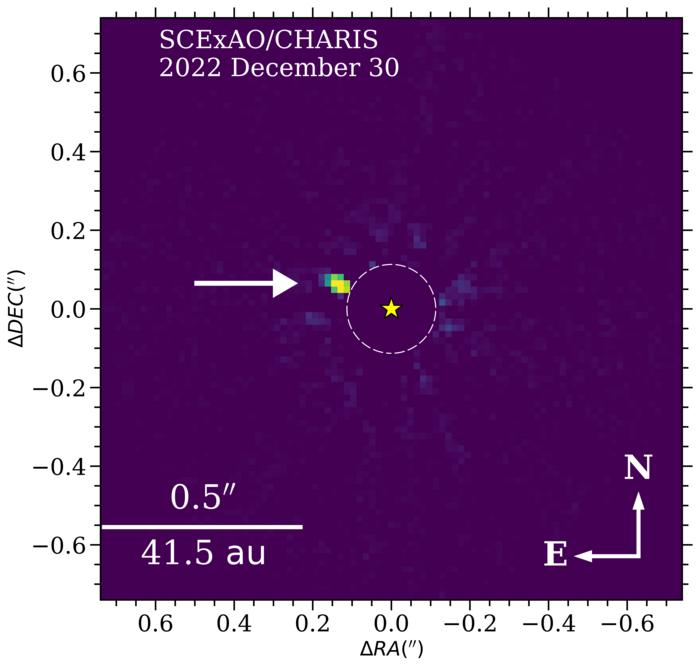
Credit: T. Currie/Subaru Telescope, UTSA

Key Takeaways:
- An international team, utilizing the Subaru Telescope and its SCExAO system, reported the discovery of a massive planet (HIP 54515 b) and a brown dwarf (HIP 71618 B), representing the initial findings of the OASIS (Observing Accelerators with SCExAO Imaging Survey) program.
- The OASIS survey identifies candidate stars with unseen companions by analyzing data from the Hipparcos and Gaia missions, subsequently observing them with the Subaru Coronagraphic Extreme Adaptive Optics (SCExAO) system.
- HIP 54515 b is an 18-Jupiter-mass gas giant orbiting a star 271 light-years distant, while HIP 71618 B is a 60-Jupiter-mass brown dwarf situated 169 light-years away, featuring properties suitable for future observational testing.
- Discoveries from OASIS contribute to the evaluation of critical imaging technologies pertinent to NASA’s forthcoming Roman Space Telescope, particularly for detecting Earth-like exoplanets.
An international team of astronomers using the Subaru Telescope in Hawaiʻi have discovered a massive planet and a brown dwarf orbiting distant stars. Their results were published in an article that appeared in The Astronomical Journal. The discoveries are the first results from OASIS (Observing Accelerators with SCExAO Imaging Survey), whose purpose is to find and categorize massive planets and brown dwarfs. Discoveries made by this program help test critical technologies for imaging Earth-like planets with NASA’s upcoming Roman Space Telescope.
Where and how to look?
Current telescopes can directly photograph only about 1 percent of all the stars that host massive planets and brown dwarfs. This includes recently formed planets, which still glow hot, making them easier to detect. Unfortunately, they’re still a lot fainter than the stars they orbit, so they get lost in the star’s glare.
Enter OASIS. Researchers scan data from two European Space Agency missions, Hipparcos and Gaia, and use it to identify stars moving in a way that shows they have unseen companions orbiting them. They then photograph these promising candidates with the Subaru Coronagraphic Extreme Adaptive Optics (SCExAO) system.
Newly found objects
The planet the team found is designated HIP 54515 b. It’s a gas giant, like Jupiter, but 18 times as massive. It orbits a star 271 light-years away in the constellation Leo the Lion at roughly the same distance that Neptune orbits the Sun, about 25 times the Earth-Sun distance. That may sound like a lot, but from Earth, the star and planet are separated by just 0.15 arcseconds. That angle roughly corresponds to the diameter of a baseball 60 miles (100 kilometers) away. The optics of the SCExAO system, however, are of such quality that they allowed researchers to spot the planet.
“With OASIS, we are able to find, weigh, and track the orbits of massive planets and brown dwarfs around stars we never thought of looking at before,” says OASIS Principal Investigator, Thayne Currie at the University of Texas at San Antonio.
The second discovery, the brown dwarf HIP 71618 B, orbits a star twice as massive as the Sun at a distance roughly equal to Saturn’s distance from our star. Its mass, 60 times that of Jupiter, wasn’t enough to generate nuclear fusion in its core and turn it into a star. It lies 169 light-years away in the constellation Boötes the Herdsman.
Although it’s not a planet, HIP 71618 B features highly suitable properties for observations with the Roman Space Telescope. In 2027, that scope will test a coronagraph system that will let it and future telescopes photograph Earth-like planets 10 billion times fainter than their host stars. HIP 71618 B is the first object that meets requirements for this demonstration: its star is bright and the brown dwarf is in the right location.
“Thanks to innovative instruments like SCExAO and Maunakea’s world-leading astronomical observing conditions, Subaru Telescope will continue to be a preeminent observatory even as other telescopes come online, making breakthrough discoveries far into the future,” says Masayuki Kuzuhara, who co-leads OASIS with Currie.