Credit: Álvaro Penteado Crósta/IG-UNICAMP
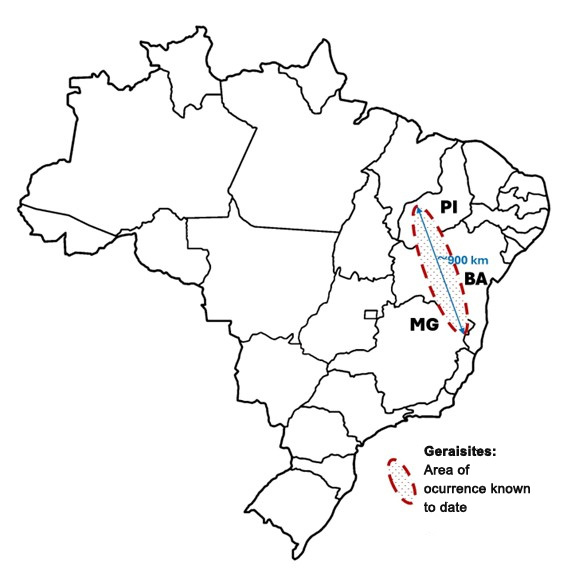
Tektites are natural glasses formed by the high-energy impact of large meteorites against Earth’s surface. Recently, a team of researchers found a new strewn field of them in the Brazilian state of Minas Gerais. Because of the location of the find, the tektites have been named geraisites.
The discovery was described in an article published in the journal Geology by a team led by Álvaro Penteado Crósta, a geologist and senior professor at the Institute of Geosciences at the State University of Campinas. Crósta collaborated with researchers from Brazil, Europe, the Middle East, and Australia.
Prior to this discovery, only five large tektite fields had been recognized: in Australasia (called Australites), Central Europe (Moldavites), the Ivory Coast (Ivorites), North America (Bediasites), and South East Asia (Indochinites).
Statistics
More than 600 geraisites have been collected so far, stretching the strewn field to more than 56 miles (90 kilometers) in length. “This growth in the area of occurrence is entirely consistent with what is observed in other tektite fields around the world. The size of the field depends directly on the energy of the impact, among other factors,” the researcher explains.
“One of the decisive criteria for classifying the material as a tektite was its very low water content, as measured by infrared spectroscopy: between 71 and 107 parts per million. For comparison, volcanic glasses, such as obsidian, usually contain from 700 ppm to 2 percent water, whereas tektites are notoriously much drier,” Crósta points out.
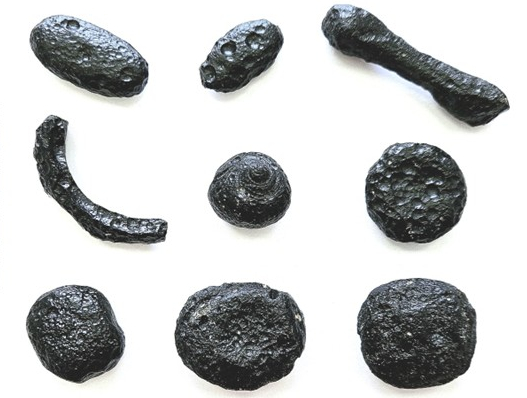
The fragments range in size from less than 0.04 to 3 ounces (1 to 85.4 grams) and reach about 2 inches (5 centimeters) on the longest axis. Their shapes are typical of aerodynamic tektites: spherical, ellipsoidal, drop-shaped, discoid, dumbbell-shaped, and twisted. They become translucent under intense light and display a grayish-green color. Their surfaces are marked by many small cavities. “These small cavities are traces of gas bubbles that escaped during the rapid cooling of the molten material as it traveled through the atmosphere, a process also observed in volcanic lava but especially characteristic of tektites,” says Crósta.
Credit: Álvaro Penteado Crósta/IG-UNICAMP
When did it strike?
Dating based on the ratio of argon isotopes indicates that the event occurred approximately 6.3 million years ago, at the end of the Miocene epoch. “The age of 6.3 million years should be interpreted as a maximum age since some of the argon may have been inherited from the ancient rocks targeted by the impact,” the researcher comments.
To date, no associated crater has been identified. According to Crósta, this is not unusual; only three of the six large classical tektite fields have known craters. While it is not yet possible to accurately estimate the size of the impacting body, researchers consider it unlikely that it was small. The large amount of molten material and the wide area of dispersion indicate a significant impact event.
The discovery of the geraisites fills an important gap in the record of impacts in South America. Fewer than 10 large impact structures are known there, and almost all of them are much older. This discovery also reinforces the idea that tektites may be more common than previously thought, but often go unnoticed or are mistaken for ordinary glass.