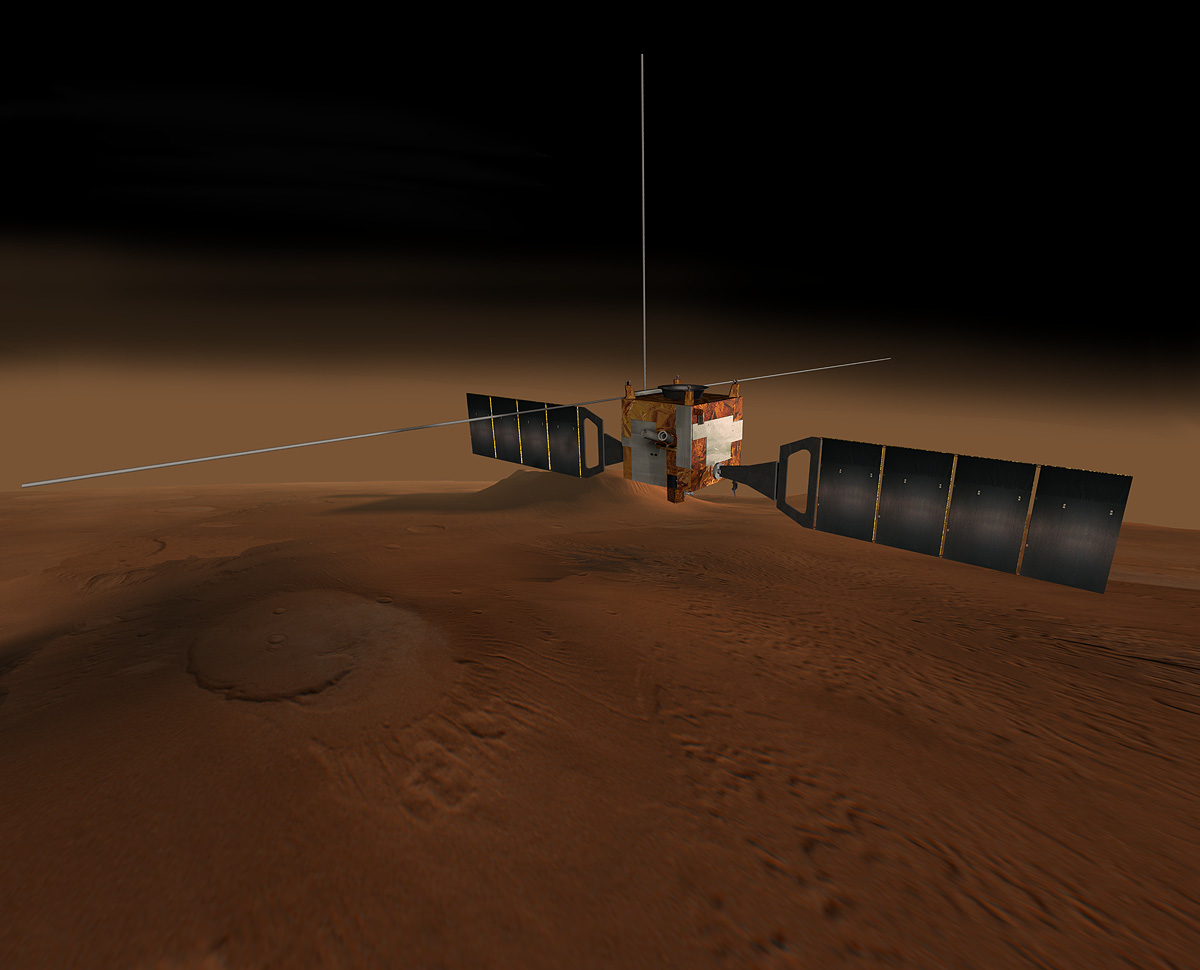
On Jan. 18, 2004, the European Space Agency’s Mars Express successfully mapped Mars’ south pole, and, in a first, revealed the presence of both water ice and carbon dioxide ice.
Launched June 2, 2003, the Mars Express orbiter arrived at the Red Planet on Dec. 25 of the same year to begin its mission of studying the planet’s atmosphere, surface, and subsurface. The probe is equipped with the Mars Advanced Radar for Subsurface and Ionosphere Sounding (MARSIS), OMEGA (a visible and infrared spectrometer), and the High Resolution Stereo Camera (HRSC). With those and other instruments, Mars Express analyzes the structure under the planet’s surface and searches for liquid water and ice, and maps and collects data on the planet’s mineralogical structure, its surface, and its poles.
Mars Express continues its investigations today, over 20 years after its detection of ice at Mars’ south pole, making it second only to NASA’s Mars Odyssey in the longevity of its ongoing mission around the Red Planet.