Missed the live event? All 'Astronomy Unlocked' videos are now available
Stream the presentations
Skip to content
Astronomy Magazine logo
  • Login/Register
  • Logout
  • Shop
  • Subscribe

  • News
  • Science
    • Solar System
    • Exoplanets
    • Stars
    • Milky Way
    • Galaxies
    • Exotic Objects
    • Cosmology
  • Observing
    • In The Sky
    • Upcoming Events
    • The Sun
    • The Moon
    • Planets
    • Comets
    • Deep-Sky Objects
    • Observing Basics
    • Telescopes and Equipment
    • Astrophotography
    • Gear Guide
    • This Week in Astronomy
  • Space Exploration
    • What’s Launching This Week
    • Human Spaceflight
    • Robotic Spaceflight
  • The Magazine
  • Ask Astro
  • Star Products
  • News
  • Science
    • Solar System
    • Exoplanets
    • Stars
    • Milky Way
    • Galaxies
    • Exotic Objects
    • Cosmology
  • Observing
    • In The Sky
    • Upcoming Events
    • The Sun
    • The Moon
    • Planets
    • Comets
    • Deep-Sky Objects
    • Observing Basics
    • Telescopes and Equipment
    • Astrophotography
    • Gear Guide
    • This Week in Astronomy
  • Space Exploration
    • What’s Launching This Week
    • Human Spaceflight
    • Robotic Spaceflight
  • The Magazine
  • Ask Astro
  • Star Products
  • Login/Register
  • Logout
  • Shop
  • Subscribe

Black Holes

An artist’s representation of one of brightest explosions ever seen in space, an LFBOT. Called a Luminous Fast Blue Optical Transient (LFBOT). Credit: NASA, ESA, NSF's NOIRLab, Mark Garlick , Mahdi Zamani
Exotic Objects, Science

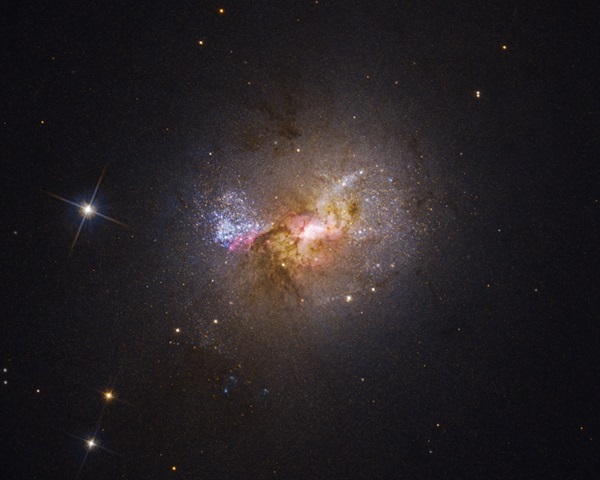
‘Tasmanian devil’ rises from slumber with brilliant bursts of light

A visual representation of the tilted accretion disk model, the black hole's vertical spin axis, and the precessional jet directions.
Exotic Objects, Science

Study reveals M87 has a spinning black hole

It may not look like much, but capturing photons from the distant quasar 3C 273 is one of the most awe-inspiring observations you can make with a small telescope.
Deep-Sky Objects

Target acquired: Observe Quasar 3C 273

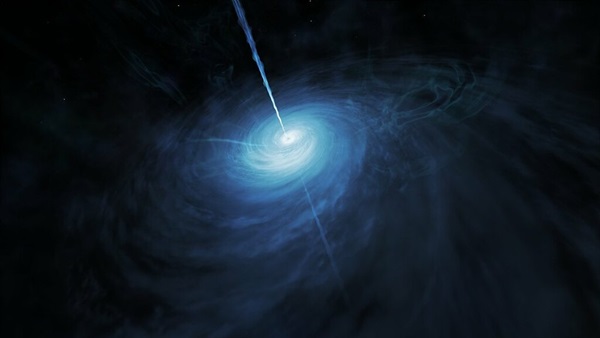
This artist’s impression shows how ULAS J1120+0641, a very distant quasar powered by a black hole with a mass two billion times that of the Sun, may have looked. This quasar is the most distant yet found and is seen as it was just 770 million years after the Big Bang. This object is by far the brightest object yet discovered in the early Universe.
Exotic Objects

What we’ve learned in 60 years of studying quasars

Exotic Objects

Black holes are everywhere: This Week in Astronomy with Dave Eicher

How mass warps space-time
Exotic Objects

Do black holes have bottoms?

Exotic Objects, Science

Powerful black holes might grow up in bustling galactic neighborhoods

Science

 Astronomy covers 50 years of space science

Milky Way, Observing

Find the center of the Milky Way: This Week in Astronomy with Dave Eicher

Cosmology, Exotic Objects, Science

The Great Hum: Scientists finally detect continuous gravitational waves rippling across space-time

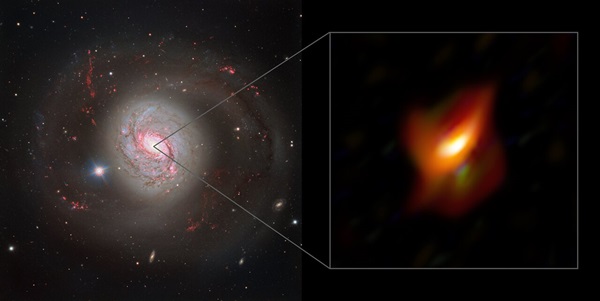
Galaxy NGC 1448 with active galactic nucleus
Exotic Objects, Galaxies

Even ‘lonely’ galaxies can host snacking supermassive black holes

Exotic Objects, Science

Hunting rogue black holes in the Milky Way

Posts pagination

Newer posts 1 … 3 4 5 6 7 … 32 Older posts
Astronomy Magazine logo
  • Facebook
  • LinkedIn
  • YouTube
  • Instagram
  • Twitter
  • About Us
  • Contact Us
  • Subscribe
  • Customer Service
  • Advertising
  • Terms of Use
  • Privacy Policy

@ 2025 Firecrown Media. All Rights Reserved.

More Sites from Firecrown Media Publisher logo
Scroll to Top

Login

New User? Create an Account

Why Sign In? Subscribers can access their digital magazine issues, and registered users can participate in our Community forums and galleries.

Email is required
Password is required
Forgot your password?
Manage My Account
Contact
Customer Support