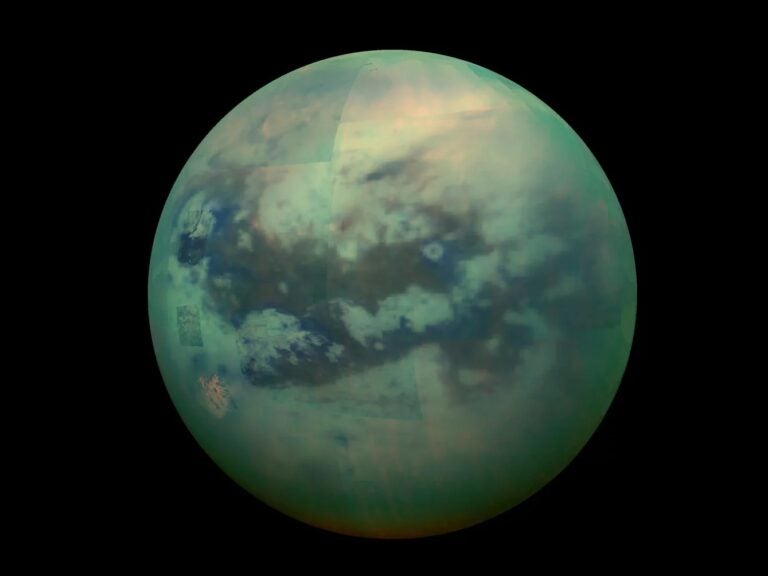
A University of Arizona team is reporting the first experimental evidence showing how atmospheric nitrogen can be incorporated into organic macromolecules. The finding indicates what organic molecules might be found on Titan, the moon of Saturn that scientists think is a model for the chemistry of pre-life Earth.
Earth and Titan are the only known planetary-sized bodies that have thick, predominantly nitrogen atmospheres, said Hiroshi Imanaka, who conducted the research while a member of UA’s chemistry and biochemistry department.
How complex organic molecules become nitrogenated in settings like early Earth or Titan’s atmosphere is a big mystery, Imanaka said.
“Titan is so interesting because its nitrogen-dominated atmosphere and organic chemistry might give us a clue to the origin of life on our Earth,” said Imanaka, now an assistant research scientist in the UA’s Lunar and Planetary Laboratory. “Nitrogen is an essential element of life.”
However, not just any nitrogen will do. Nitrogen gas must be converted to a more chemically active form of nitrogen that can drive the reactions that form the basis of biological systems.
Imanaka and Mark Smith converted a nitrogen-methane gas mixture similar to Titan’s atmosphere into a collection of nitrogen-containing organic molecules by irradiating the gas with high-energy ultraviolet (UV) rays. The laboratory setup was designed to mimic how solar radiation affects Titan’s atmosphere.
Most of the nitrogen moved directly into solid compounds, rather than gaseous ones, said Smith, a UA professor and head of chemistry and biochemistry. Previous models predicted that the nitrogen would move from gaseous compounds to solid ones in a lengthier stepwise process.
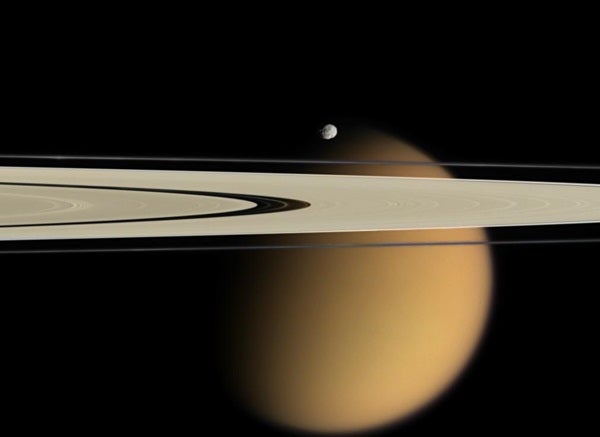
Titan looks orange in color because a smog of organic molecules envelops the planet. The particles in the smog will eventually settle down to the surface and may be exposed to conditions that could create life, said Imanaka, who is also a principal investigator at the SETI Institute in Mountain View, California.
However, scientists don’t know whether Titan’s smog particles contain nitrogen. If some of the particles are the same nitrogen-containing organic molecules the UA team created in the laboratory, conditions conducive to life are more likely, Smith said.
Laboratory observations such as these indicate what the next space missions should look for and what instruments should be developed to help in the search, Smith said.
Imanaka and Smith’s paper, “Formation of nitrogenated organic aerosols in the Titan upper atmosphere,” is scheduled for publication in the Early Online edition of the Proceedings of the National Academy of Sciences the week of June 28. NASA provided funding for the research.
The UA researchers wanted to simulate conditions in Titan’s thin upper atmosphere because results from the Cassini mission indicated that “extreme UV” radiation hitting the atmosphere created complex organic molecules.
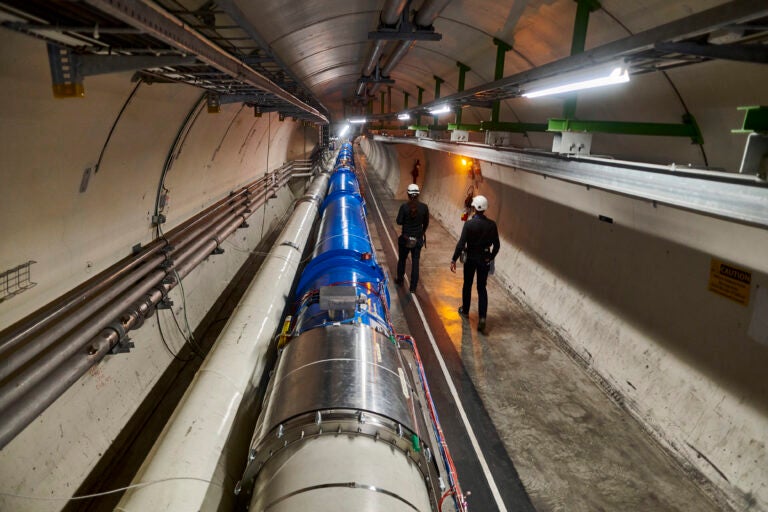
Therefore, Imanaka and Smith used the Advanced Light Source at Lawrence Berkeley National Laboratory’s synchroton in Berkeley, California, to shoot high-energy UV light into a stainless steel cylinder containing nitrogen-and-methane gas held at very low pressure.
The researchers used a mass spectrometer to analyze the chemicals that resulted from the radiation.
Simple though it sounds, setting up the experimental equipment is complicated. The UV light itself must pass through a series of vacuum chambers on its way into the gas chamber.
Many researchers want to use the Advanced Light Source, so competition for time on the instrument is fierce. Imanaka and Smith were allocated one or two time slots per year, each of which was for 8 hours a day for only 5 to 10 days.
For each time slot, Imanaka and Smith had to pack all the experimental equipment into a van, drive to Berkeley, set up the delicate equipment and launch into an intense series of experiments. They sometimes worked more than 48 hours straight to get the maximum out of their time on the Advanced Light Source. Completing all the necessary experiments took years.
It was nerve-racking, Imanaka said: “If we miss just one screw, it messes up our beam time.”
At the beginning, he only analyzed the gases from the cylinder. But he didn’t detect any nitrogen-containing organic compounds.
Imanaka and Smith thought there was something wrong in the experimental setup, so they tweaked the system. But still no nitrogen.
“It was quite a mystery,” said Imanaka, the paper’s first author. “Where did the nitrogen go?”
Finally, the two researchers collected the bits of brown gunk that gathered on the cylinder wall and analyzed it with what Imanaka called “the most sophisticated mass spectrometer technique.”
Imanaka said, “Then I finally found the nitrogen!”
Imanaka and Smith suspect that such compounds are formed in Titan’s upper atmosphere and eventually fall to Titan’s surface. Once on the surface, they contribute to an environment that is conducive to the evolution of life.