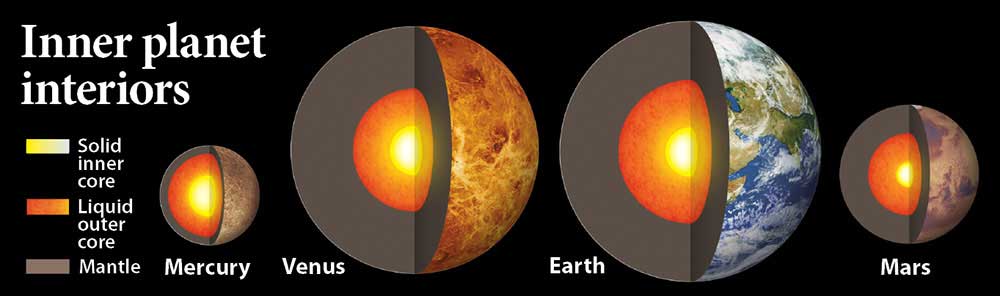
Why does Mercury have such a large core?
Tony, Wisconsin
One of the enduring enigmas of Mercury is why such a small planet, roughly 38 percent of Earth’s diameter, is so dense. Thanks to Mariner 10’s 1974–5 flybys of the innermost world and the orbiting MErcury Surface, Space ENvironment, GEochemistry, and Ranging (MESSENGER) spacecraft, we now know Mercury has an average density of 5.43 grams per cubic centimeter. (Earth’s average density is 5.51 g/cm3.)
This value means the planet must hold a high percentage of iron because the rocky surface material is much less dense than the planet’s average. Previous results from MESSENGER indicate that the metallic core likely makes up more than 80 percent of Mercury’s diameter. No other inner solar system planet has a core that constitutes so much of its interior.
So how did Mercury end up this way? One possibility is that in the early solar nebula, gas drag affected the bodies that were richer in rocky silicate materials more than metal-rich bodies, essentially sorting them and leading to less rocky material closer to the Sun.
Alternatively, some scientists have proposed that during an early, active phase of the Sun, much of Mercury’s rocky exterior evaporated away. This would have led to a lower percentage of more-volatile elements that radioactive decay produces, such as uranium and potassium, at the surface relative to elements that are harder to vaporize, such as thorium. However, MESSENGER’s gamma-ray spectrometer found no such depletion, ruling out this hypothesis.
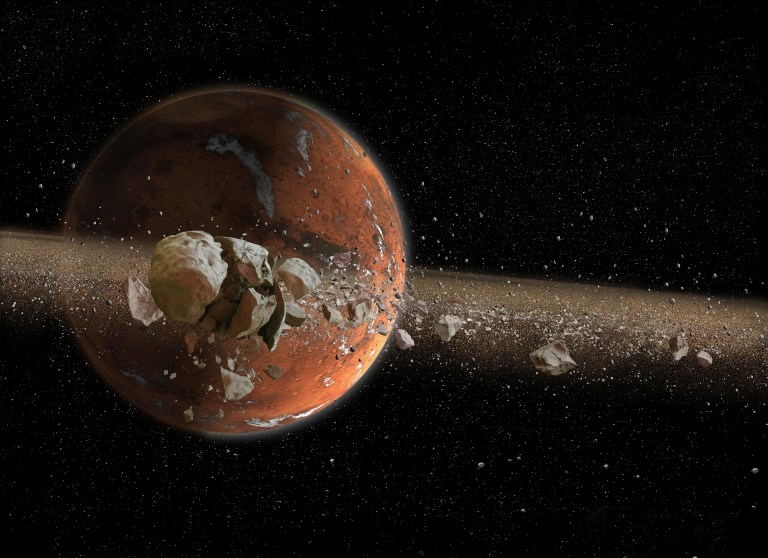
Another possibility is that Mercury may have experienced a giant impact early in its history, similar to the one that many scientists think formed the Moon. Such an impact could have ejected much of the rocky exterior, leaving behind a metal-rich planet.
[Editor’s note: A 2021 study published in Progress in Earth and Planetary Science offers yet another possible explanation for Mercury’s supersized core. The research argues that Mercury’s proximity to the Sun’s strong magnetic field is what bolstered the density, mass, and iron content of the rocky planet’s core.]
While there still might not be a definitive answer yet, scientsits are making important progress thanks to missions like MESSENGER.
[This article was updated March 2, 2023.]