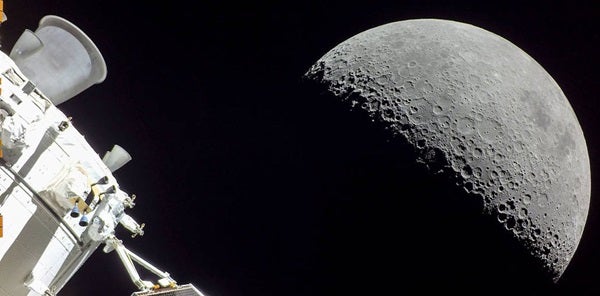
Scientists and government agencies have been worried about the space junk surrounding Earth for decades. But humanity’s starry ambitions are farther reaching than the space just around Earth. Ever since the 1960s with the launch of the Apollo program and the emergence of the space race between the U.S. and Soviet Union, people have been leaving trash around the Moon, too.
Today, experts estimate that there are a few dozen pieces of space junk like spent rocket bodies, defunct satellites and mission-related debris orbiting in cislunar space – the space between Earth and the Moon and the area around the Moon. While this isn’t yet a large amount of junk, astronomers have very little information about where these pieces of space debris are, let alone what they are and how they got there.
I am a planetary scientist and also run the Space Safety, Security and Sustainability Center at the University of Arizona. As the focus of space activities turns to the Moon, with each future mission more junk will be left in cislunar space. This junk is an emerging problem that could create hazardous conditions for astronauts and spacecraft in the future.
My colleague Roberto Furfaro and I are hoping to help prevent this problem from getting out of hand. Together, we are using telescopes and existing databases on lunar missions to find, describe and track lunar space debris and build the world’s first catalog of cislunar space objects.
Abandoned and potentially dangerous
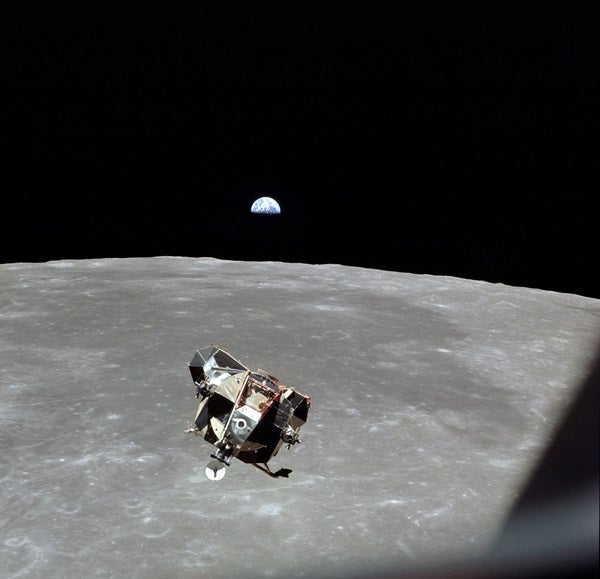
Historically, NASA and the U.S. military have not closely tracked space debris from the many dozens of crewed and robotic missions to the Moon. There is no international agency that has monitored lunar objects, either. This lack of oversight is why scientists don’t know the location or orbit of the vast majority of lunar space debris. And these objects won’t simply go away – in the near total vacuum of space, anything left in orbit around the Moon or in cislunar space will likely remain there for at least decades.
This lack of information about human-made objects orbiting the Moon poses many risks for lunar missions.
First is the risk of collision. Humanity is at the beginning of a new wave of lunar exploration. Over the next 10 years, six countries and several commercial companies have plans for more than 100 missions. With every mission, the risk of a collision with existing debris increases and so, too, does the total amount of debris as missions leave junk behind.
Crash landings onto the surface of the Moon are also a real risk because the Moon does not have a thick atmosphere that can burn up falling space junk. This was dramatically demonstrated by the impact of a spent Chinese rocket booster into the far side of the Moon in March 2022. My team and I were the ones to finally identify that object as being of Chinese origin using telescopes we built to track objects in cislunar space. With both the U.S. and China planning to build lunar bases in the coming years, falling debris could become a real threat to human life and infrastructure on the Moon.
A video taken by NASA’s Juno spacecraft shows just how far away the Moon is from Earth.
Hard to track
If you want to prevent the Moon from becoming a cosmic landfill, you need to be able to track cislunar space junk. But doing so is challenging even on a good day for two main reasons: distance and light.
Cislunar space extends about 2.66 million miles from Earth – far past the distance within which the U.S. government currently tracks objects in space. But space is not just two-dimensional. The three-dimensional volume of cislunar space is massive, and any objects within it are tiny by comparison.
Light presents another challenge. Just like the Moon itself, the brightness of an object in cislunar space depends on how much sunlight the object reflects. During a crescent moon, lunar debris appears dim and low in the evening sky, making it hard to find. During a full moon, the same objects are high in the sky and brighter due to more sunlight hitting them, but they blend in with the bright glare that surrounds a full moon. Spotting objects during a full moon is like trying to find a firefly’s faint glow next to a bright search light. Within the lunar glare is the Cone of Shame, so named because of the difficulty in tracking objects within it.
Curating the catalog
Because of the difficulty and lack of adequate resources to track objects near the Moon, there is no group or organization consistently doing so today. So, in 2020, Furfaro and I took on the challenge to discover, track and catalog human-made debris in cislunar space.
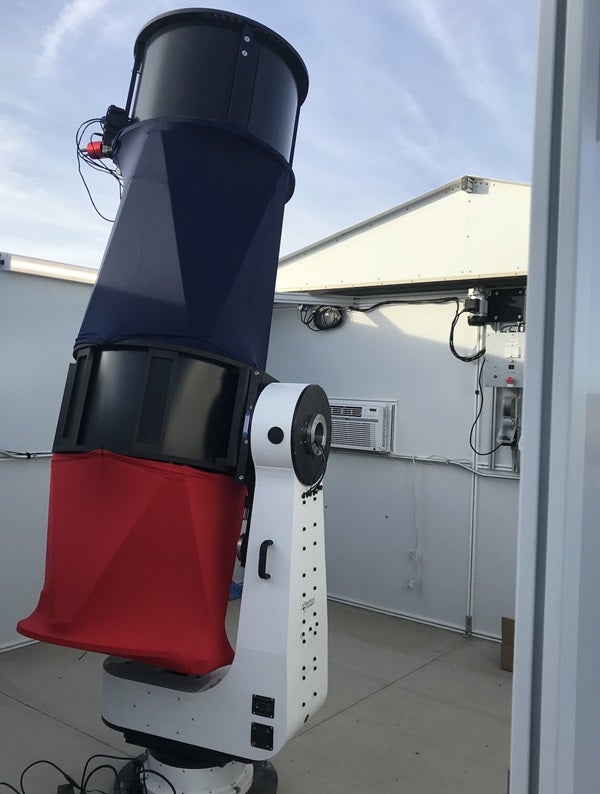
First, we linked historical observations from various telescopes and databases to each other to identify and confirm what cislunar objects were already known. Then, realizing there were no dedicated telescopes scanning the night sky for cislunar objects, my students at the University of Arizona and I built one. In late 2020, we finished building a 24-inch-diameter (0.6-meter-diameter) telescope, which is at the Biosphere 2 Observatory near Tucson.
The first object we tracked was Chang’e 5, China’s first lunar sample return mission. The large rocket launched on Nov. 23, 2020, headed toward the Moon. Despite the powerful lunar glare, my students and I were able to track Chang’e 5 to a distance of 12,354 miles from the Moon, deep into the Cone of Shame. With this success, we started tracking newly launched cislunar payloads and adding them to our nascent catalog. With this success, we started tracking newly launched cislunar payloads so we can calculate and predict their orbits to prevent them from getting lost.
To characterize both old and new space debris, once we figure out where an object is, we use optical and near-infrared telescopes on Earth to capture the object’s spectral signature – the specific wavelengths of light that bounce off an object’s surface. By doing this, we can figure out what material an object is made out of and identify it. This is how we identified the mystery rocket booster that crashed into the Moon in 2022. We can also measure changes in the light bouncing off the object over time to determine how fast that object is spinning, which can also help with identification.
Over the last two years, we have become better and better at finding and identifying objects in cislunar space. While at first we were happy to identify the school bus-sized Chang’e 5 spacecraft, now we are able to track CubeSats no bigger than a cereal box – like NASA’s Lunar Flashlight.
To date, my team has been able to identify a few dozen pieces of debris in cislunar space and are continuing to add to our ever-expanding catalog. The vast majority of the work ahead comprises continued observations and matching objects to known missions to confirm what objects are out there and where they came from.
While there is still a long way to go, these efforts are designed to ultimately form the basis for a catalog that will help lead to safer, more sustainable use of cislunar orbital space as humanity begins its expansion off of the Earth.