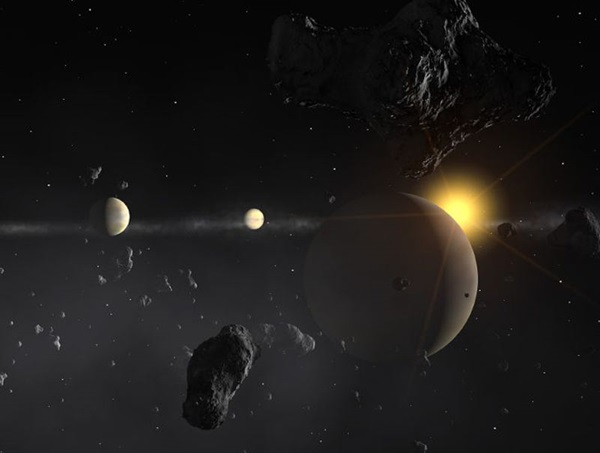
Swiss astronomers have detected three Neptune-mass planets around a star thought to have a super-sized asteroid belt. For more than 2 years, the team studied the Sun-like star HD 69830, located 42 light-years away in the constellation Puppis and faintly visible to the unaided eye.
“The planetary system around HD 69830 clearly represents a Rosetta stone in our understanding of how planets form,” says team member Michel Mayor of the Geneva Observatory. “No doubt it will help us better understand the huge diversity we have observed since the first extrasolar planet was found 11 years ago.”
The astronomers found the planets through precise spectral measurements of the star. Their gravitational influence on HD 69830 give the star a slight wobble, which revealed the presence of three roughly equal-mass companions in orbits lasting 8.67, 31.6, and 197 days.
“This is hot stuff,” Alan Boss, an astronomer at the Carnegie Institution of Washington, tells Astronomy. Finding a system with three “super-Earths” around a star slightly less massive than the Sun “makes the case for there being many Earth-like planets out there all the more compelling,” he says.
The team used the European Southern Observatory’s HARPS instrument installed on the La Silla Observatory, Chile, 3.6-meter telescope to conduct the study. “Without any doubt,” says Mayor, “it is presently the world’s most precise planet-hunting machine.” The planets impart velocity variations to the star that are less than 7 mph (11 km/h) — signals so small they could not have been resolved by most spectrographs available today.
Astronomers believe the innermost planet is probably rocky, while the outermost world is the lowest-mass planet to reside in a star’s so-called habitable zone. This is the region around a star where liquid water can exist at the surface of rocky or icy bodies.
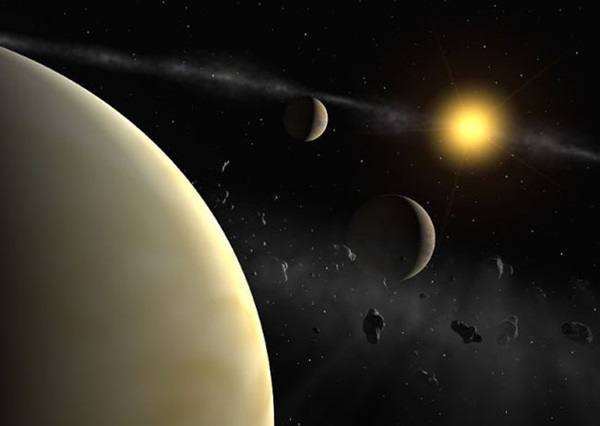
Team member Willy Benz from Bern University notes the possible presence of an asteroid belt in the triple-planet system adds “cherry to the cake.”
The newfound planets have minimum masses between 10 and 18 times that of Earth; the planets Uranus and Neptune contain 14.5 and 17.1 times Earth’s mass, respectively.
The Swiss team says simulations favor a rocky composition for the inner planet, a rock/gas structure for the middle one. They believe the outer planet probably accreted some ice during its formation, so it likely harbors a rock/icy core surrounded by a massive gaseous envelope, much like Uranus and Neptune. Orbital simulations also indicate the planets are in a stable configuration. The team reports its results in this week’s Nature.
Boss says it appears researchers have “hit the tip of the iceberg” of Earth-like planet discoveries. “Calculations show that Earths should form with a wide range of masses,” he says, ranging from masses less than Earth’s to as much as 20 times greater. “Until we can see one transit [pass in front of] its star … we won’t really know quite what they are or how they formed,” Boss explains. However, he says he’s “willing to bet” planets like these represent the massive end of an Earth-like exoplanet class.