July 2026 digital issue Now available!
Learn more
Skip to content
Astronomy Magazine logo
  • Login / Register
  • Logout
  • Shop
  • Subscribe

  • News
  • Science
    • Solar System
    • Exoplanets
    • Stars
    • Milky Way
    • Galaxies
    • Exotic Objects
    • Cosmology
  • Observing
    • In The Sky
    • Upcoming Events
    • The Sun
    • The Moon
    • Planets
    • Comets
    • Deep-Sky Objects
    • Observing Basics
    • Telescopes and Equipment
    • Astrophotography
    • Gear Guide
    • This Week in Astronomy
  • Space Exploration
    • What’s Launching This Week
    • Human Spaceflight
    • Robotic Spaceflight
  • The Magazine
  • Ask Astro
  • Star Products
  • News
  • Science
    • Solar System
    • Exoplanets
    • Stars
    • Milky Way
    • Galaxies
    • Exotic Objects
    • Cosmology
  • Observing
    • In The Sky
    • Upcoming Events
    • The Sun
    • The Moon
    • Planets
    • Comets
    • Deep-Sky Objects
    • Observing Basics
    • Telescopes and Equipment
    • Astrophotography
    • Gear Guide
    • This Week in Astronomy
  • Space Exploration
    • What’s Launching This Week
    • Human Spaceflight
    • Robotic Spaceflight
  • The Magazine
  • Ask Astro
  • Star Products
  • Login / Register
  • Logout
  • Shop
  • Subscribe

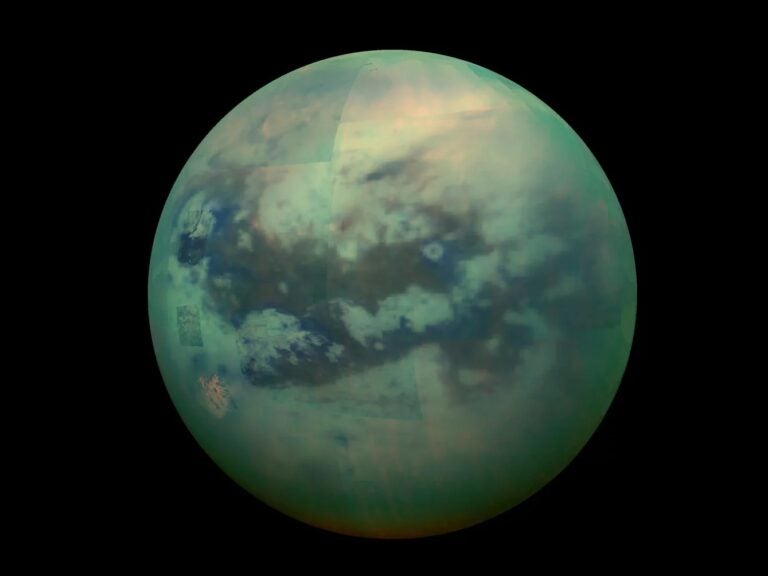
The Real Reality Show: Could Life Exist on Europa or Titan?

Two moons in our solar system offer tantalizing prospects of perhaps containing microbial life.
By Astronomy Staff | Published: December 28, 2015 | Last updated on May 18, 2023

Up Next

  • An artist's illustration of the ESA Comet Interceptor mission, showing the large main spacecraft in the foreground with its deployed solar panels, flanked by two smaller sub-probes, all approaching a comet whose bright white nucleus and two-toned tail — blue ion tail and golden dust tail — dominate the upper right of the image against a starry black background.
    Science, Solar System

    Could we send a spaceship to Comet 3I/ATLAS to collect samples and bring them back for analysis?

  • A dark, curved planet with a warm orange-brown atmospheric glow fills the lower right of the frame, its horizon lit by a small, bright orange star glowing near the center of the image. The black background is scattered with faint white stars, with a soft orange haze surrounding the star.
    Exoplanets

    Astronomers just found the first atmosphere on a rocky exoplanet in the habitable zone

  • A rocket climbs into a black night sky, leaving a bright golden-white trail that curves slightly as it rises. The glow reflects off calm water in the foreground, forming a bright vertical streak on the surface, with a dark, flat horizon line separating sky and water.
    Solar System, Space Exploration

    An abandoned SpaceX rocket is about to crash into the Moon

  • A close-up photograph of two hands cradling a dark, angular meteorite. The rock is roughly fist-sized with a black, slightly textured fusion crust and irregular flat faces, characteristic of a chondrite meteorite.
    Solar System

    How can I get a rock tested to see if it’s a meteorite?

  • Robotic Spaceflight, Solar System

    Tianwen-2 arrives at target asteroid Kamoʻoalewa

  • A diagram illustrating the outer solar system from an angled top-down perspective. Concentric orbital paths are shown around a central yellow Sun, with Jupiter, Saturn, Uranus, and Neptune labeled at increasing distances. Pluto is shown in yellow text outside Neptune's orbit, and the entire outer region is surrounded by a diffuse haze representing the Kuiper Belt, labeled in white text.
    Solar System

    How do planets clear out objects on the other side of their orbit?

  • A large planet occupies the upper right of the frame, its surface swirling with bright orange, yellow, and deep red clouds on its sunlit side, fading to dark blue-black on its shadowed edge. Below and to the left, a bright white glow from a nearby star washes out part of the lower frame, set against a dark brown sky scattered with faint stars.
    Exoplanets

    JWST reveals Roasted Planet’s extreme heat

  • A size comparison illustration showing Earth and the Moon side by side against a black background. Earth appears on the left, showing the Americas, swirling cloud cover, and blue oceans, while the gray, crater-marked Moon is shown to the right at roughly one-quarter of Earth's diameter, accurately reflecting their relative sizes.
    Solar System

    How is the Moon 1% of Earth’s mass, but its gravity is 17% of Earth’s?

  • A highly pixelated, black-and-white image features a single blurry object floating against a pitch-black background. The subject appears to have two connected sections: a larger, brighter rounded shape on the left and a smaller, dimmer lobe extending to the right. The contrast is sharp between the solid black void and the glowing, blocky white patches of the central object.
    Solar System, Today in the History of Astronomy

    June 28, 2011: Kerberos is discovered

Astronomy Newsletter

Get newsletters, updates and special offers via email from Astronomy.com!

Please enter a valid email address.

Astronomy magazine: 50 years and counting

Astronomy leads the astronomy hobby as the most popular magazine of its kind in the world. Get information about subscriptions, digital editions, renewals, advertising and much, much more.

Count me in

FREE DOWNLOAD

All About the Apollo Mission

Get it now
Astronomy Magazine logo
  • Facebook
  • LinkedIn
  • YouTube
  • Instagram
  • Twitter
  • About Us
  • Contact Us
  • Subscribe
  • Customer Service
  • Advertising
  • Terms of Use
  • Privacy Policy
  • Do Not Sell

@ 2025 Firecrown Media. All Rights Reserved.

More Sites from Firecrown Media Publisher logo
Scroll to Top

Sign In

New User? Create an Account

Why Sign In? Subscribers can access their digital magazine issues, and registered users can participate in our Community forums and galleries.

Please enter your email.
Please enter your password.

Lost your password?

Manage My AccountCustomer Support