
Key Takeaways:
- The Nancy Grace Roman Space Telescope completed its construction on November 25 at NASA's Goddard Space Flight Center, with a potential launch now anticipated as early as fall 2026, ahead of its formal May 2027 schedule, aboard a SpaceX Falcon Heavy.
- Roman's 300-megapixel Wide Field Instrument, offering a field of view 100 times larger than Hubble's, will execute a High-Latitude Wide-Area Survey to map over a billion galaxies for dark matter research and a High-Latitude Time-Domain Survey to study the universe's accelerating expansion attributed to dark energy.
- A Galactic Bulge Time-Domain Survey will utilize the Wide Field Instrument to monitor hundreds of millions of stars in the Milky Way's center, aiming to discover thousands of exoplanets through gravitational microlensing.
- The observatory also includes an experimental Coronagraph Instrument, designed with complex masks and active mirrors to block starlight, enabling the direct imaging of faint, Jupiter-sized exoplanets as a technological demonstration for future direct imaging missions.
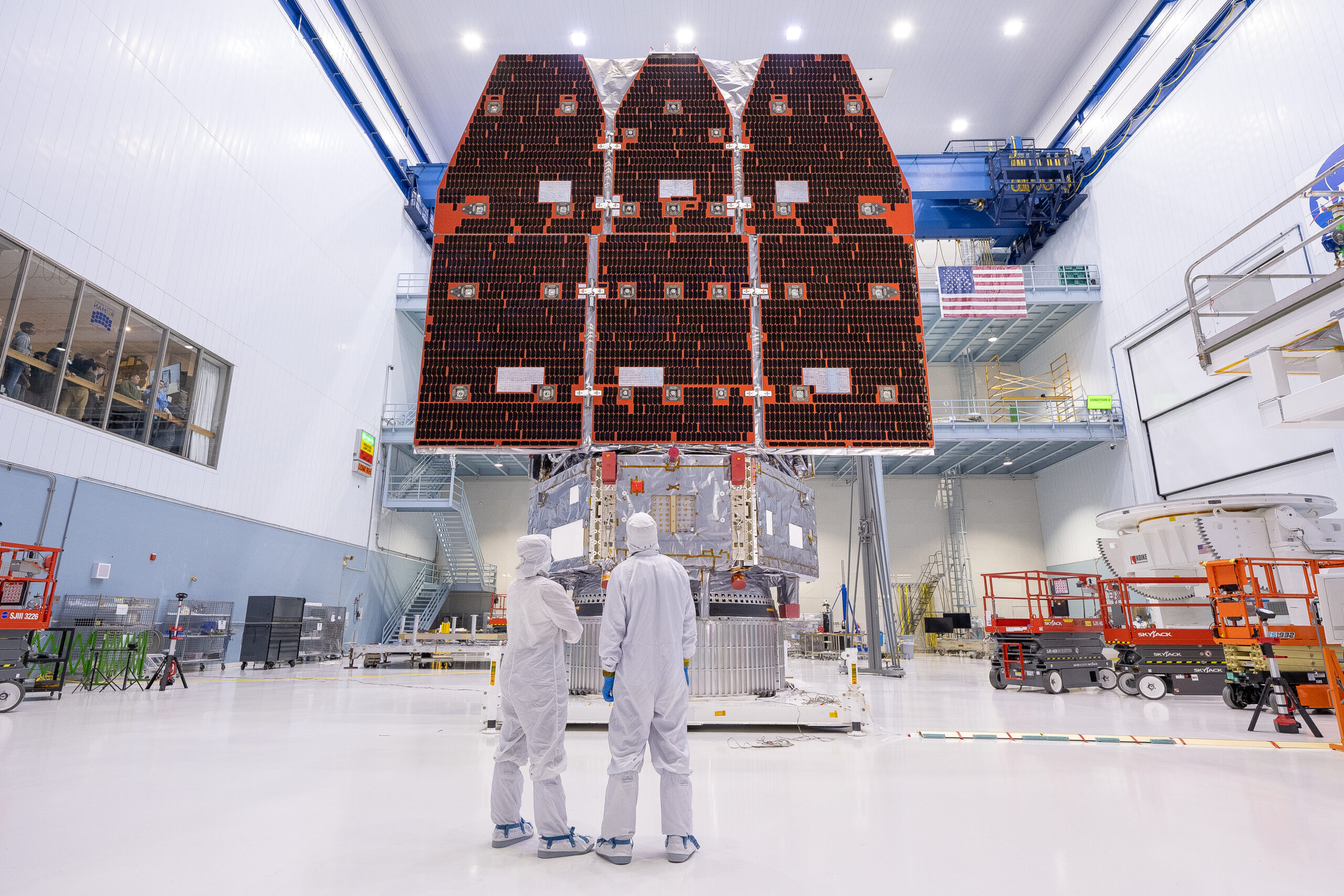
On Nov. 25, engineers at NASA’s Goddard Space Flight Center successfully joined the two main segments of the Nancy Grace Roman Space Telescope, officially completing the construction of an observatory designed to help scientists study dark energy and hunt for alien worlds.
While the mission is formally scheduled to launch by May 2027, the project has been running ahead of schedule. In June, Roman mission office head Kristen McQuinn said at the American Astronomical Society’s summer meeting in Anchorage, Alaska, that Roman was 90 percent complete and on track for a launch as early as October 2026. A Dec. 4 NASA press release reiterated that timeline, citing a potential liftoff in fall of 2026 aboard a SpaceX Falcon Heavy.
“Completing the Roman observatory brings us to a defining moment for the agency,” said Amit Kshatriya, NASA Associate Administrator. “As Roman moves into its final stage of testing following integration, we are focused on executing with precision and preparing for a successful launch on behalf of the global scientific community.”
A trio of surveys
Roman’s 300-megapixel Wide Field Instrument boasts a field of view 100 times larger than Hubble’s, allowing it to capture vast panoramas of the universe.
This capability will power a trio of surveys designed to unravel cosmic mysteries. The High-Latitude Wide-Area Survey will map over a billion galaxies to aid in the study of dark matter. Simultaneously, the High-Latitude Time-Domain Survey will watch the universe change in real-time, rewinding cosmic history to understand why the universe’s expansion is accelerating — a phenomenon attributed to dark energy.
“Within our lifetimes, a great mystery has arisen about the cosmos: why the expansion of the universe seems to be accelerating,” said Nicky Fox, associate administrator for NASA’s Science Mission Directorate. “Roman was built to discover what it is.”
Closer to home, the Galactic Bulge Time-Domain Survey will stare into the dense center of the Milky Way. By monitoring hundreds of millions of stars, Roman is expected to find thousands of exoplanets using gravitational microlensing — a technique that detects planets based on how their gravity bends starlight, making stars that they pass in front of momentarily brighter.
Masking starlight
Roman also carries a second, experimental instrument that is a type of coronagraph. Far more than just a camera, the Coronagraph Instrument uses a system of complex masks and active mirrors that flex in real-time to physically block the blinding glare of stars. By creating an artificial eclipse inside the telescope, it will allow astronomers to directly image faint planets orbiting them — specifically cool, Jupiter-sized worlds that are 100 million times fainter than their host stars. While it won’t spot Earth twins, it is proof of concept for future direct imaging missions that may.
“With Roman’s construction complete, we are poised at the brink of unfathomable scientific discovery,” said Julie McEnery, Roman’s senior project scientist. “In the mission’s first five years, it’s expected to unveil more than 100,000 distant worlds.”
The telescope will now undergo a final gauntlet of tests before it is moved in summer 2026 to NASA’s Kennedy Space Center in Florida, where it will be prepared for launch.