Just 10 years after the first extrasolar planet was discovered, two teams of astronomers report the detection and measurement of infrared radiation from “hot Jupiters” circling nearby stars. The researchers predict these first observations will open a new window for understanding the evolution and characteristics of planets around other stars.
“We’re ecstatic,” says David Charbonneau of the Harvard-Smithsonian Center for Astrophysics in Cambridge, Massachusetts, and leader of one of the research teams. “We’ve been hunting for this light for almost 10 years.”
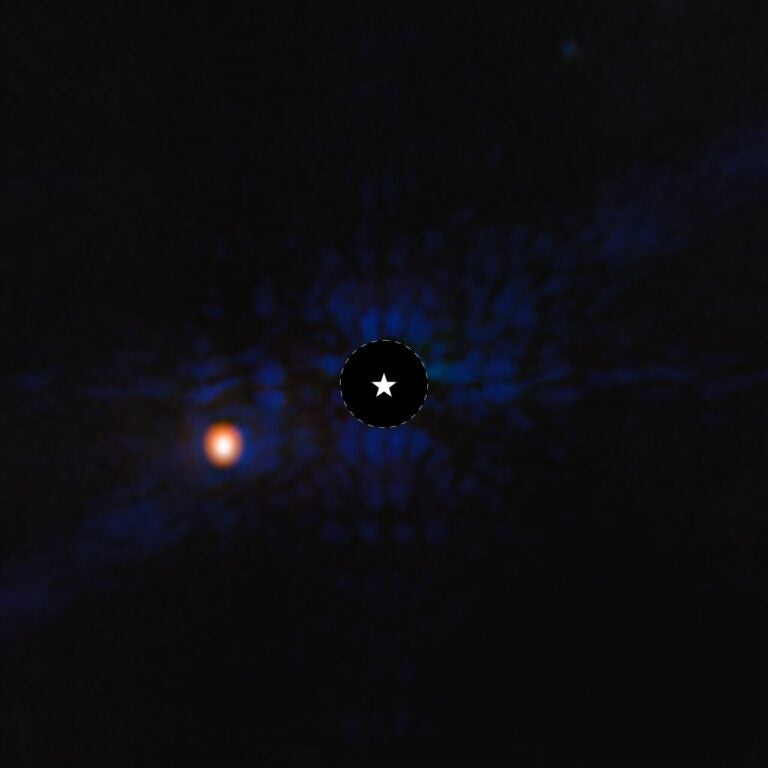
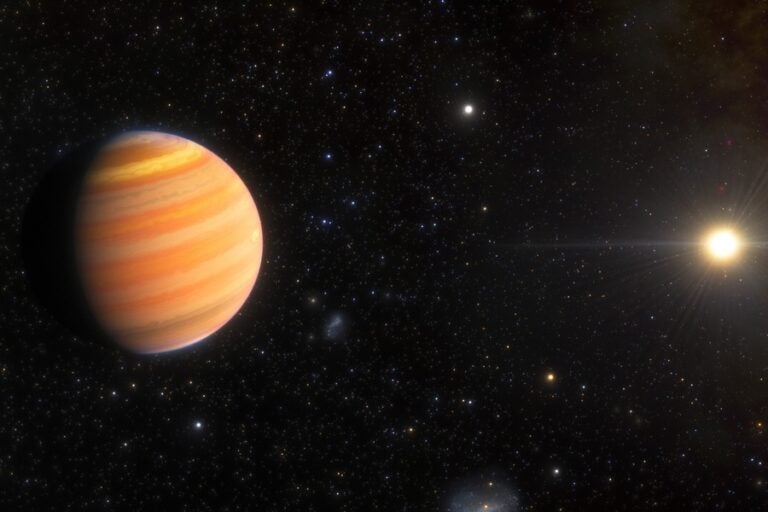
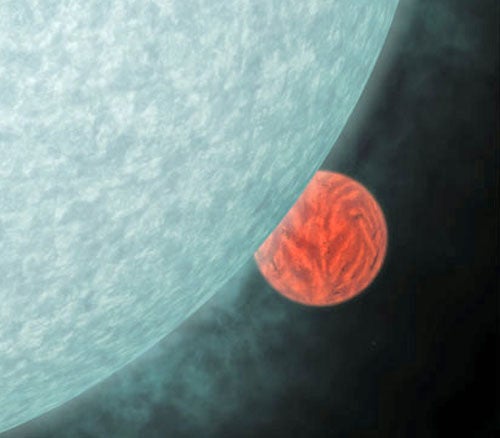
Charbonneau’s group used the Spitzer Space Telescope’s Infrared Array Camera to home in on the light from TrES-1, a “hot Jupiter” zipping around a Sun-like star about 500 light-years from Earth in the constellation Lyra. The astronomers tracked the intensity of two infrared “colors” as the planet passed behind its star, an event called secondary eclipse. The team subtracted the star’s radiation from the total seen when the planet was not eclipsed by the star.
Measuring the gas giant’s infrared radiation allowed the team to calculate its temperature — a sizzling 1,450° F (1,060 kelvins). Charbonneau suspects his group has also found the spectral fingerprint of carbon monoxide in the planet’s atmosphere, but, he says, “We’re going to go back and get more data.”
A separate group led by Drake Deming at NASA’s Goddard Space Flight Center in Greenbelt, Maryland, used Spitzer’s Multiband Imaging Photometer to monitor the radiation at a single infrared wavelength — 24 microns — as a glowing gas giant world called HD 209458b passed behind and re-emerged from its star, which lies 153 light-years from Earth in the constellation Pegasus.
Deming’s team was able to take the temperature of the gas giant, which zips around its star every 3.5 days in an orbit 1/20th the size of Earth’s. It hovers around 1,575° F (1,130 kelvins), closely matching what theorists had predicted.
The masses of both planets are a little less than Jupiter’s. Alan Boss of the Carnegie Institution of Washington notes that possible images of other planets reported earlier were not as clear-cut as the Spitzer findings. The best case, 2MASS1207, orbits a brown dwarf star, but TrEs-1 and HD 209458b both orbit Sun-like stars and have well established orbits and masses.
Deming’s group was also able to shed light on a question about HD 209458b. It weighs about two-thirds the mass of Jupiter, but it is 1.4 times larger. Theorists suggested that tidal heating from an eccentric orbit might be causing the planet to puff up, but the group’s precise timing of the planet’s transits and eclipses rules out an eccentric orbit. “We’re left with a mystery that we need to solve,” says Deming.
Astrophysicist Adam Burrows at the University of Arizona is thrilled to have hard data to feed back into his theories about how giant planets form and evolve. “The theory has been waiting for this data,” he says. “The subject is starting to emerge as a real science, in which the theory and the observations can start to dance with each other.”
Both research teams credit the Spitzer Space Telescope, launched August 25, 2003, as the hero behind their discoveries. They relied on Spitzer’s ability to make extremely sensitive and reliable observations in the infrared part of the spectrum. This is ideal for detecting giant planets orbiting close to their stars because, in the infrared, stars are only 400 times brighter than a hot Jupiter in a tight orbit. “Spitzer has done some wonderful and amazing things,” Boss says.
Boss sees a glowing future as observers using Spitzer and next-generation space telescopes, such as the Terrestrial Planet Finder coronagraph, gain the ability to detect light not just from gas giants but from Earth-size planets as well. “This discovery shows that we are well along the way to combining astronomy and biology into the new science of astrobiology,” Boss says, “with the ultimate goal being to search for life beyond Earth.”