Key Takeaways:
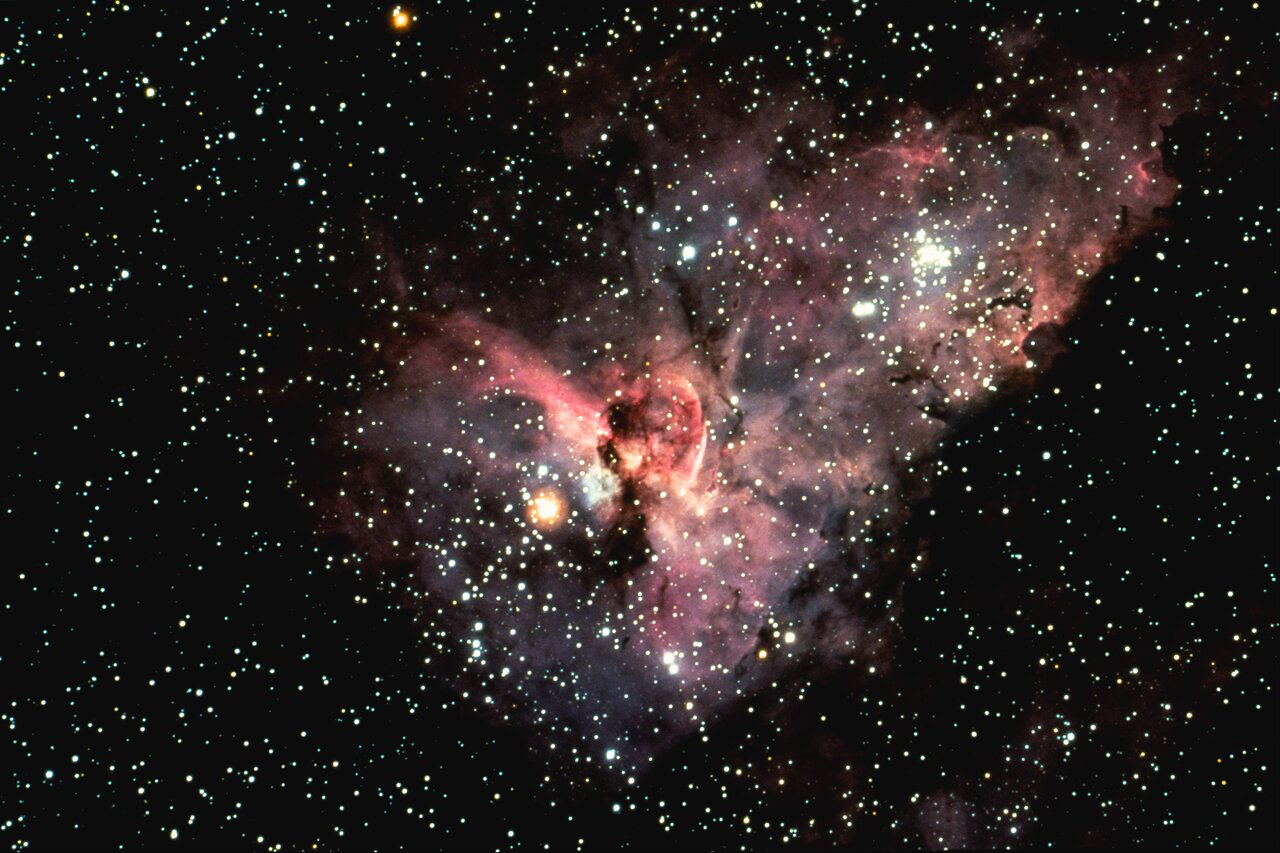
Eta Carinae, the fire opal wonder of the southern skies, currently shines as a 4th-magnitude star system nested in the vast Carina Nebula. It is one of the seven wonders of the deep southern skies. The system is dynamic: The primary star is a hypergiant, roughly 100 times the Sun’s mass and 4 million times its luminosity. Through binoculars and telescopes, Eta has a rich orange hue, which, unlike other stars of its magnitude, seems to burn with a mysterious steady light, like a distant Mars. When we look at this star, we are, in fact, not seeing a star at all, but the gaseous remains of the biggest explosion that any star is known to have survived in our galaxy.
Historical records show that Eta Carinae varied between magnitude 1 and 3 in the late 1820s and early 1830s. Then, in 1843, it erupted to magnitude –0.7 (outshining nearly all the night sky’s stars) before hitting rock bottom in 1968 at magnitude 7.6. Today it hovers around magnitude 4. The 1843 event sent out two opposing expanding lobes, which squeezed out of a dense torus of cold dust and gas before expanding like a balloon inflating in a napkin ring. This weird figure-8 pattern is known as the Homunculus Nebula. Through a 4-inch telescope at high power, the southern observer Ernst Hartung saw the Homunculus as an “orange-red nebula about 3″ wide.” When I saw it in 1982 through the 9-inch refractor at Carter Observatory, it looked like two puffs 1′ on either side of an intense core of light.