Deep in heliocentric space, dimly lit by the weak glow of the distant Sun, drifts a spacecraft which forever altered our view of the Moon and overturned long-held assumptions about Earth’s closest celestial companion.
“Dead as a doornail,” says Pete Wilhelm of Clementine. Wilhelm is the retired head of the Naval Center for Space Technology at the Naval Research Laboratory (NRL) in Washington, D.C., which built the half-ton spacecraft intended to orbit the Moon and pass the near-Earth asteroid 1620 Geographos. “But the data it collected surely lives on.”
His rueful remark aptly sums up the tragicomic ballad of Clementine. The spacecraft owes its curious epithet not to the tangy citrus hybrid fruit native to Algeria’s northern shores, but to a woman who never really existed: a female literary trope whose persona and mythos are tightly woven into America’s cultural fabric.
The connections between Clementine and water
In the melody reputedly hummed by itinerant Mexican miners during the California Gold Rush – committed to prose by Percy Montross and popularised in Hollywood movies from John Ford’s My Darling Clementine to Robert Zemeckis’ Back to the Future Part III – Clementine was a miner’s daughter, a “forty-niner,” from the earliest era of the hustle for gold in 1848-1849. Her story is regaled by an unnamed lover. One day, the hapless girl stumbled and toppled into a raging river. Unable to swim, she drowned in its “foaming brine,” much to her lover’s insouciant distress.
Water, which was the tragic Clementine’s undoing, actually proved her 20th-century descendant’s enduring claim to fame.
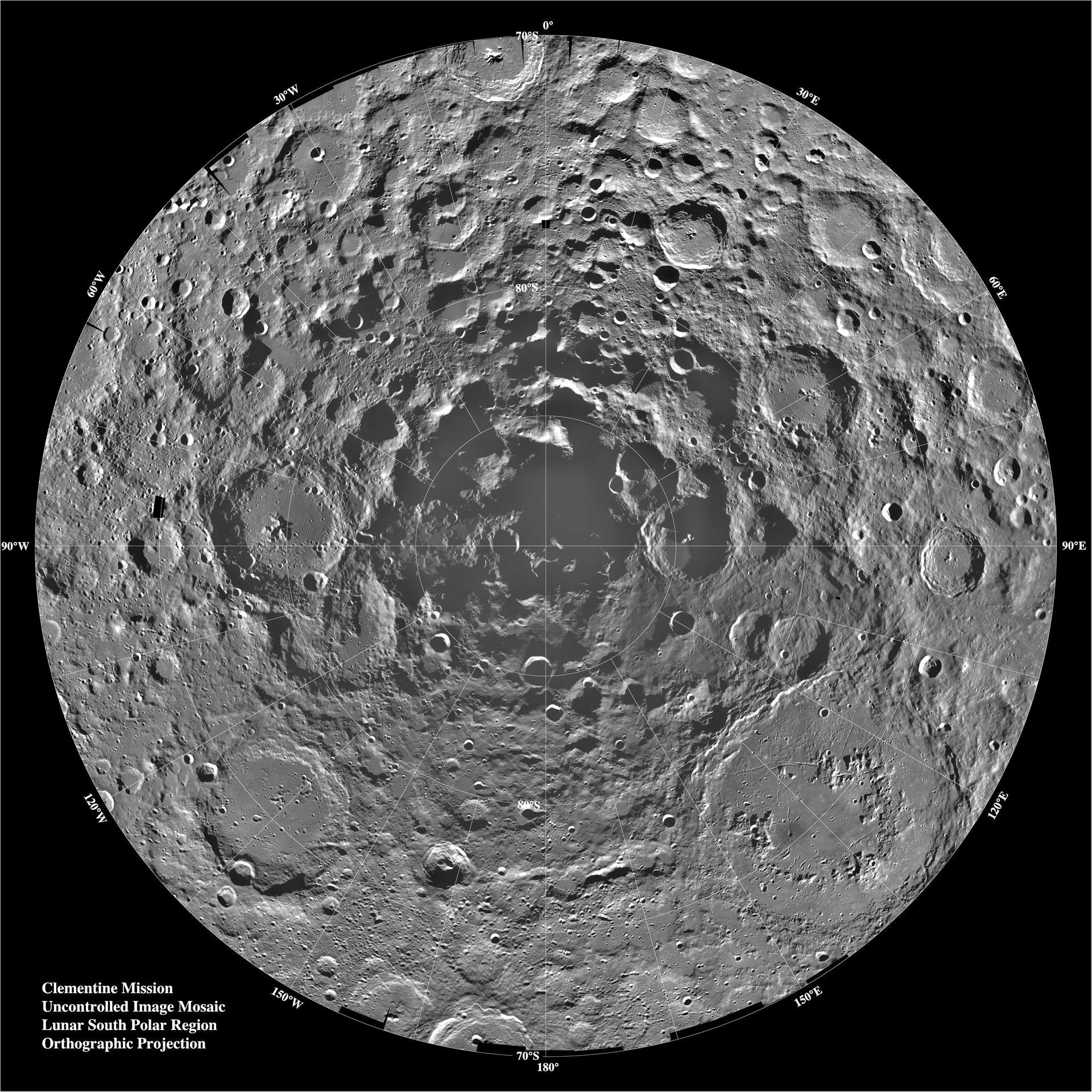
Results from its bistatic radar experiment hinted that water-ice (bounded as hydrates and hydroxides in lunar minerals or existing as free water) could endure near the Moon’s poles, inside eternally shadowed craters where temperatures never creep above -382 degrees Fahrenheit (-230 degrees Celsius). Such areas are sufficiently cold to permanently entrap water molecules delivered by comets or water-bearing meteoroids.
Clementine suggested ice deposits up to 4.2 million cubic feet (120,000 cubic meters), comparable to a lake with a surface area of four football fields at a depth of 16 feet (5 meters). And though the veracity and interpretation of its data was subsequently questioned, perceptions of the Moon in popular thought changed virtually overnight: from the lifeless, desiccated place visited by Apollo astronauts in 1969-1972 to a world which might nourish a thriving future human colony.
From construction to space in 22 months
Despite its scientific contributions, Clementine was at heart a technology mission. Conceived “from a napkin,” says Mark Johnson, former branch head of Space Electronics at NRL, it was built, integrated, tested, and launched in 22 months at under $80 million.
Devised jointly by NASA and the Ballistic Missile Defense Organization, it epitomised the “faster, better, cheaper” management ethos, testing miniaturised sensors, multimode propulsion and attitude-control systems, and gallium arsenide solar cells in deep space. And with just enough fuel for its short life, like Clementine herself, it would be “lost and gone forever” when its mission was through.
The spacecraft stood 6.2 feet (1.88 m) tall with a high-gain antenna at one end and a thruster at the other. Equipped with dual solar panels and French-built imaging software, it carried high-resolution and ultraviolet/visible cameras to examine lunar petrology, morphology and cratering, a charged-particle telescope to characterise proton/electron densities, long-range and infrared cameras with pixel resolutions of 500 feet (150 m) at the Moon and 130 feet (40 m) at Geographos, a lidar altimeter, and star trackers for celestial navigation.
A return to the Moon
Clementine rose from Space Launch Complex 4 West at California’s Vandenberg Air Force Base atop a Titan IIG rocket at 8:34 a.m. PST on Jan. 25, 1994. It was America’s first voyage to the Moon in two decades and posed multiple challenges. “This was new territory,” recalled Wilhelm. “We’d never done anything other than Earth-orbiting satellites. How do you track a satellite at those distances? It was all new stuff.”
The spacecraft executed a pair of highly elliptical phasing loops around Earth’s poles. The first loop attained a perigee of 172 miles (277 kilometers) and an apogee of 105,600 miles (170,000 km), the second a perigee of 680 miles (1,100 km) and an apogee of 241,000 miles (388,000 km) to intercept the Moon. It entered a five-day lunar orbit on Feb. 19 with a perilune of 270 miles (430 km) and an apolune of 1,830 miles (2,950 km).
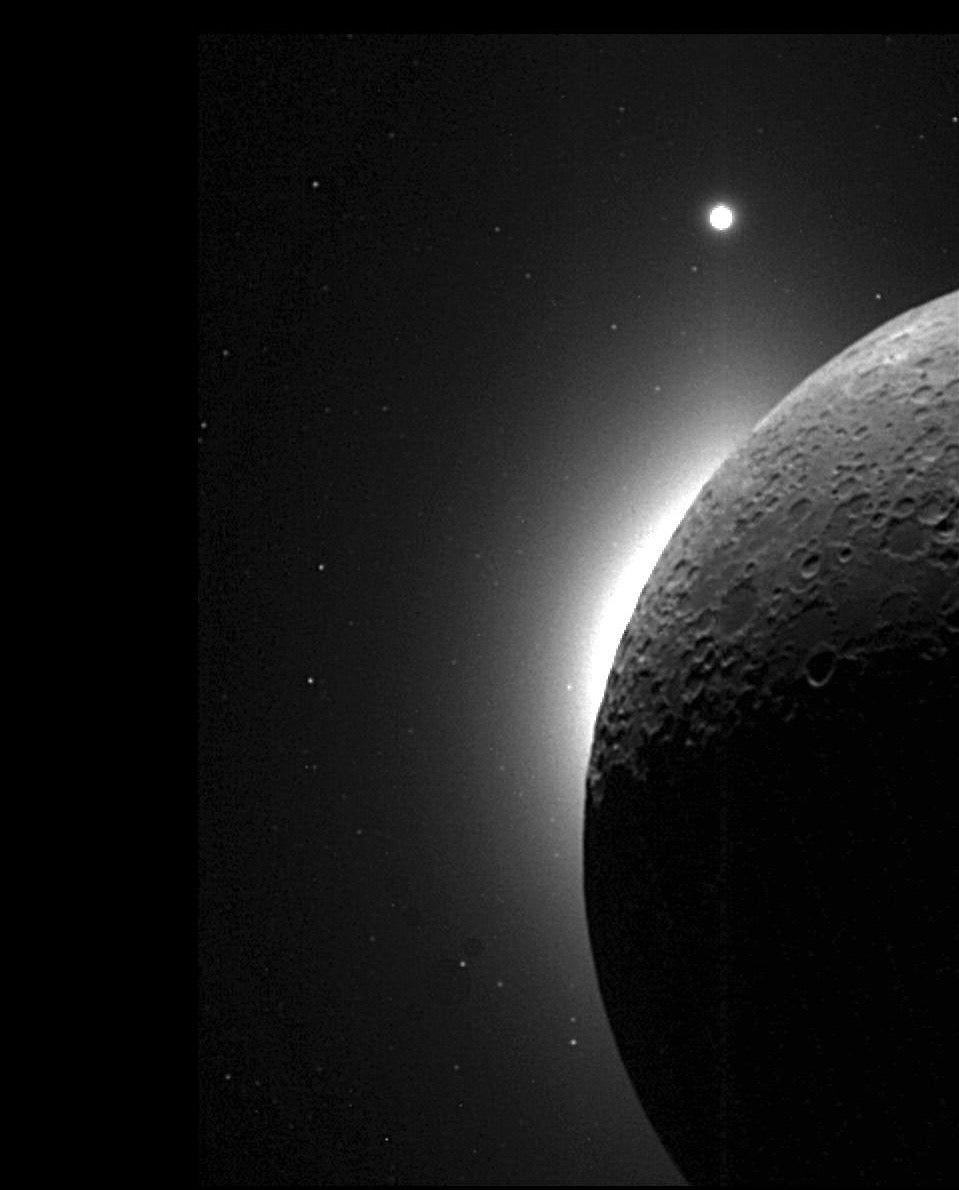
For 71 days and 297 lunar orbits, Clementine imaged our nearest neighbor and transmitted 1.6 million images, many at resolutions of 330 feet (100 m). It mapped the Moon’s whole surface, including the poles — a staggering 14.6 million square miles (38 million square km) — at near ultraviolet through visible to far infrared wavelengths. And it scrutinised the Apollo landing sites, measured mare basalt compositions on the lunar farside, and acquired stereo imagery of the colossal Mare Orientale impact basin.
Clementine, get ready to meet Geographos
With this first part of its mission done, Clementine set its sights on Geographos, a highly elongated, stony asteroid some 1.6 miles (2.5 km) long. Named for the National Geographic Society, it is a Mars-crossing and potentially hazardous near-Earth object whose highly elliptical orbit carries it around the Sun every 17 months.
In August 1994, the asteroid made its closest passage to Earth for the next five centuries, passing us at 19 lunar distances or 4.5 million miles (7.2 million km). Plans called for Clementine to leave lunar orbit on May 5 and pass within 62 miles (100 km) of Geographos on Aug. 30.
It was an exacting challenge to reach a specific point in space at a specific point in time. Navigating a route to Geographos tested Clementine’s limits and was no walk in the park. “When you’re going after an asteroid that’s just flying by, if you’re not there, you’re done,” says Wilhelm. “There’s no such thing as ‘Give me another week.’ Can’t do it.”
Sadly, on May 7 a computer glitch caused one of Clementine’s attitude-control thrusters to misfire for 11 minutes, wasting precious fuel and inducing an 80-revolutions-per-minute spin. It could still reach Geographos, but the anomaly negated useful data return so the spacecraft was kept in geocentric orbit. In June, a power-supply glitch rendered Clementine’s telemetry unintelligible and the mission ended a few months later in August.
Clementine’s legacy
“Now she’s dead, I’ll draw the line,” the singer of “Oh, My Darling Clementine” laments, before falling into the arms of his lost love’s sister. Three decades after the spacecraft’s launch, several “sisters” followed in Clementine’s footsteps: NASA’s Lunar Prospector and Lunar Reconnaissance Orbiter, China’s Chang’e-1, and India’s Chandrayaan-1. Their names may not have the same romantic allure as Clementine, but all have added to a growing corpus of evidence for water-ice at the Moon’s poles.
And when Artemis astronauts alight near the south pole and plant their boots in lunar regolith to search for water-ice later this decade, they will owe a debt to Clementine, which 30 years ago found whispers of water in this most unlikely of places.