Key Takeaways:
Friday, December 9
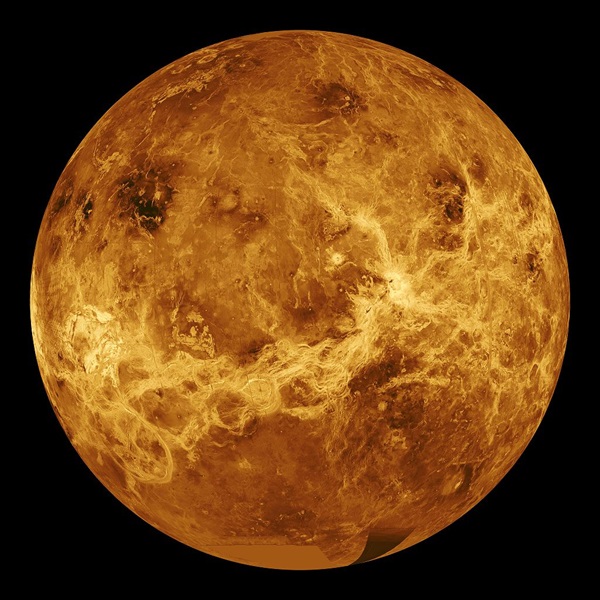
Brilliant Venus stands out in the southwest during early evening. The planet lies 20° above the horizon an hour after sunset and doesn’t dip below the horizon until after 7:30 p.m. local time, well after twilight comes to a close. At magnitude –4.2, Venus is the brightest object in the evening sky after the Moon. A telescope reveals the planet’s 18″-diameter disk, which appears two-thirds lit.
Saturday, December 10
After the Sun sets this evening, look low in the southwest for Mercury. For observers at 40° north latitude, the innermost planet lies 7° above the horizon 30 minutes after sunset. (It appears somewhat higher the farther south you live.) Binoculars will help you to pick the magnitude –0.5 object out of the twilight glow. Today marks the peak of Mercury’s evening apparition because it now lies at its maximum elongation from the Sun (21°).
Saturn passes behind the Sun from our perspective, a configuration astronomers call solar conjunction, at 7 a.m. EST. Needless to say, our star’s glare makes it impossible to see the planet. Saturn will return to view before dawn at the end of December.
Sunday, December 11
Mars continues to put on a nice show these December evenings. The magnitude 0.7 Red Planet lies among the background stars of Capricornus, and tonight passes 1° north of that constellation’s brightest star, magnitude 2.8 Delta (d) Capricorni. The pair appears some 30° high in the south-southwest after darkness falls. A telescope shows the world’s 7″-diameter disk, though you’ll be hard-pressed to see much surface detail except under exceptional viewing conditions.

Tonight’s nearly Full Moon passes in front of (occults) the 1st-magnitude star Aldebaran for observers across most of the United States and Canada. As darkness falls, you’ll see Earth’s only natural satellite suspended against the stars of the Hyades, the cluster that forms the face of Taurus the Bull. As the evening wears on, the Moon edges closer to Aldebaran. The occultation occurs at roughly midnight EST on the East Coast but closer to 8 p.m. PST on the West Coast. Binoculars or a telescope will deliver the best views of this dramatic event.
If the Moon looks a little bigger than normal set against the Hyades star cluster, it may not be your imagination. Luna reaches perigee, the closest point in its orbit around Earth, at 6:29 p.m. EST. It then lies 222,737 miles (358,461 kilometers) away from us.
Tuesday, December 13
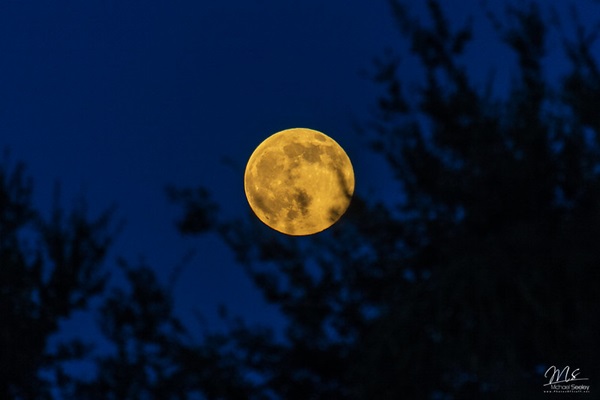
Full Moon officially arrives at 7:06 p.m. EST, but it looks completely illuminated all night. You can find it rising in the east just after sunset and peaking in the south around midnight local time. It dips low in the west by the time morning twilight begins. The Moon lies in southeastern Taurus during the evening hours but crosses into northern Orion before daybreak.
The annual Geminid meteor shower reaches its peak this evening. Unfortunately, the Full Moon shares the sky with the meteors and will drown out the shower’s fainter members. Under clear skies, attentive observers could see perhaps 10 to 15 meteors per hour. Your best option is to observe from a rural location, where the lights of the city won’t add to the Moon’s glow.
Wednesday, December 14
If it weren’t for the presence of a bright Moon, Jupiter would dominate the morning sky. The giant planet rises around 2 a.m. local time and climbs 35° above the southeastern horizon by the time twilight begins. Jupiter shines brilliantly at magnitude –1.8 and shows a 34″-diameter disk when viewed through a telescope. A small scope also reveals the planet’s four bright moons, though you may have to hunt for two of them this morning. Giant Ganymede transits Jupiter’s north polar region beginning at 2:40 a.m. EST. While only those in eastern North America can see the transit’s start, nearly everyone can witness its finish at 5:08 a.m. Io’s shadow begins a transit just seven minutes later, at 5:15 a.m., followed by Io itself at 6:21 a.m.
Thursday, December 15
Head outside in early evening this week and you can see the Big Dipper scraping the northern horizon. For latitudes north of about 40°, this conspicuous asterism never rises or sets (“circumpolar” in astronomical parlance), though December evenings find it at its lowest ebb. This means that the constellation on the opposite side of the North Celestial Pole, the familiar W-shaped Cassiopeia, currently rides highest in the sky.

This is a good week to target the dwarf planet Ceres, the largest object in the asteroid belt between the orbits of Mars and Jupiter. It lies among the background stars of northern Cetus and appears more than halfway to the zenith in the southern sky during early evening. To find it, first locate magnitude 3.6 Theta (q) Ceti, then head 8° north to the magnitude 5.6 star 42 Ceti. Eighth-magnitude Ceres lies 3° east of 42 Ceti all week.
Saturday, December 17
Although the calendar says December, the Summer Triangle of bright stars remains prominent during the early evening. Look for this large asterism in the western sky after darkness falls. The Triangle’s brightest member, magnitude 0.0 Vega in the constellation Lyra, lies about one-third of the way to the zenith. Approximately 25° above Vega lies magnitude 1.3 Deneb in Cygnus. And 35° to Vega’s left lies magnitude 0.8 Altair in Aquila. Altair sets around 8:30 p.m. local time, destroying the geometric pattern.
Sunday, December 18
The variable star Algol in Perseus reaches minimum brightness at 10:48 p.m. EST, when it shines at magnitude 3.4. If you start watching it during the midevening hours, you can see it more than triple in brightness (to magnitude 2.1) over the course of about five hours. This eclipsing binary star runs through a cycle from minimum to maximum and back every 2.87 days. Algol appears nearly overhead in midevening and dips lower in the northwest after midnight.