More than 4,000 years after the stones of Stonehenge were erected on what today is Salisbury Plain in the U.K., astronomers and archaeologists are still investigating its connections to the sky above. In particular, while Stonehenge is famous for its alignments with the Sun, some scientists argue the monument is also a temple to the Moon.
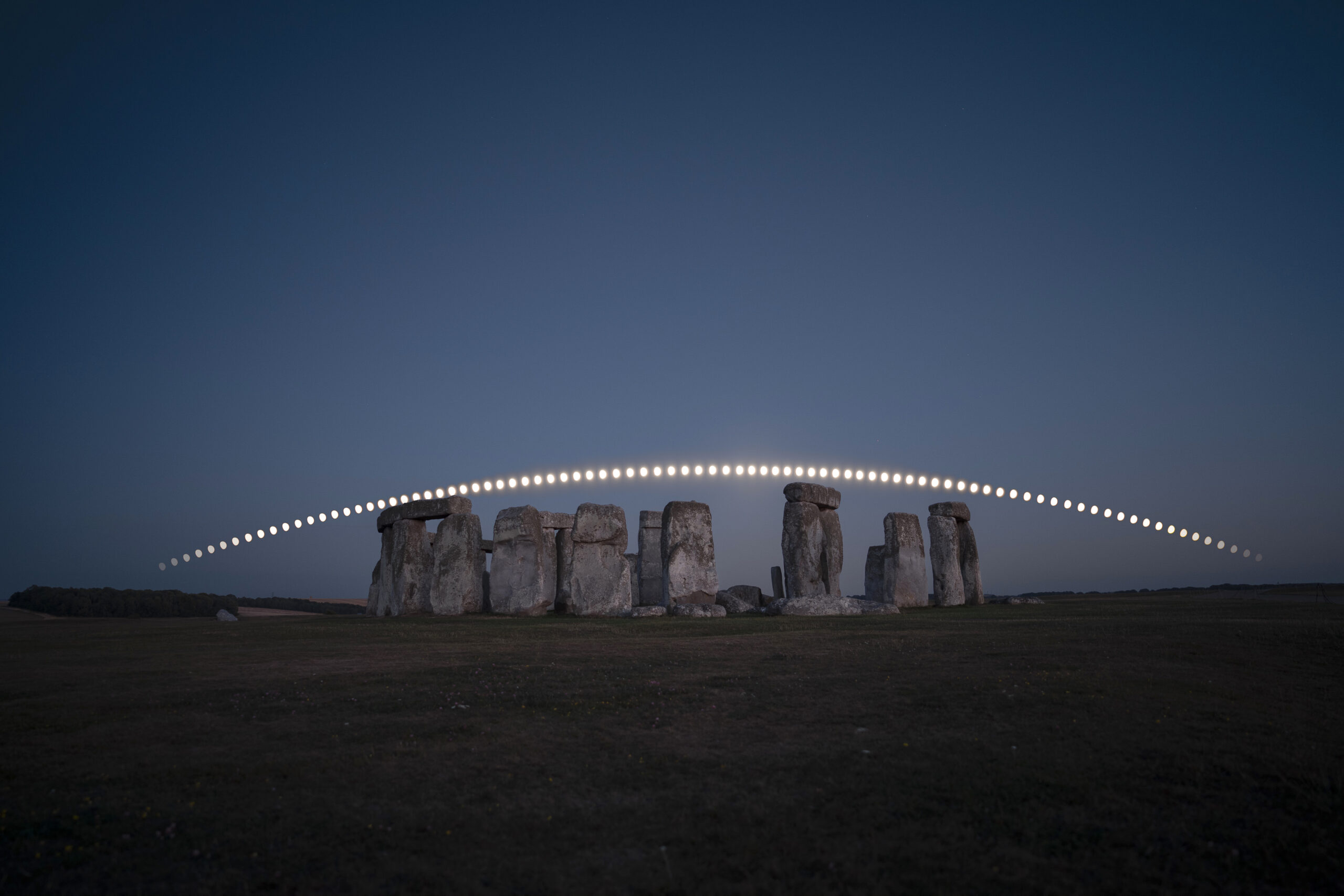
Astrophotographer Josh Dury captured this concept visually in what he calls the “dance of the Moon,” a sequence showing Luna arcing dramatically over Stonehenge’s megaliths. The composite was taken over a single night during the 2024/5 major lunar standstill — an alignment of the Earth and Moon that occurs only every 18.6 years.
This alignment is related to the Earth’s tilted rotational axis and the smaller tilt in the Moon’s own orbit. Earth’s tilt is responsible for the seasons, causing the Sun and Moon to migrate higher and lower in the sky. But because the Moon’s orbit is also tilted an additional 5.14° with respect to the ecliptic, the Moon performs an additional, subtler migration. Every 18.6 years, as its orbit precesses, those tilts align, causing the Moon to rise and set at its northernmost and southernmost extremes, reaching declinations of around 28.7° north or south of the celestial equator. This produced unusually low arcs of the Moon over Stonehenge.
The recent major standstill caught the attention of researchers, who took the opportunity to put Stonehenge’s proposed lunar alignments to the test. “Stonehenge’s architectural connection to the Sun is well known, but its link with the Moon is less well understood,” said Clive Ruggles, an archaeoastronomer at Leicester University, in a 2024 news release announcing this campaign.
In particular, a set of four stones — called the Station Stones — are set in a rectangle outside the circle of megaliths. The short axis of this rectangle points toward the midsummer sunrise and the midwinter sunset — the well-known solstice alignments. But researchers have also noted that the long axis of the Station Stones points toward the southernmost moonrise at a major lunar standstill. “Researchers have debated for years whether this was deliberate, and — if so — how this was achieved and what might have been its purpose,” said Ruggles.
To capture this intersection of folklore, history, and modern science, Dury chose Aug. 4, 2025, for the Moon’s low declination on that date of around –28°. This meant the Moon would reach no higher than 11 degrees at Stonehenge’s latitude of 51° North.
Dury had previously photographed Stonehenge on behalf of English Heritage, the charity that manages the monument grounds, and obtained permission to set up near the location of the northernmost Station Stone. To plan the shot, Dury used The Photographer’s Ephemeris, an online visualization tool and mobile app.
Because the Moon was a waxing gibbous, Dury shot the first half of the sequence in fading twilight, requiring careful exposure management. Later, at night, Dury dialed the shutter speed back down to ensure the Moon was not overexposed and its disk remained defined.
“It was quite a hazy sky,” said Dury, and as a result, “the light was a lot more minuscule and not as refined. And so it created quite a stunning, really, visual effect above the monument.”
Dury is a full-time astrophotographer and the author of 52 Assignments: Night Photography (Ammonite Press, 2025), which contains a year’s worth of weekly lessons and challenges. He advises nightscape photographers to seek a greater connection with their subject. “Rather than being tethered to aspects like social media influencer images and, in some instances, repetitive images, look to create unique, striking images from your own perspective of life,” he said.
In conceiving this shot, Dury, who hails from nearby Somerset and first visited Stonehenge a decade ago as a university student, drew on his technical skills and creativity. But he was also drawn to the site’s history and the reasons its builders constructed it — “what the Moon must have meant to those people and their greater connection to the sky above us.”
Such considerations give us “a cultural lens into the past,” said Dury. “It also makes you think more about what you are photographing, your own connection to the experience.”
Dury notes that the original priests or observers at Stonehenge lacked the benefits of modern medicine, meaning a major lunar standstill could well have been a once-in-a-lifetime event. Even today, the passage of nearly two decades between major standstills instilled a profound sense of perspective — and an urgency to get the shot. “I’m 27 now; the next time it happens, I will be 43,” he said. “You almost have to bite the bullet with these things to witness them firsthand.”