Venus and Jupiter are the top evening features for your observing run after sunset in May. Jupiter also hosts a handful of exciting double transits — and double shadow transits — involving Europa and Ganymede. Saturn and Mars make a brief reappearance in the predawn sky, joined by a crescent Moon. So let’s begin!
You’ll find Venus shining brightly in the evening sky soon after sunset. On May 1 it stands 14° above the western horizon an hour after sunset and remains visible until about 10:30 p.m. local daylight time. By May 31 it remains above the horizon until about 11 p.m. A pair of amazing star clusters — the Pleiades (M45) and the Hyades — sit to the lower right and left of Venus, respectively. The latter is punctuated by the nearer bright star Aldebaran.
Venus starts at magnitude –3.9 and brightens to –4.0 during May as it moves across Taurus and into Gemini. It stands 6.5° due north of Aldebaran the night of the 2nd and lies between the horns of the Bull (Beta [β] and Zeta [ζ] Tauri) on the 13th.
On the 18th, a lovely crescent Moon stands 2° north of Venus. Watch them as the sky darkens and the earthshine on the Moon becomes more evident. Viewed from the Moon, Earth is an almost fully illuminated sphere, dazzlingly bright — enough to cast an ethereal light across the dark lunar surface.
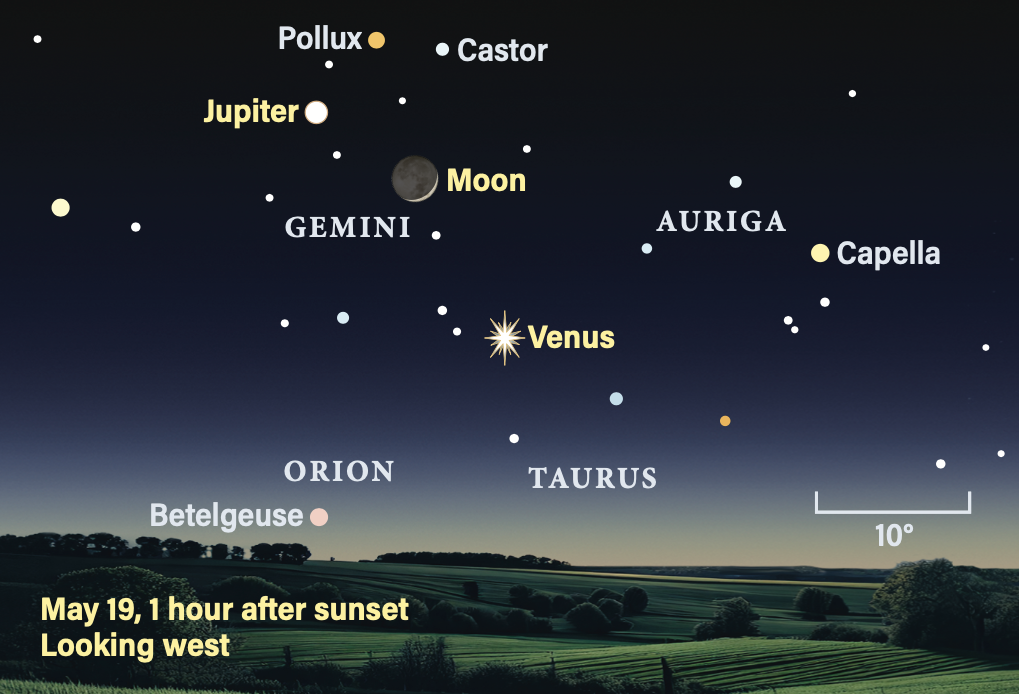
The next evening (the 19th), Venus crosses into Gemini and stands some 20° west of Jupiter, while the crescent Moon has moved up to meet Jupiter, situated in the middle of Gemini about 7° from the bright planet. Watch for the rest of the month as the gap between Venus and Jupiter closes, reaching about 8° on the 31st. The two planets are lining up for a fine conjunction in June.
Venus is an interesting object to view with a telescope, best done in twilight. Its brilliance makes the disk difficult to see against the harsh contrast of a black sky. In twilight, you’ll easily see a gibbous phase all month, starting on May 1 as an 88-percent-lit disk spanning 12″. The phase decreases to 80 percent lit by May 31, and the disk’s diameter grows slightly to 13″ as the planet’s distance from us decreases.
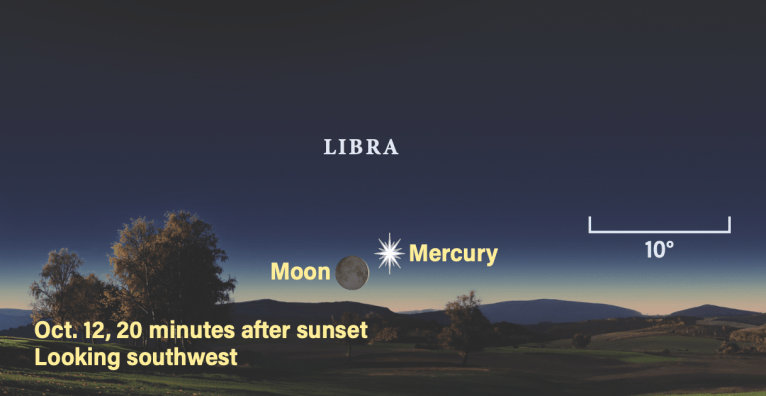
Mercury becomes visible by the end of the month, quickly increasing its elongation from the Sun following superior conjunction on the 14th. On May 25, it is 6° above the western horizon 30 minutes after sunset, glowing at magnitude –1.1. Five days later, on the 30th, it is nearly 10° high 30 minutes after sunset, but has faded to magnitude –0.6. On the 31st, it sets an hour and a half after the Sun, and has dimmed another 0.1 magnitude. On that date, its disk spans 6″ and appears 70 percent lit.
Returning to Jupiter, the gas giant remains visible until 1 a.m. local daylight time in early May and until nearly midnight by the end of May. It stands high in the western sky soon after sunset, visible as a magnitude –2.0 planet just to the lower left (southwest) of Gemini’s twin stars, Castor and Pollux. It fades (barely noticeably) to magnitude –1.9 by midmonth. On May 31, Jupiter stands just over 6° south-southwest of Pollux. On May 19 and 20, a crescent Moon stands within 8° west and east of Jupiter, respectively, drawing attention to the giant planet.
The visibility of Jupiter is narrowing, and to capture features on its disk with a telescope requires good seeing while the planet is still at a decent altitude. Early evening in deep twilight is a good place to start. You’ll notice a wealth of detail on its cloud tops. Two dark belts span the equator, with more subtle shading and features on other parts of the globe. During May, Jupiter shrinks from 35″ to 33″.
A fine series of double shadow transits involving Europa and Ganymede occurs this month. But first, there’s a nice transit of Callisto as two other moons are occulted. Watch May 6 as Callisto’s transit begins at Jupiter’s eastern limb at 10:33 p.m. EDT (in twilight for the Mountain time zone). Notice Europa approaching the western limb — about one hour later (11:36 p.m. EDT), Europa disappears in an occultation, hidden by Jupiter’s disk. Next, Io (also approaching from the west) is occulted at 11:35 p.m. PDT, followed by Callisto’s exit from transit at 11:41 p.m. PDT, best seen from this time zone.
The following night you can watch Io transit Jupiter, an event that takes less time due to its faster orbital period. The transit begins May 7 at 11:48 p.m. EDT. Just over an hour later, at 11:56 p.m. CDT (note the time zone change), Io’s shadow appears at the eastern limb. Io then leaves the disk at 12:04 a.m. MDT, with Jupiter some 7° high from this region. Pacific Coast observers will see the egress clearly, followed about an hour later by the shadow’s egress as well.
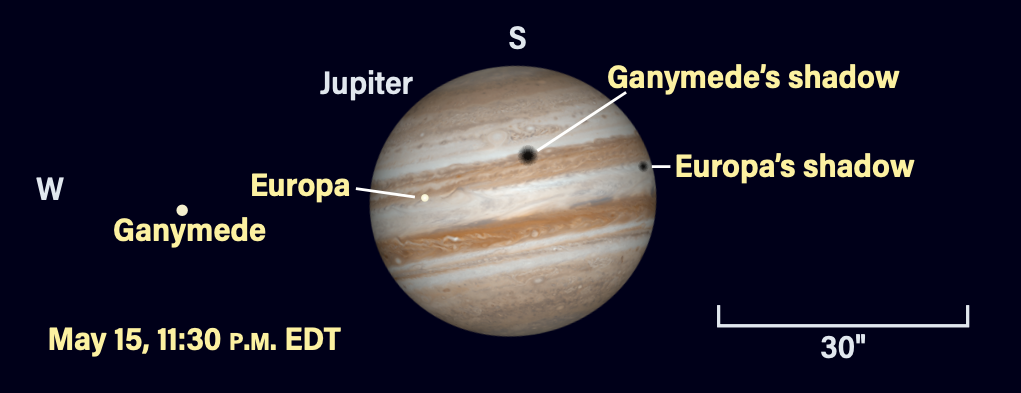
A double shadow transit occurs May 15/16, as Europa and Ganymede’s shadows cross the jovian disk overnight. As twilight falls on May 15 across the Central time zone, Europa is transiting as Ganymede’s shadow appears at the eastern limb (at 9:58 p.m. EDT). Ganymede itself stands west of the planet. Europa’s shadow appears on the eastern limb of Jupiter at 11:20 p.m. EDT. Europa exits the disk at 11:03 p.m. CDT (with Jupiter very low along the East Coast), leaving the two shadows alone on the cloud tops. Ganymede’s shadow is clearly larger and slower moving. Watch over the next hour to see Europa’s shadow gaining on Ganymede’s, though it won’t catch up —Ganymede’s shadow leaves at 11:26 p.m. MDT, visible largely in the western half of the U.S.
Seven days later, a similar event occurs. Europa and Ganymede cross the disk the evening of May 22; also make note of Io west of the planet. Ganymede’s transit begins at 9:57 p.m. EDT and Europa follows 2 hours later. Io approaches the western limb and enters occultation at 11:02 p.m. MDT (note the time change), just as Ganymede approaches the same limb, exiting about 20 minutes later. Europa then sits in the center of Jupiter’s disk.
What’s remarkable about this double transit is that the shadows arrive at nearly the same time on the eastern limb. Watch this happen about 10:55 p.m. PDT, best seen from the western Pacific time zone, as Jupiter is only 9° high. Which shadow do you see first? Ganymede’s is larger, but Europa’s shadow appears two minutes earlier, moving faster so that it quickly springs ahead of Ganymede’s. Observers in Alaska and Hawaii will have the best views of the majority of the double shadow transit.
By the end of May, Jupiter sets half an hour before midnight. Another double transit of Europa and Ganymede occurs on May 29 but it’s only visible in Alaska and Hawaii (the latter of which has the best view).
Saturn becomes a bit easier to spot in May, notwithstanding the low inclination of the ecliptic to the predawn horizon. By May 13, it stands 7° high in the eastern sky an hour before sunrise. It’ll be easy to spot then because a waning crescent Moon rises about half an hour before Saturn (which rises shortly after 4 a.m. local daylight time), with Saturn 6° below the crescent.
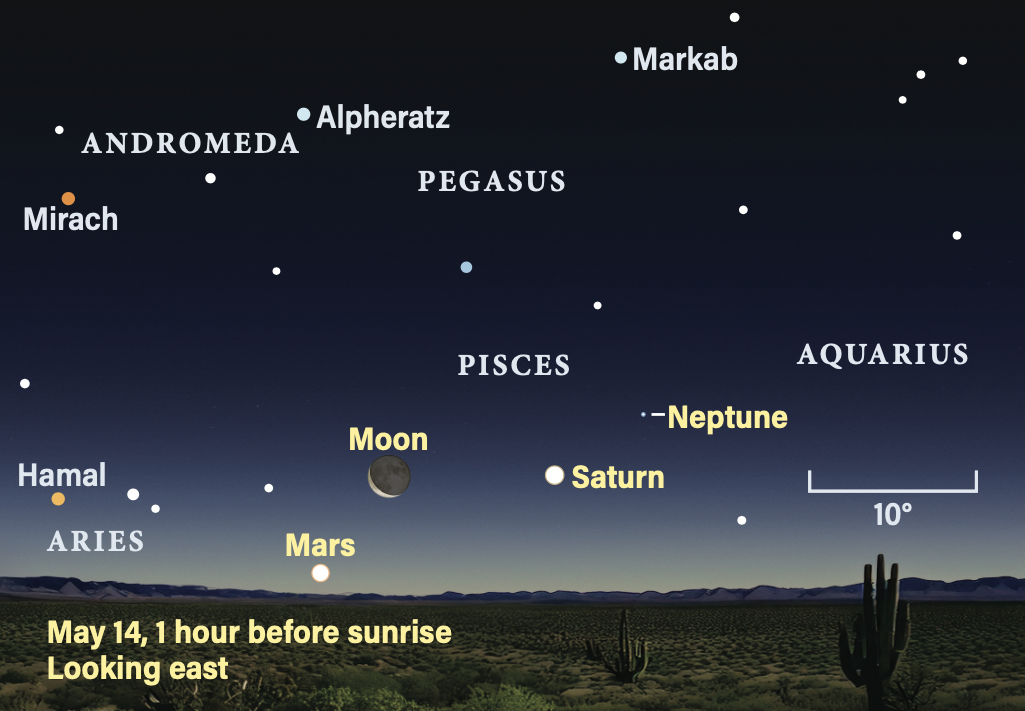
The following morning, look for the Moon again, then scan 7° to its lower left (east) for Mars, shining at magnitude 1.3. By May 15, the Moon is almost gone (one day away from New), but it does rise a few minutes before Mars. The planet is now southwest (to the right) of the Moon. Both are a similar altitude above the horizon, rising about an hour before sunrise.
Neptune may be easier to spot in late May as its elongation from the Sun increases. You’ll find it 8° west of Saturn on the 31st, standing 10° high in the eastern sky two hours before sunrise.
Uranus reaches conjunction with the Sun May 22 and although it is briefly above the western horizon on early May evenings, it isn’t readily visible this month.
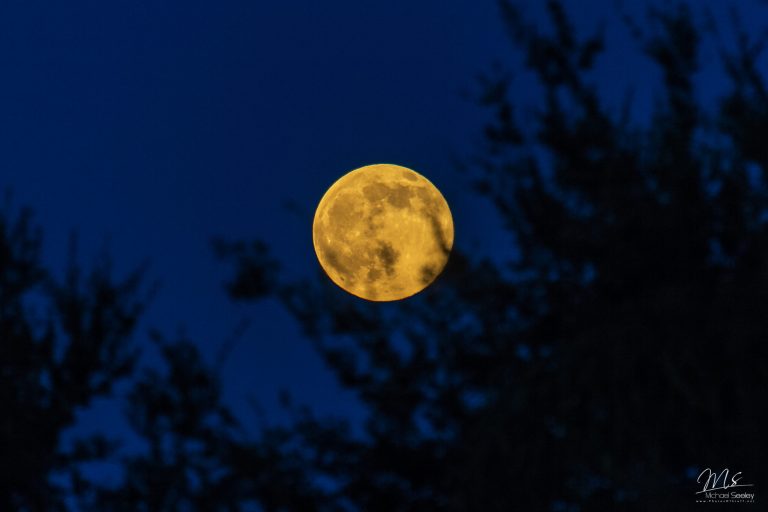
Rising Moon: Libration all the way around
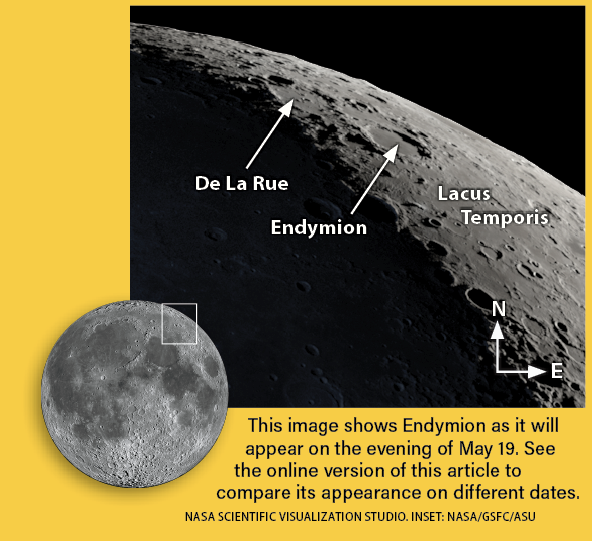
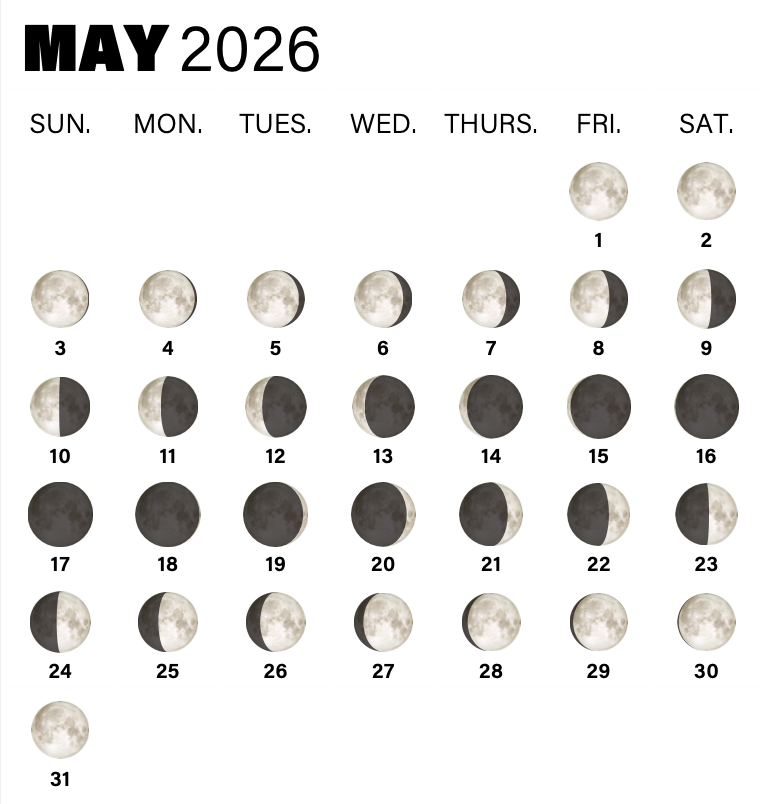
When you watch someone roll their head all the way around, you won’t see the back, but you will view more than just the front half. Our companion Luna appears to perform a similar maneuver, called libration, with a 27-day period, revealing a total of 59 percent of its face toward us, including a bit of the top, bottom, and sides. Binoculars are the best way to follow this motion, yet it is noticeable to the discerning eye. We’ve hit the timing just right this month, as the 29.5-day illumination cycle is in sync with the roll.
May opens at Full phase with Luna below the ecliptic, letting us see past the north pole. Nansen and Peary point the way to the outer rim of Rozhdestvenskiy. Note how close Tycho is to the bottom; Schickard’s large, flat oval is to the southwest, and Oceanus Procellarum’s lava goes right to the northwestern limb. Over the following nights, keep an eye on Mare Orientale, as dark Lacus Autumni and Veris roll into view as the nearer cordillera tilts down toward us.
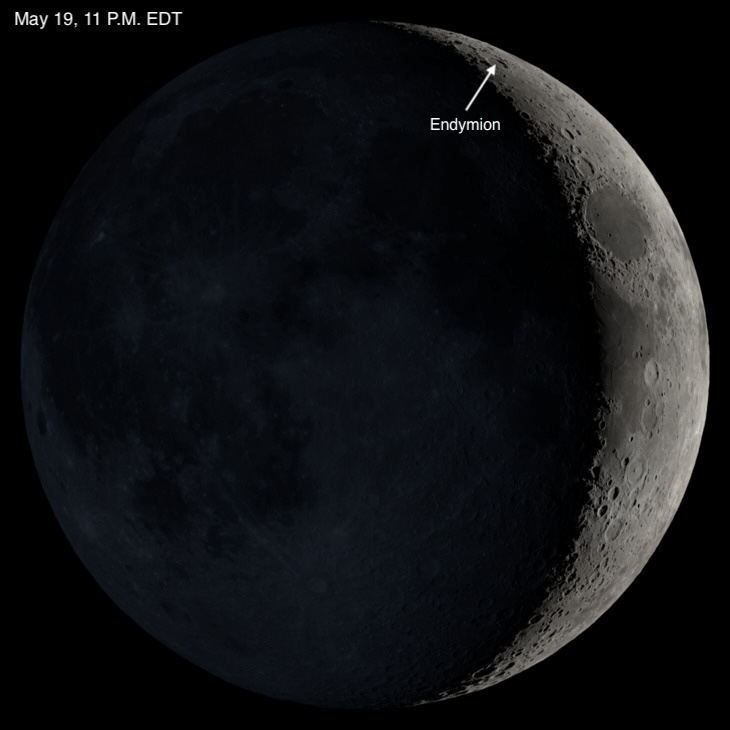
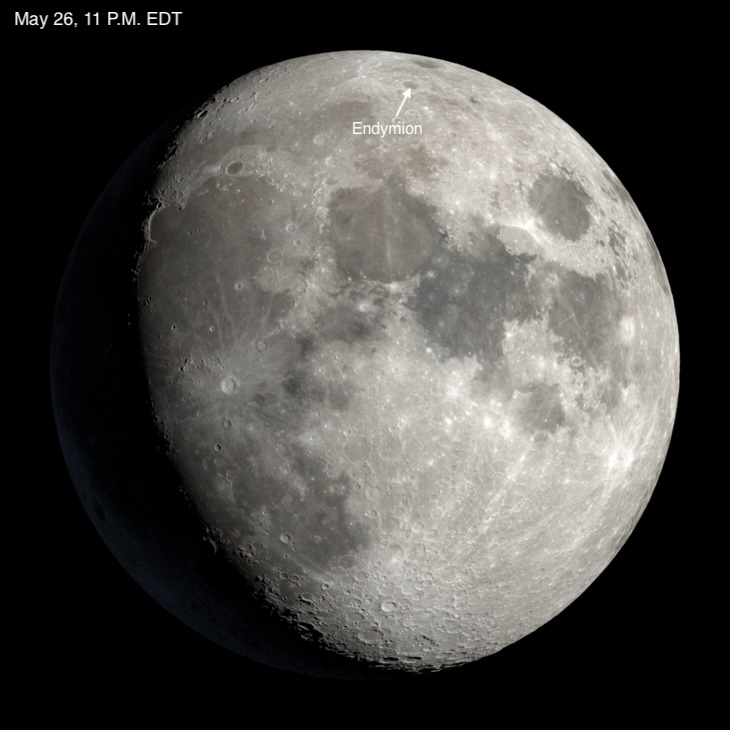
Jumping to the pre-sunrise crescent on the 12th, Schickard has climbed well away from the limb. Returning to the evening crescent on the 19th, the mottled Mare Australe fills the southeast with dark and light lakes soon to roll away. See Mare Crisium and the flat-bottomed Endymion far to the northeast shift from near the limb to well inside it.
As we reach Full phase at month’s end, the whole sequence now nearly repeats, but two days earlier, with each following month showing us less of the backside.
The Moon itself doesn’t physically wobble — its apparent motion is due to our changing viewing angle.
Below, compare the views on the evening of May 19 (left) and 26 (right) to see how far Luna has rolled forward.
Meteor Watch: Faint but not forgotten
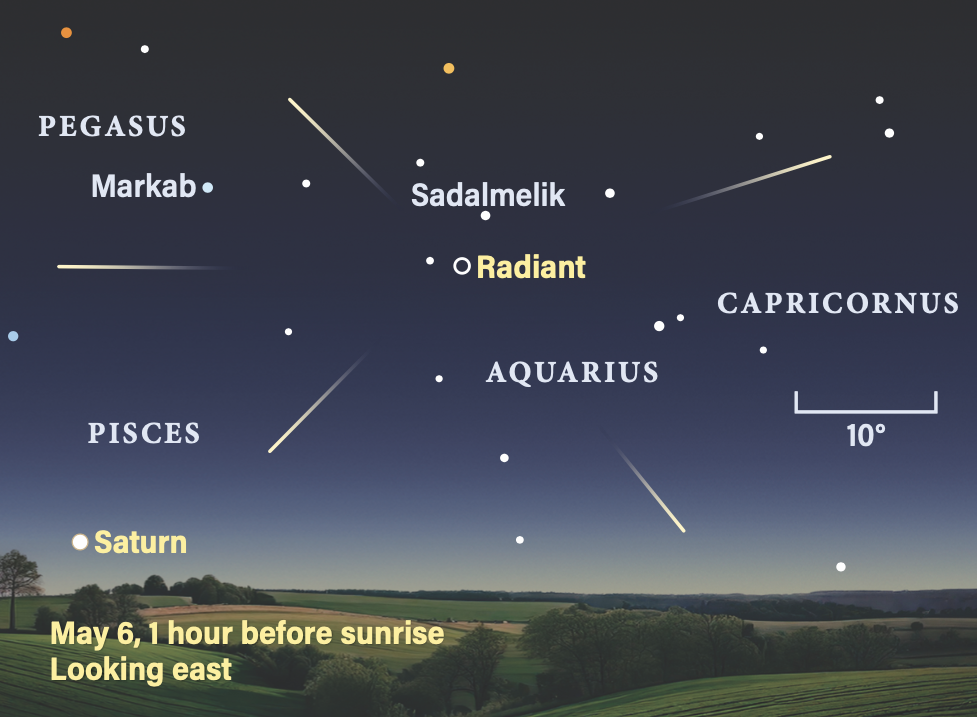
This month’s Eta Aquariid shower is active between April 19 and May 28, and peaks the morning of May 6. The waning gibbous Moon interferes strongly. On the night of maximum, the Moon lies in Sagittarius and stands in the southeastern sky as Aquarius rises. Moonlight strongly diminishes the number of meteors you will see.
The maximum zenithal hourly rate is 50 per hour on May 6 in a dark sky, but observed rates will be under a dozen per hour. The radiant rises around 2 a.m. local daylight time on the morning of maximum and reaches about 20° in altitude as twilight breaks. The hour before dawn is the best time to watch, with Earth heading directly into the stream, resulting in higher velocities of entry into our atmosphere. Although unfavorable this year, there’s always strong interest in the shower due to its association with Halley’s Comet. Halley’s dusty debris, left over from hundreds of orbits, results in both this shower and the October Orionids each year.
Comet Search: Inbound for opposition
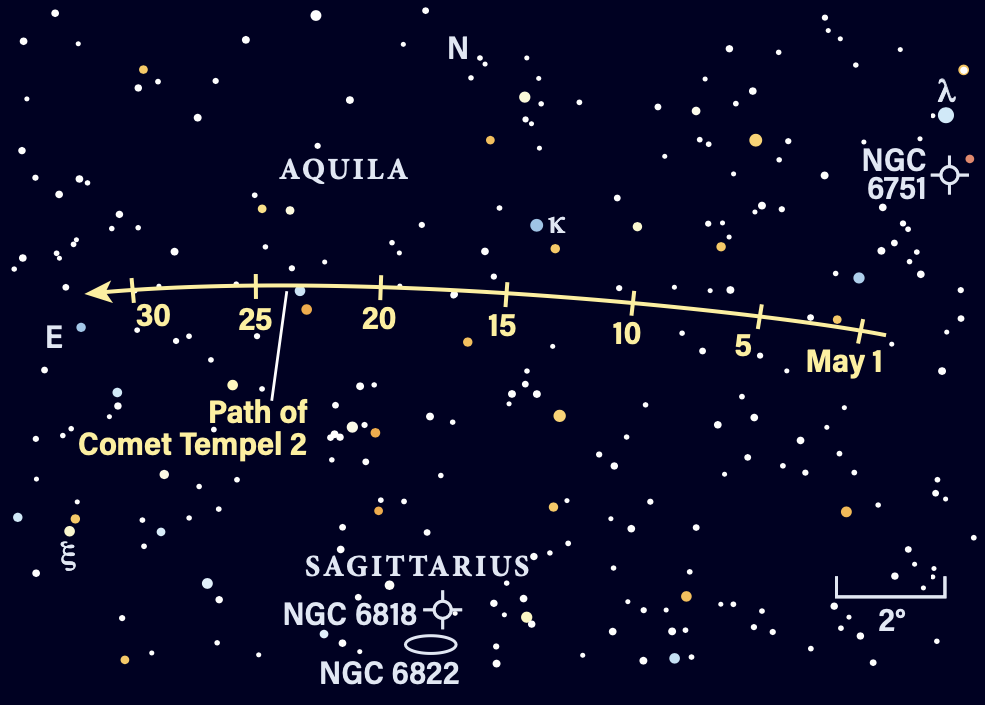
Reliable Comet 10P/Tempel (also called Tempel 2) is back, here to keep us company the whole summer through. It’s a decent telescopic comet brightening past 9th magnitude, destined to hit the top three of its apparitions since discovery in 1873. May is the month to stay up late as our programming switches from galaxy fields to the core of the Milky Way in the south. By 1 a.m. local daylight time, our target is more than 10° high, and starting on May 8/9, the session-ending Moon rises closer and closer to dawn.
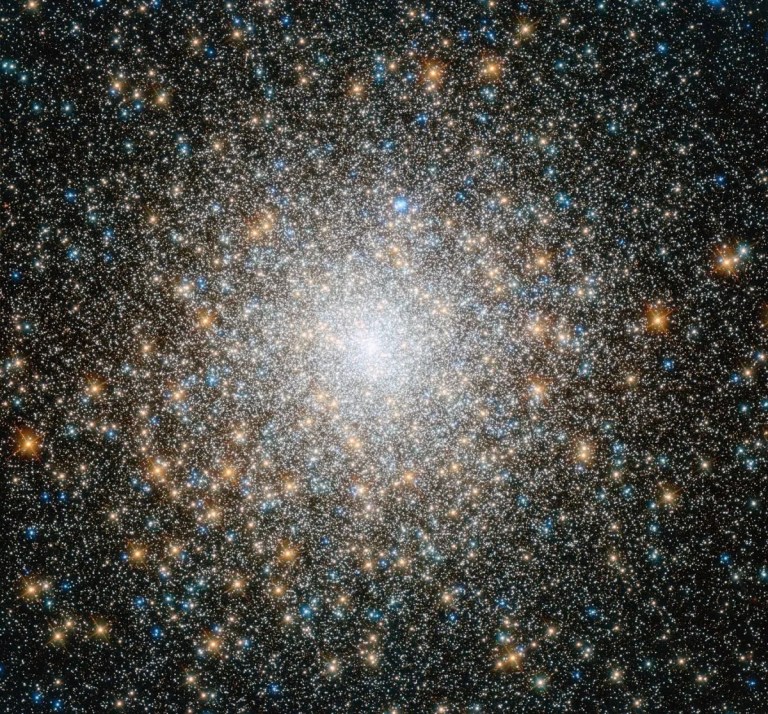
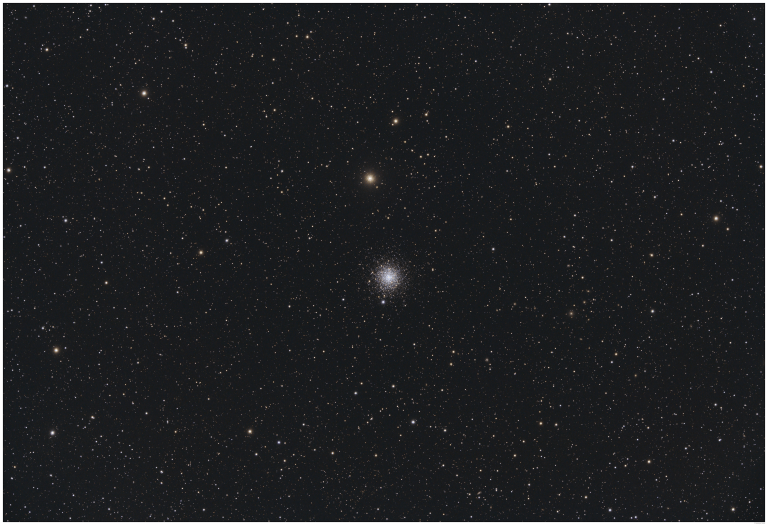
Our lookalike object is magnitude 9.2 globular cluster NGC 6638 near the lid of the Sagittarius Teapot asterism. From a dark sky, these nonstellar fuzzies can be picked up through a 4-inch scope, but powers of 150x are better handled with 6- to 8-inch optics. Tempel 2 should be lopsided, sharper where the solar wind pushes back the emitted dust, different from the rounder globular. Is the light falloff from the comet’s bright core better simulated by the elliptical galaxy M87? What about the texture?
Wilhelm Tempel was a successful visual observer, nabbing 21 comets and 5 asteroids during the period when photography was barely able to record the Great Orion Nebula.
Locating Asteroids: A practiced jump
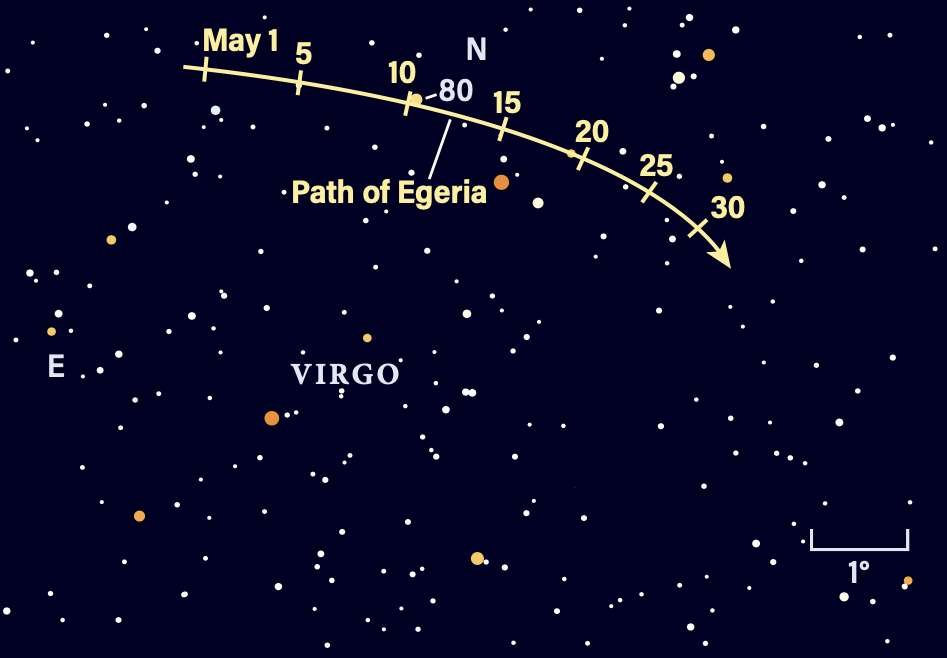
There are several beacons in the evening sky to help orient ourselves in space. Our lighthouse this month is Spica (Alpha [α] Virginis), a third of the way up in the southern sky as darkness sets in. Shift one finder field or outer Telrad ring north to find a wide stick-figure of a lawnmower. The handle, magnitude 5.7 80 Vir, lies right on the path of main-belt asteroid 13 Egeria.
A 4-inch scope from the suburbs is needed to pull the 10th-magnitude dot confidently into view. Star-hopping here is straightforward. The background is not overcrowded with suns from the galactic hub, while the variety of magnitudes and shapes lets us lock onto pattern after pattern while shifting the telescope. The best dates for seeing Egeria move in a three-hour session are May 5, 6, 11, 19, and 24. Make sure your comparison sketch has at least two field stars to set the sky’s orientation.
Annibale de Gasparis was on a discovery roll, having just picked up 10 Hygiea and 11 Parthenope. In November of 1850, asteroid No. 13 floated into his eyepiece at magnitude 10.1, with no matching dot on his star charts. With a reflectivity of about 8 percent and diameter of 125 miles, Egeria’s steep 16° inclination to the ecliptic eliminates any interest for a space mission. It’s all ours to watch.
Star Dome
The map below portrays the sky as seen near 35° north latitude. Located inside the border are the cardinal directions and their intermediate points. To find stars, hold the map overhead and orient it so one of the labels matches the direction you’re facing. The stars above the map’s horizon now match what’s in the sky.
The all-sky map shows how the sky looks at:
midnight May 1
11 p.m. May 15
10 p.m. May 31
Planets are shown at midmonth