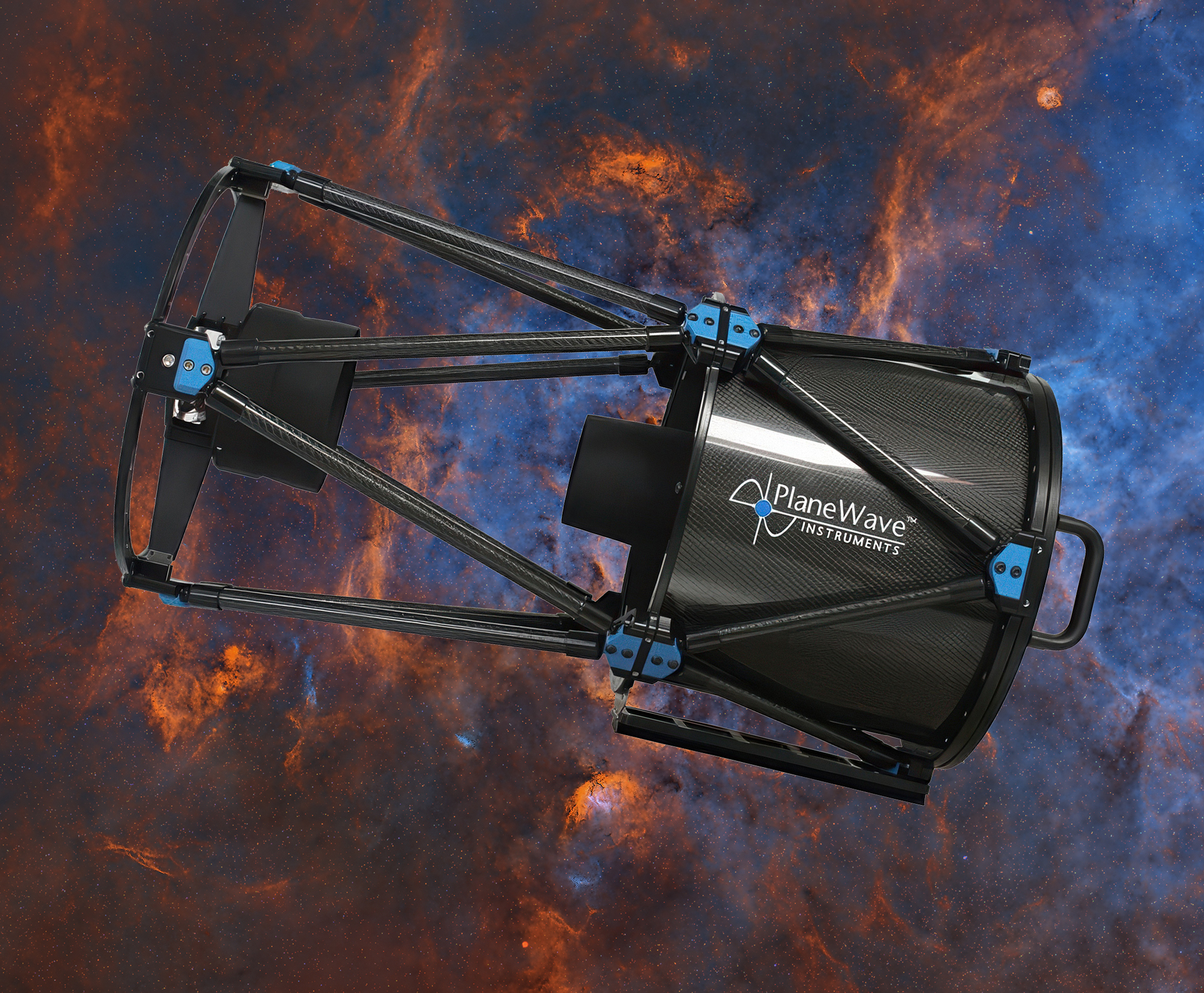
To many of you, Observable Space — formerly PlaneWave — needs no introduction. Starting as a breakaway from Celestron in southern California in 2006, PlaneWave was founded by Rick Hedrick and Joe Haberman. It has grown to become an international provider of telescopes from 12.5 inches to 1 meter in size. The most popular design is the Corrected Dall-Kirkham, which gives a flat field with no coma and no astigmatism across a large circle of illumination at a relatively fast f/ratio, typically f/6.8.
I’ve had several PlaneWave/Observable Space scopes over the years, and I’ve watched as these telescopes evolved to what they are today. My latest is the CDK 14, a 14-inch Corrected Dall-Kirkham utilizing a large two-element corrector lens located in the primary baffle tube.
Shop now at PlaneWave Instruments
The CDK 14 is one of the sharpest telescopes that Observable Space makes. On nights of exceptional seeing, my smallest stars look like they were made with an apochromatic refractor — they are mere pinpricks. This from a telescope with a focal length of 2,563 millimeters.
By the numbers
The telescope’s statistics are impressive. Its focal ratio is f/7.2, which is plenty fast for imaging. It has a huge 282 mm of back focus, meaning you can put just about anything between the scope and the camera. It weighs a modest 48 pounds (21.8 kilograms), so you don’t need a huge mount. The mirror substrate is fused silica — which, unlike Pyrex, is thermally stable. The telescope maintains focus with typical temperature drops during the night. And all the mirrors are coated with enhanced aluminum.
The focus is so stable that I focus maybe once a week just to check it. With a proper cooldown (using three fans mounted to the back plate that blow air onto the back of the mirror), the focus goes back to the previous night’s position. The telescope doesn’t lose collimation no matter its orientation. I shoot several hours past the meridian, at which point the telescope is upside down — stars are still perfect.
Collimation is usually a scary proposition with most Cassegrains, but not the CDK 14 because the primary mirror has been aligned and fastened in place. All you need to do is adjust the spherical secondary until you have symmetrical “doughnuts” — slightly out-of-focus stars. And the collimation holds. I’ve not adjusted mine in more than a year.

The perfect telescope?
Not quite. There are a few things you should know.
The first is the shroud. It tends to sag into the optical path. There are rods that you can buy that fasten to the front cage assembly that keep the cloth from sagging, but I made mine using long threaded bolts that I fastened to the front. Then I slid some tubing over the bolts. The shroud rides on top of the rods, keeping it out of the light path. But you also have to keep the shroud tight. I solved this by using long zip ties that I poked through the end of the shroud and fastened to the back of the scope. This keeps tension on the shroud.
The other issue is more serious: heating the primary when there’s a lot of dew. For some reason, the small heating pads to accomplish this were fastened directly to the massive aluminum back plate. The idea was to gently heat the air around the mirror. Unfortunately, the back plate acts as a gigantic heat sink. It absorbs any heat generated, and it’s exposed to the cold night air. End result: little heat ever reached the primary.
My solution was to remove the entire back mirror assembly to access the heating pads. I peeled them off and put some insulating material between them and the back plate. Now the pads’ heat really does heat the air, which in turn heats the primary. It only takes one to two degrees above ambient to keep dew off the mirror. The back plate assembly is pin registered, which ensures correct alignment should removing it be necessary, for example, to clean the primary.
The other aspects of the telescope are wonderful. Observable Space created its own software to control the telescope. There are many ways you can set cooling and heating, either automatically or manually. If you have the massive focuser or rotator unit, you can control both from your computer. The focusing software is the best that I’ve ever used. Simply set your parameters and press “go.” In a matter of minutes, focus will be perfect.
A lot of the telescope is carbon fiber, which is thermally stable. Observable Space even incorporates an expansion joint, should there be any movement between the aluminum and carbon fiber components. It helps maintain the accurate alignment of the optical elements.
An absolute joy
Once I solved the two minor problems I mentioned, the telescope has been a real workhorse that operates night after night without complaint or error. It is seeing-limited under almost all conditions and can hold a variety of cameras, large or small.
In addition, it lets you shoot wider fields than bigger telescopes, but you can zoom in by using a camera with a smaller chip. More samples of what this telescope can do can be seen on my AstroBin page: app.astrobin.com/u/tonyhallas.
In sum, the Observable Space CDK 14 is an observatory-class telescope that’s a huge performer. It operates in a relatively small footprint and costs less than larger scopes. And being smaller, it reaches thermal equilibrium in less time than larger telescopes. Yet it provides a substantial focal length over a 52mm image circle with perfect stars. As an advanced imager, I demand the best from my equipment. The Observable Space CDK 14 delivers this and more.
PRODUCT INFORMATION
Observable Space CDK 14
Aperture: 14 inches
Focal length: 2,563 millimeters
Focal ratio: f/7.2
Image circle: 52 mm
Mirror: Fused silica
Optical tube assembly: Carbon fiber
Length: 35 inches (889 mm)
Weight: 48 pounds (21.8 kg)
Price: $18,500
Contact: Observable Space
1375 N. Main St., Bldg. #1
Adrian, MI 49221
1-310-639-1662
www.planewave.com