Key Takeaways:
- Mutual planetary transits and occultations are rare phenomena, primarily attributed to the varying orbital inclinations of planets relative to Earth's.
- Historical observations include Mars transiting Jupiter on September 12, 1170, as recorded by Gervase of Canterbury, and Venus occulting Mercury on May 28, 1737, detailed by John Bevis.
- The most recent documented mutual planetary event was Venus transiting Jupiter on January 3, 1818.
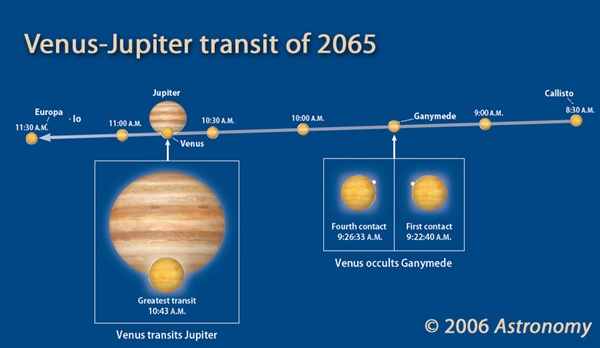
- The next anticipated event, a transit of Venus across Jupiter on November 22, 2065, will occur near the Sun, requiring optical aid, solar protection, and potentially orbiting telescopes for observation, and will be preceded by Venus occulting Ganymede.
English monk Gervase of Canterbury provided one of the first Western descriptions of a mutual planetary transit. On September 12, 1170, Mars crossed the disk of Jupiter. The event ended moments after Gervase saw the planets rise. He recorded that “Two planets were seen in conjunction to such a degree that it appeared as though they had been one and the same star; but immediately they were separated from each other.” Chinese observers also witnessed the event, calling it an occultation.
On the evening of May 28, 1737, English amateur astronomer John Bevis used a telescope at Greenwich Observatory to watch Venus approach Mercury. The planets were low on the horizon, and clouds often obscured his view, but Bevis briefly glimpsed Venus before it covered Mercury and once again after the occultation began. Bevis’ report is the only detailed account of such an event.
The next opportunity arrives November 22, 2065, around 12h43m UT (10:43 a.m. in Brazil), when Venus transits Jupiter, but the pair lies only 8° west of the Sun. This means observing the event will require both optical aid and solar protection. Orbiting telescopes probably will give us the best views.
Venus, at the farthest point in its orbit, will be at its smallest (9.9″) and faintest (–3.9). Jupiter, appearing nearly 3 times larger, will provide a 31″-wide, magnitude –1.7 backdrop. At their closest, the two planets will gleam as one magnitude –4.0 object. And there’s even a bonus: Before transiting Jupiter, Venus actually occults the large jovian moon Ganymede. — Francis Reddy, associate editor