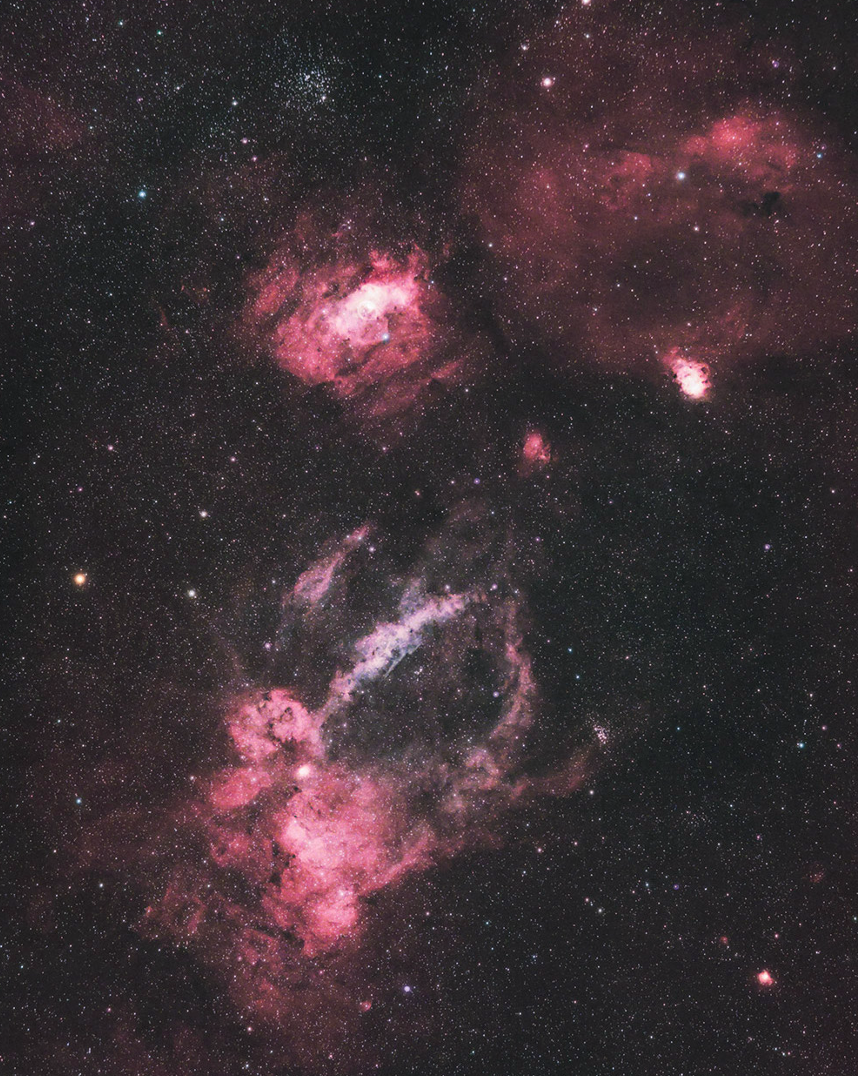
As we’ve seen in recent posts, the northern constellation Cassiopeia is chock-full of intriguing nebulae and bright star clusters. A large and relatively bright emission nebula among this group, Sharpless 2–157, is rarely observed by amateur astronomers. It is sometimes called the Lobster Claw Nebula due to its distinctive shape.
This big nebula lies in relatively close proximity to the well-known and frequently observed Bubble Nebula (NGC 7635).
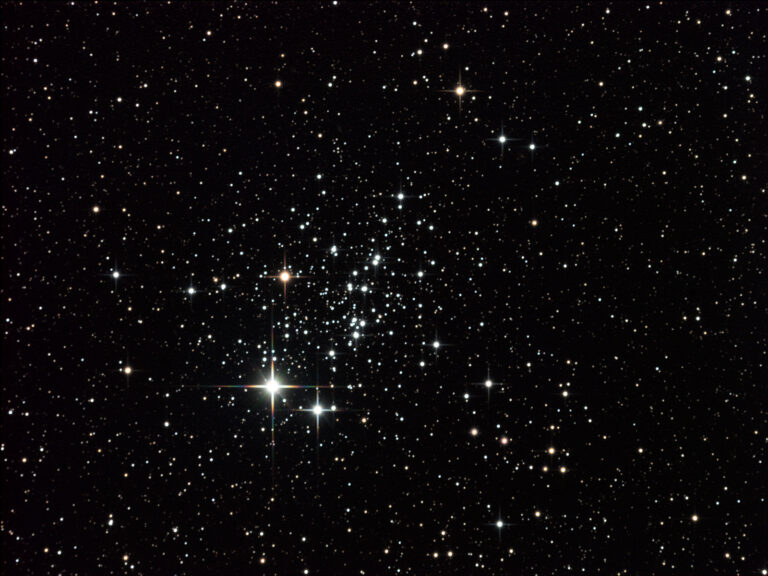
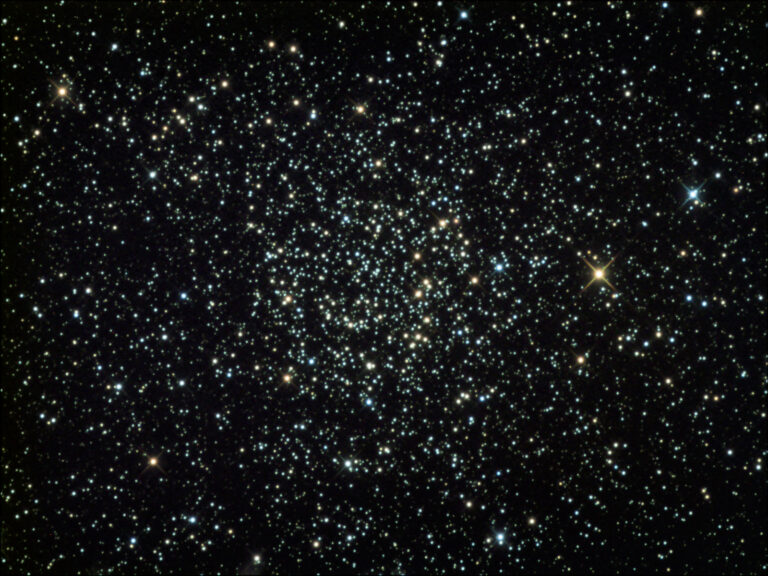
Two open clusters lie within or close to Sharpless 2–157. They are Markarian 50, which lies 11,000 light-years away and is 7.5 million years old, and, near the northern edge of the nebula, the bright cluster NGC 7510. The latter glows at 8th magnitude, spans 7’, lies 11,000 light-years away, and is about 10 million years old.
The northern part of Sharpless 2–157, sometimes identified as Sharpless 2–157a, contains a circular nebula surrounding a Wolf-Rayet star, WR 157, which is ionizing the surrounding gas.