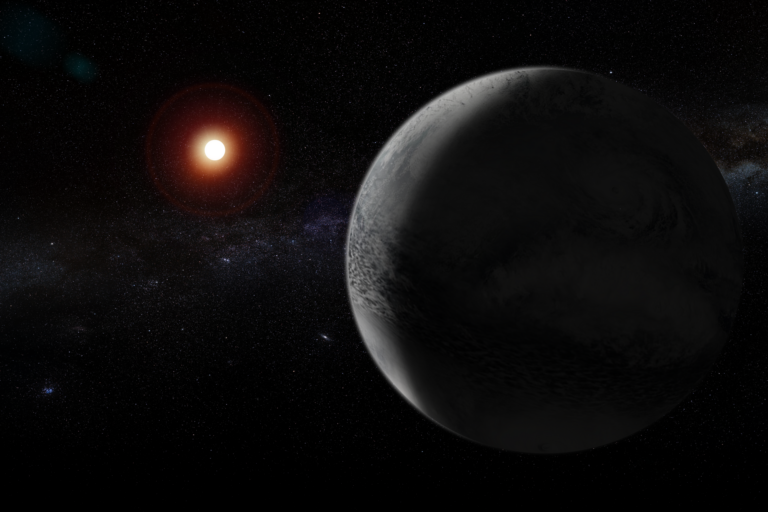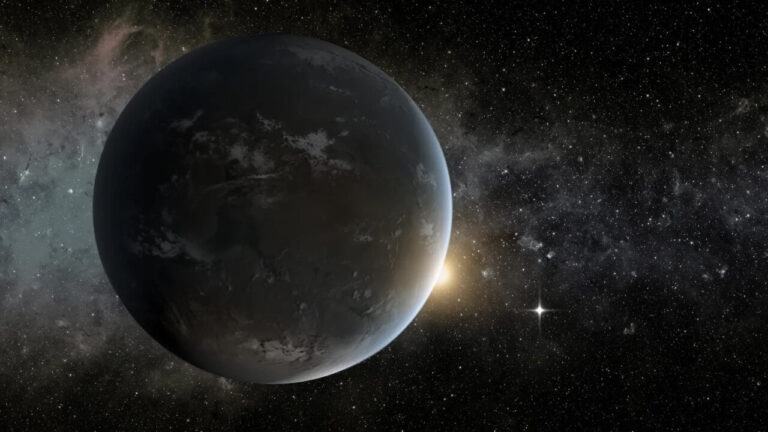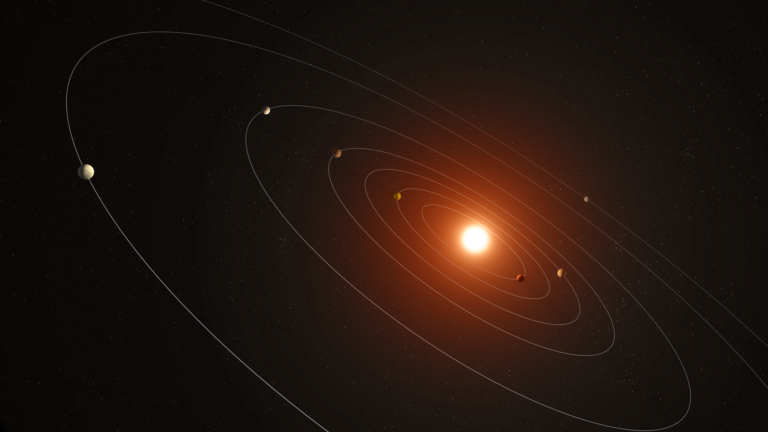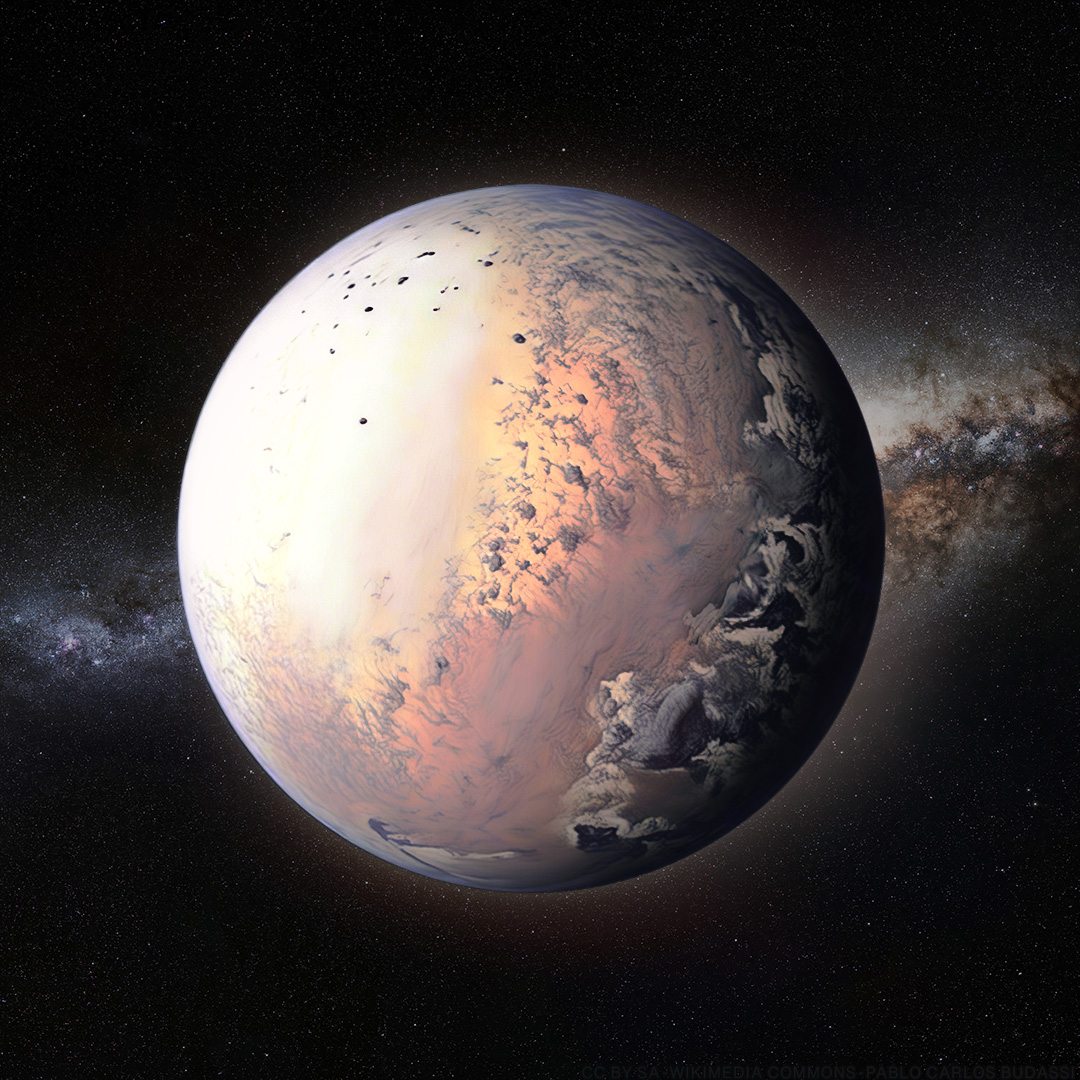
Sixty-six light-years away, an Earth-sized exoplanet completes an orbit in under six hours, skimming around its star at nearly one-hundredth the distance that Mercury orbits the Sun. This planet is on the edge of destruction.
Astronomer Fei Dai of the University of Hawai’i Institute for Astronomy and his team combined data from the Transiting Exoplanet Survey Satellite (TESS) and Keck Planet Finder (KPF) to officially verify the world, called TOI-6255 b, as an exoplanet. The find enables astronomers to observe two rare planetary phenomena: an ultra-short-period planet that’s also nearing the end of its life. The study, published in August 2024 in The Astronomical Journal, is one of the early science results from KPF and also demonstrates the instrument’s research potential.
Tugged by tides
Tidal forces occur when the gravitational pull from an outside source varies across an object due to its size. Just as Earth’s gravity pulls stronger on our feet than at our heads, so too does a star’s gravity pull stronger at the nearside of a planet than the farside. But celestial objects experience these forces on a much larger scale than we do. If a planet wanders too close to its star, the star’s tidal forces will overcome the planet’s structural integrity, ripping it apart entirely. The threshold where this occurs is called the Roche limit.
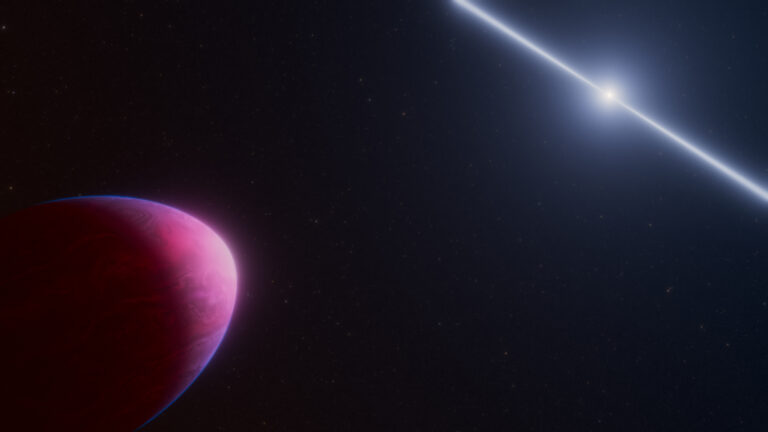
Although TOI-6255 b currently orbits outside its star’s Roche limit, the planet still orbits its star so closely that the star’s tidal forces have stretched it like putty, molding it from a sphere into an egg. And complex interactions between the planet and its star could — and likely will — cause its orbit to decay. The researchers calculate that TOI-6255 b could cross the star’s Roche limit in a few hundred million years — just the blink of an eye on the cosmic scale.
James Fuller, an astrophysicist at Caltech unaffiliated with the discovery, notes that this transition could happen even sooner. When planets orbit close to their stars with very short periods, the gravitational interactions between them can cause the planet to lose orbital energy and spiral closer. The exact mode of this energy dissipation is highly dependent on the star’s structure and how much the star is deformed by the orbiting planet. Fuller points out that Dai and his team are “just kind of choosing a typical value [for that influence in TOI-6255 b’s case]. But that choice could be off by a factor of 1,000. We don’t know necessarily.” Fuller explains that calculating this value from first principles is highly complicated and notes that, given the information Dai’s team has about the star, they made a best-effort guess and chose a reasonable value within a commonly accepted range.
A unique opportunity
No matter how long it takes the planet’s orbit to decay, TOI-6255 b presents a unique opportunity for astronomers. Sam Halverson, a member of Dai’s team and the KPF Instrument Scientist, says that most confirmed exoplanets orbit far from their star’s Roche limit, in no imminent danger of destruction. Although past research has identified evidence of planets destroyed after crossing the Roche limit, TOI-6255 b is one of only a few exoplanets found near this precipice: a “convenient data point,” Halverson says. It presents a perfect opportunity for astronomers to observe exactly how these intense forces play out over the planet’s surface as it orbits ever closer to its star.
TOI-6255 b’s impending demise isn’t its only unique characteristic. It’s also a rare type of planet: an ultra-short-period planet (USP). USPs orbit their stars in less than one Earth day. Earth’s orbit is 365 days long; TOI-6255b’s orbit is only 5.7 Earth hours. Of the more than 5,000 confirmed exoplanets, fewer than 150 USPs have been identified, and Fuller calls TOI-6255 b one of the most extreme examples of a USP discovered to date. Halverson agrees: “It’s really a very interesting laboratory for probing something that we just don’t have in [our] solar system.”
With so few USPs identified, any new discovery will help astronomers understand these planets as a population, as well as individuals. Each USP provides new data about this class of planets, and the more we find, the better astronomers can piece together how they form, why we don’t have any in our solar system, and how rare they really are in the universe.
Combining forces
But before astronomers can really understand USPs, they must first be able to reliably detect and characterize them. TESS observes exoplanets transiting their stars. It looks at dips in the star’s brightness as the planet passes in front of the star, collecting data including the planet’s radius and orbital period. KPF employs the radial velocity method to measure how much a star wobbles due to the gravitational pull of its orbiting planet. Measuring this wobble by studying the star’s slight motion toward and away from us shows how much the planet’s gravity affects the star, revealing the mass of the exoplanet. Dai’s study demonstrates how combining TESS and KPF data enables astronomers to determine the densities of exoplanets (density requires both mass and size to calculate), which can then provide a clue to their composition.
This combined approach allows astronomers to use TESS to target specific planets for KPF observations, resulting in more efficient and cheaper research. “Thankfully, because of missions like TESS that have really told us, ‘Here are your precise planet periods and here’s where to look,’ that makes it easier because we’re not doing blind searches,” Halverson says. And because this combined approach also enables astronomers to collect information needed to start sketching out the composition of the planet, astronomers will be better able to characterize rare exoplanets like USPs than if they were using just KPF or TESS data.
Related: Explore 30 years of exoplanet discoveries
Tidal forces shape our solar system and our world every day. They pull Earth’s oceans into tides, stretch and squeeze Jupiter’s moon Io and drive its volcanism, and possibly even shredded Saturn’s ancient satellites to form its rings. Light-years away, these forces are reshaping a planet. Perhaps, in the last few hundred million years of its existence, TOI-6255 b will teach us about both rare planets and the destructive tidal forces they endure — before its sun tears it apart.