Key Takeaways:
- A new study, utilizing the Very Large Baseline Array (VLBA), determined the distance to the Perseus spiral arm of the Milky Way galaxy to be 6,400 light-years.
- This distance is significantly closer than previous estimations (approximately 14,000 light-years and 7,200 light-years), achieved through parallax measurements of the methanol maser source W3OH with unprecedented accuracy (0.01 milli-arcsecond).
- The VLBA's high resolution allowed for the precise measurement of W3OH's parallax, enabling the three-dimensional mapping of its movement through space, revealing its slower-than-expected orbital speed and inward trajectory toward the galactic center.
- Future research using the VLBA will focus on mapping other galactic regions, refining our understanding of the Milky Way's structure and potentially contributing to the study of dark matter.
Research shows the Milky Way’s Perseus arm lies closer to Earth than previously thought. It is 6,400 light-years away, nearly half as far as previous studies had found. The Perseus arm is the closest arm to the Orion arm, where the Sun resides. An international team of astronomers led by Ye Xu of Nanjing University used the Very Large Baseline Array (VLBA), a global system of 10 radio telescopes, to determine the distance.
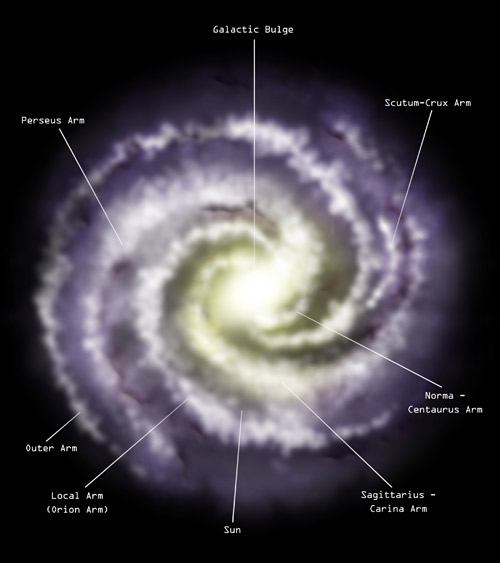
The new measurement has an accuracy of 0.01 milli-arcsecond. This resolution is equivalent to observing a person on the Moon and determining which hand he or she is holding a book in. It is also 100 times more accurate than the best previous distance measurement, gathered by the Hipparcos satellite. Earlier studies based on star motions provided a distance close to 14,000 light-years, while comparisons between stars’ apparent and intrinsic brightnesses yielded a number close to 7,200 light-years.
In addition to resolving this long-standing distance-measurement discrepancy, the five observations made between July 2003 and 2004 enabled the astronomers to plot W3OH’s 3-D movements through space. W3OH has methanol masers, compact, strong radio sources that served as beacons for the observations. The team found W3OH orbits the galaxy slower than the galaxy spins and is falling toward the Milky Way’s center. Over time, this and similar studies will help astronomers map the galaxy’s unseen dark matter.
In the meantime, the team will use the VLBA to map other parts of the galaxy. This data will refine astronomers’ knowledge of the Milky Way’s structure, which is difficult to determine given our location within the galaxy itself.
These results appeared online in Science Express December 8, 2005.