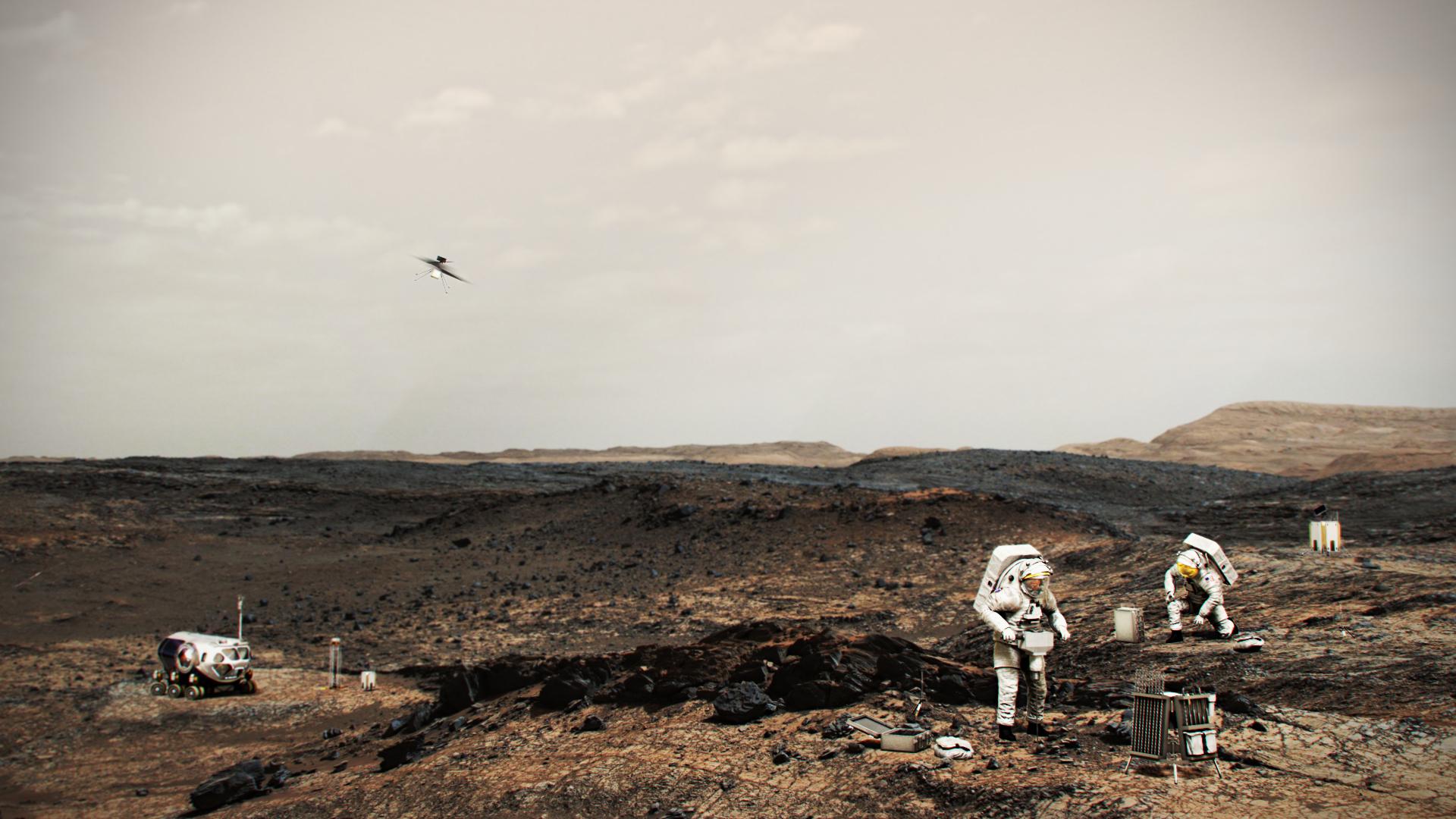
Since Viking 1 landed in 1976, humans have studied Mars from afar, relying on rovers and orbiters to analyze the planet. But with NASA planning a human mission as early as the 2030s, that will soon change. A new National Academies report details what those first astronauts might do once they arrive at the Red Planet. The comprehensive strategy identifies the highest priority science objectives for crewed missions and proposes four distinct campaigns to achieve them.
Commissioned by NASA, the 240-page report was released by the National Academy of Sciences, Engineering, and Medicine on Dec. 9, 2025. It represents nearly two years of work by the Committee for a Science Strategy for the Human Exploration of Mars.
The committee was led by a 15-member steering committee co-chaired by Lindy Elkins-Tanton, professor of planetary science at Arizona State University and principal investigator of NASA’s Pysche mission, and Dava Newman, the Apollo Program Professor of Astronautics at MIT. Supported by more than 50 volunteer experts, the steering committee relied on input from four specialized panels — astrobiology, atmospheric science and space physics, geosciences, and biological and physical sciences and human factors — to identify the most pressing objectives in every field.
“The first human landing on Mars will be the most significant moment for human space exploration since we first set foot on the Moon over 50 years ago,” said Elkins-Tanton in a press release. “Our report puts science at the center of what will be a remarkable achievement, and outlines the incredible knowledge we’ll have the opportunity to glean about our place in the universe.”
Eleven science objectives
The report details eleven science objectives ranked by priority. The committee clarified that this list does not strictly align with the specific mission requirements produced by each panel. Rather, it distills the highest priority scientific inquiries across all disciplines into broader, actionable goals.
While the hunt for evidence of past or present life takes the top spot, the agenda is far-reaching: it calls for investigations into martian geology and climate history, and critical experiments on how the alien environment affects human, plant, and animal biology to support future permanent settlement. The eleven objectives are as follows:
- Look for life: Search for evidence of past or present life, indigenous prebiotic chemistry, or general habitability.
- Water and carbon-dioxide: Analyze the planet’s water and CO2 cycles to understand their evolution over time.
- Martian geology: Map the geologic record to reveal the physical evolution of the Red Planet.
- Human impact: Determine how the martian environment affects the physical, mental, and emotional health of the crew over time.
- Dust storms: Identify what causes the massive dust storms that govern atmospheric activity and how they evolve.
- Locate resources: Look for local resources, especially water and propellants, for use in future permanent habitation.
- Reproductive research: Explore whether the martian environment affects the reproduction or functional genome of plants and animals across generations.
- Microbial research: Ensure microbial population dynamics are stable and not detrimental to astronaut health.
- Effects of martian dust: Explore how abrasive martian dust impacts both the human body and the mission hardware.
- Ecosystem dynamics: Monitor how plants, animals, and microbes interact and develop within an ecosystem on Mars.
- Radiation: Sample radiation in crew habitat and at various sampling sites to refine risk estimates for future missions.
Four campaign options
To achieve these objectives, the committee designed four distinct campaigns for the first human missions to Mars, each comprised of three landings (with each landing’s scope denoted by the campaign’s parenthetical title). Each campaign prioritizes a different set of the objectives with the report detailing which objectives would be met, what crew members would do, and the overall pros and cons. Notably the report focuses on what science each campaign would tackle and not necessarily how the science would be achieved.
The top-ranked option, called Mars Science Across an Expanded Exploration Zone (30-Cargo-300), concentrates its effort within a single exploration zone approximately 62 miles (100 kilometers) in radius. Ideally situated near glacier water ice and rich geological features, this campaign is designed for long-duration, long-range study. It begins with a short 30-sol (one sol is one martian day, roughly 40 minutes longer than an Earth day) human mission to scout and set up infrastructure, followed by a massive uncrewed cargo delivery, and culminates in a 300-sol stay for the crew. This comprehensive approach is the only campaign designed to fully address all eleven science objectives. While this establishes substantial infrastructure like laboratories and drilling rigs for deep research, the singular focus is a gamble. Relying on one location offers a limited view, and if the site proves scientifically poor, the campaign could fail to meet its objectives.
The second option, known as Synergy of Mars Science Measurements (30-Cargo-300), uses the same three-day mission structure but is designed to capture scientific measurements that could be recorded at a variety of landing sites, making it less site-specific. This campaign explicitly prioritizes measurements required by objectives 1, 2, 3, and 5. It paints with broad strokes to cover as much scientific ground as possible, gathering measurements common to several different disciplines at once, but sacrificing some specialty measurements in the process. The main advantage is its flexibility; however, this approach may miss out on specialized, high-impact discoveries — such as deep subsurface life — that require more specific, hard-to-reach locations and measurements.
The third option, Seeking Life Beneath the Martian Icy Crust (30-Cargo-300), is a dedicated hunt for biology that prioritizes the number one objective above all else: getting samples from liquid water deep in the martian cryosphere (the permanently frozen outer layer of the martian crust). Targeting sites where deep drilling (1.2 to 3.1 miles [2 to 5 km]) is possible, the primary focus is collecting cores to return to Earth. Consequently, the mission design is almost entirely focused on achieving the first objective of looking for life. While this offers the best chance of finding life, the strict requirement for deep water severely limits site selection and reduces the science return for other fields like physical sciences and human factors. Furthermore, relying so heavily on unproven drilling technology creates a higher risk of mission failure if the equipment malfunctions.
Finally, the Investigating Mars at Three Sites (30-30-30) campaign proposes a variety pack approach with three separate 30-sol missions to widely different environments, such as ancient igneous rocks, sedimentary deposits, and polar glaciers. This broad-but-shallow strategy samples the planet’s global diversity, satisfying a large number of objectives (focusing primarily on objectives 1,3 and 5) while lowering the risk for astronauts through shorter surface stays. The rapid turnaround time of three distinct landings could also generate high levels of public excitement. However, the trade-off is depth: the short timeframe limits the ability to drill deep or perform complex science. There is also limited reaction time, meaning astronauts might collect a sample containing a major discovery but not realize it until they have already returned to Earth.
From the Moon to Mars
Since the conclusion of the Apollo program, NASA has spent more than 50 years analyzing different architectures to return humans to deep space. Unlike previous approaches that often shifted based on available technologies, the agency has now adopted an objectives-based strategy. NASA’s Moon to Mars Architecture establishes clear goals before prescribing the how of specific vehicles or hardware. This architecture is built around ten core objective areas, including lunar/planetary science, human and biological science, and lunar/martian infrastructure.
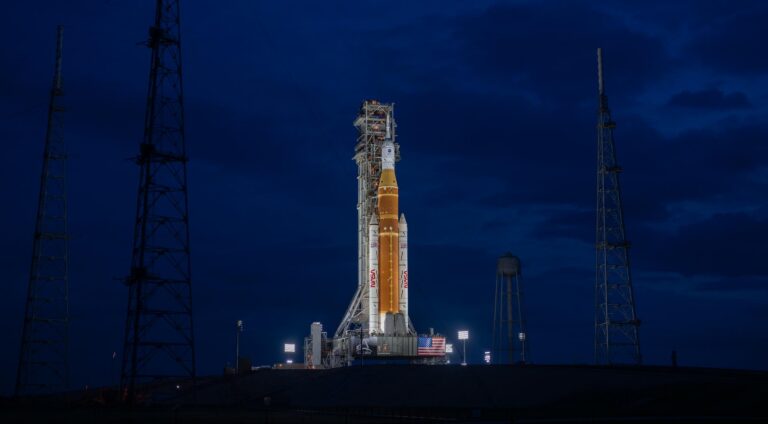
The National Academies report is designed to plug directly into this framework. By mapping its eleven priorities to NASA’s established objectives, the committee ensures that the science done on Mars builds logically on the systems tested during the Artemis missions. The report emphasizes that the Moon is the proving ground for Mars. Technologies crucial for the Mars campaigns — such as sealed ecosystem habitats, radiation shielding, and dust mitigation tools — will first be vetted on the lunar surface.
A transformative moment
As humanity prepares to return to the Moon with the upcoming Artemis missions and extend its reach into deep space, the science objectives and campaigns outlined in this report offer the first tangible glimpse of the research that will define the coming decades on the martian surface.
“This is a thrilling moment for us as scientists,” said Andrew Read, senior vice president for research at Penn State, in a press release. “We are setting the guideposts that will transform our knowledge of Mars and, on a deeper level, our place in the cosmos.”