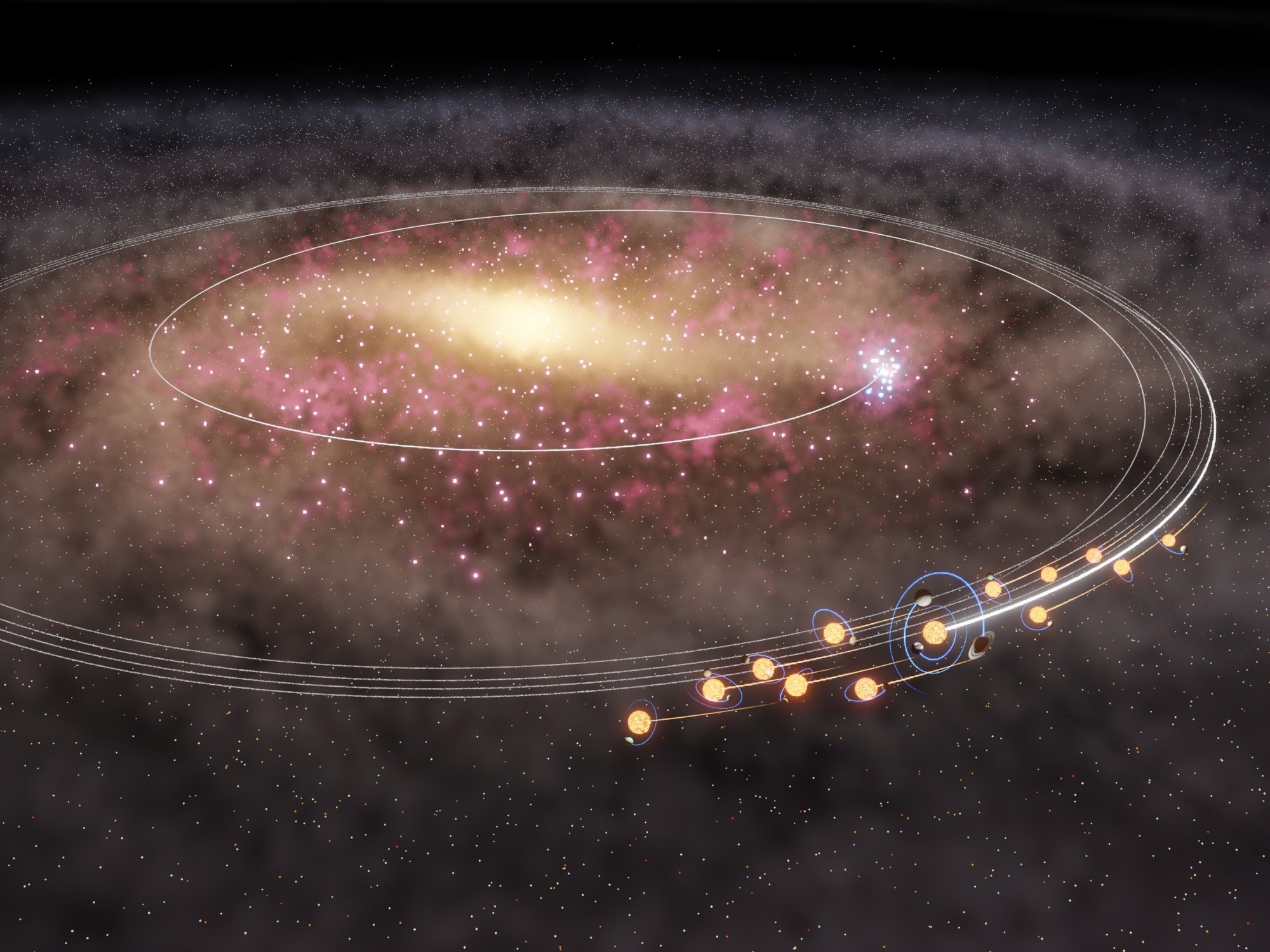
Over 4 billion years ago, as planets were coalescing around the newborn Sun, our star may have gone on an epic road trip across the Milky Way along with thousands of stellar “twins.” And we may owe our lives to that cosmic voyage, as it brought our solar system from an inhospitable region to a milder galactic environment where life on Earth could flourish.
Scientists already suspected that our Sun originated some 10,000 light-years closer to the center of the galaxy than where it sits today, based on its composition. Our star is enriched with heavy elements like iron, silicon, and magnesium that are rare around our current location but more common in the inner Milky Way, where previous generations of stars have sprayed metals into space, making them available to become new stars.
A new study published today in two parts in Astronomy & Astrophysics exploring this journey from the center of the galaxy found that the Sun didn’t travel alone — it was part of a mass migration with thousands of stellar lookalikes during a period of galactic upheaval.
Stars on the move
Researchers combed through data from the European Space Agency’s Gaia spacecraft to compile a catalog of 6,594 stars in our general neighborhood (around 27,000 light-years from the middle of the Milky Way) with Sun-like compositions, temperatures, and surface gravity (which is related to mass and size). They calculated these so-called solar twins’ ages and noticed two main groups.
First, there’s a collection of younger stars born about 2 billion years ago. That suggests there was a recent burst of star formation in our region of the galaxy, which supports previous research.
The team then focused on a second batch of 1,551 stars that are between about 4 billion and 6 billion years old — a group that includes our Sun. Finding so many stars about the same age and distance from the galactic center hints at a shared history.
“We found evidence suggesting that many solar twins of the same age migrated near the same time, providing clues about the timing and possible mechanism,” says Daisuke Taniguchi, an assistant professor at Tokyo Metropolitan University, who led the development of the solar twin catalog.
Rather than drifting individually over billions of years, the Sun and its stellar siblings appear to have migrated away from the galaxy’s core together.
That’s intriguing because scientists thought stars born deep within the Milky Way shouldn’t be able to travel out to our part of the galaxy. There’s a sort of cosmic moat in the way — a gravitational boundary that should be very difficult to cross.
The researchers suspect that this barrier must not have been fully established yet when the Sun was young. Instead, a major structural change in the galaxy may have helped propel stars outward.
Related: How Gaia revealed the Milky Way
Space bar
The Milky Way is what astronomers call a barred spiral galaxy. Its sparkling spiral arms wrap around a central nucleus that is elongated into a 16,000-light-year-long rotating bar-shaped structure of stars. But that feature hasn’t always been there.
“If the galactic bar formed roughly 6 [billion]–7 billion years ago, the dynamical processes associated with its formation could have both enhanced the star-formation rate in the inner region of the Milky Way and also have triggered a large-scale radial [outward] migration of stars,” Taniguchi says. In other words, the bar’s birth may have created a gravitational shake-up that sent stars sailing across space. “In this scenario, the Sun and solar twins formed in the inner part of the galaxy around 4 [billion]–6 billion years ago and soon migrated towards outer regions during this dynamically active period.”
If this interpretation is correct, it could give astronomers the best estimate yet of the timing of the bar’s formation.
The journey may also have had major consequences for life on Earth. It took our young solar system out of a galactic environment that encouraged the formation of planets but was likely lethal to them. “The inner regions of the Milky Way are thought to be more hostile environments for life,” Taniguchi says. “High-energy events such as supernova explosions occur more frequently there.” That could bathe planets in enough radiation to disrupt atmospheres and even sterilize entire worlds.
Related: An exploding star close to Earth would make for a very bad day
Although volatile, the inner galaxy is richer in planet-building materials. From the iron in Earth’s core and silicon in its mantle and crust to the oxygen in our atmosphere and the carbon that forms the basis of all Earth life, the raw ingredients we take for granted are relatively scarce out here in the Milky Way’s disk.
So the Sun’s journey across the galaxy might have delivered the best of both worlds: a birthplace rich in planet-building ingredients and a long-term home in a quieter galactic suburb.
“If, as our study suggests, the Sun migrated outward relatively soon after its birth, the solar system may have moved from this more hazardous inner region to the quieter outer disk of the galaxy early in its life,” Taniguchi says. “This would have allowed the solar system to spend most of its lifetime in a comparatively stable environment.”
That stability was crucial; it took billions of years for life on Earth to emerge and evolve to the rich diversity we see today. If it weren’t for the Sun’s early migration across the Milky Way, we might not exist now.