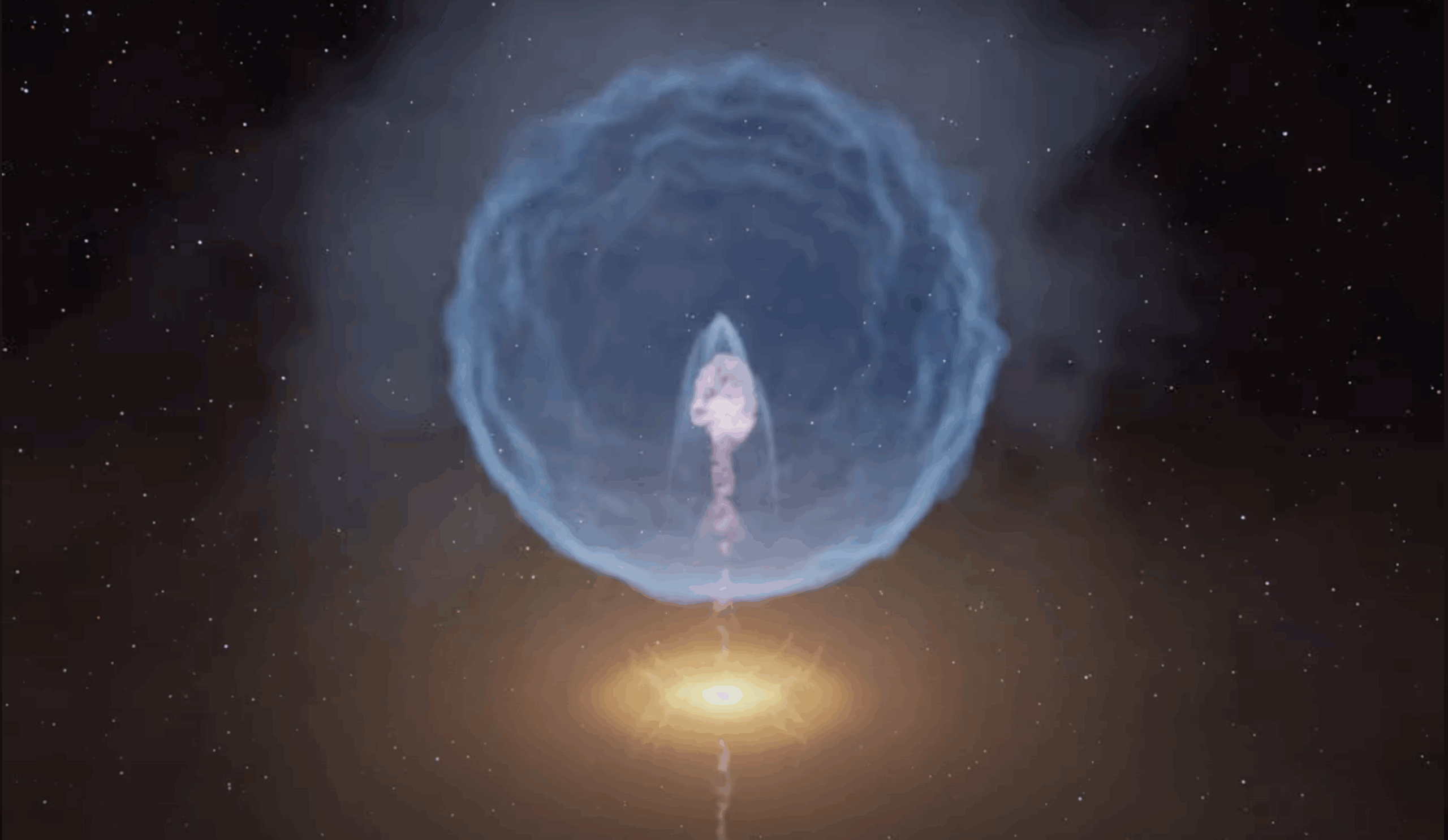
By reanalyzing archival data from the Atacama Large Millimeter/submillimeter Array (ALMA), scientists have discovered a giant, expanding bubble that is pushing against and distorting the protoplanetary disk surrounding a young star, WSB 52. You can see an animation of this event here:
Stars and their planets form when large molecular clouds collapse in on themselves. Gravity pulls the dust and gas into a violent spiral, which flattens out into a structure known as a protoplanetary disk. Over hundreds of thousands of years, the disk heats up and becomes denser, with a young star forming at its center while planets take shape from the accreted matter. Not all of this material turns into planets and stars, though. Some of the matter is expelled from the center in large jets that shoot out from the young star’s poles, returning energy to the star-forming environment around the disk.
RELATED: How stars are born and die
Masataka Aizawa of Ibaraki University and his team were looking over archival ALMA data when they found an expanding bubble structure near the protoplanetary disk of WSB 52, a young star located about 441 light-years away in the direction of the constellation Ophiuchus. The scientists hypothesize that the bubble was formed when a jet expelled from WSB 52 met with cold gas in the disk, compressed, and exploded.
Similar bubble structures have been found in other protoplanetary disks, but this one is unique. It is the first time scientists have witnessed a direct collision between such a bubble and the protoplanetary disk that spawned it.
Detailed analysis revealed a shock front from the expanding bubble that is not only distorting the disk but is also actively blowing away fragments of its gas. This type of direct feedback from a star’s jet back onto its disk, which the team calls “jet–bubble–disk interaction,” was not predicted by existing theories of planet formation.
The discovery suggests that stellar jets play a far more immediate and interactive role than previously known. They don’t just carry excess material away; they can create explosive events that directly affect the planet-forming environment.
This has potentially profound implications for our understanding of how planets form. If such explosions are a universal feature of young stars, it means that protoplanetary disks — and the fledgling planets within them — are subjected to a much harsher and more chaotic environment than models have accounted for.
RELATED: Planets 101: What they are and how they form
“Through this discovery, I once again realized that nature is far more complex than humans think,” stated Aizawa. This newfound complexity could help explain certain features of planetary systems, including our own. Future research will focus on how frequently these explosions occur and what their long-term effects are on the formation of diverse planetary systems.
The research, led by Masataka Aizawa of Ibaraki University in Japan, was published in The Astrophysical Journal on Aug. 4, 2025.