2026 is lining up to be a great year for skywatchers. Our comprehensive guide, curated by Astronomy‘s observing experts, lists everything you need to know to catch eclipses, meteor showers, planetary conjunctions, comets, and more in the sky this year. Scroll down to the bottom of this page to download this year’s Sky Guide for free!
Observing highlights
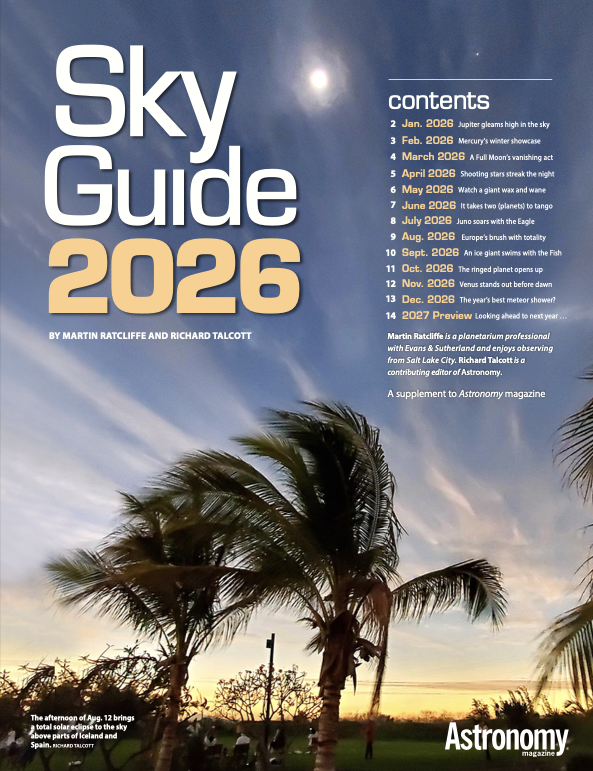
2026 brings us both solar and lunar eclipses. The big show is a total solar eclipse on Aug. 12, as the Moon’s umbral shadow cuts a narrow path across Greenland, Iceland, and Spain. At maximum off Iceland’s west coast, totality lasts 2 minutes 18 seconds.
The morning of March 3 offers a total lunar eclipse to those across most of North America, though the Moon sets during totality in the east. Luna will lie completely in Earth’s umbral shadow for 59 minutes. A second, nearly total, lunar eclipse graces our sky the night of Aug. 27/28.
For those who prefer viewing planets, 2026 promises to be a stellar year. Venus reappears in the evening sky during February on its way toward greatest elongation in mid-August. Don’t miss its conjunction with Jupiter on June 9. After it disappears for a few weeks in October, the inner planet returns to view before dawn in November and December. Although Mars remains inconspicuous for much of the year, it brightens to magnitude –0.1 by late December among the background stars of Leo the Lion.
Both gas giant planets look great in 2026. Jupiter reaches opposition Jan. 10, when it shines brightest and rides high in the south against the backdrop of Gemini the Twins. Saturn comes to opposition in the non-zodiacal constellation Cetus the Whale Oct. 4. The good news for Saturn watchers is that the planet’s rings then tilt a healthy 7.5° to our line of sight.
Meteor observers also have a lot to look forward to in 2026. After a down year in 2025, the Perseids peak with perfect conditions at New Moon. And the equally fine Geminid shower reaches its maximum under a thin crescent Moon that sets by 10 p.m. local time.