
Key Takeaways:
- A research team proposes utilizing numerical relativity, a computational technique for solving Einstein's equations in high-gravity environments, to investigate the universe's origin.
- The approach addresses limitations of current cosmological models, which rely on simplifying assumptions of homogeneity and isotropy that break down at the singularity (infinite density and temperature) at the Big Bang.
- Numerical relativity's success in predicting and subsequently confirming the gravitational wave signals from black hole mergers demonstrates its capability to handle complex space-time scenarios.
- The researchers suggest that this method can potentially allow for the testing of hypotheses about the universe's origin, moving the study of cosmic origins from theoretical speculation to computer-based simulation.
A team of scientists claims a computational tool for studying black hole collisions could be our best bet for answering mysterious questions about the universe’s origins. In a new paper in Living Reviews in Relativity, they argue for applying a technique called numerical relativity to peer into the moment before the Big Bang.
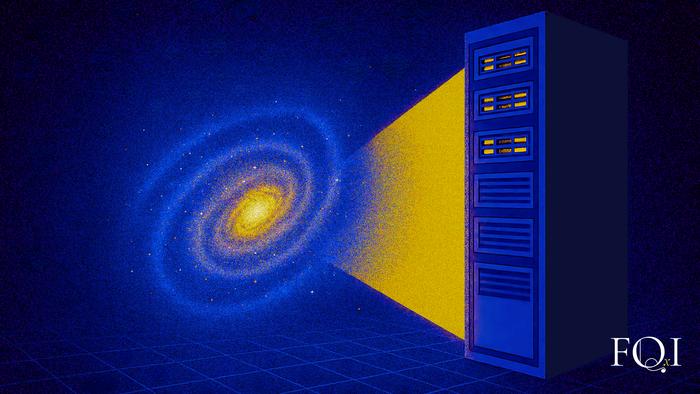
At its heart, numerical relativity is “the art and science of developing computer algorithms to solve Einstein’s equations,” as defined in the textbook Numerical Relativity. It brings Einstein’s theory of general relativity to life inside a supercomputer when gravity becomes too strong for equations to be solved by normal methods. The paper is authored by Eugene Lim, cosmologist at King’s College London, Katy Clough, astrophysicist at Queen Mary University of London, and Josu Aurrekoetxea, astrophysicist at Oxford University.
Their proposal aims to solve a fundamental problem for cosmology. For decades, our cosmological model has relied on a crucial simplification: that the cosmos is homogenous (smooth) and isotropic (the same in every direction). While this has been incredibly successful, it hits a wall at the universe’s origin because of the singularity. This is a theoretical point of no return where, as the August 20 press release describes, there is “a state of infinite density and temperature–where the laws of physics collapse.” The simplified model that works so well today is useless in the face of such a chaotic beginning.
Because of these limitations, a more powerful tool is needed, and numerical relativity has already proven its value. Computer simulations using numerical relativity predicted that the merger of two black holes would be possible according to Einstein’s theory and would release a powerful burst of gravitational waves. Then, in 2015, the LIGO observatory detected the signal from such a merger for the first time, confirming both Einstein’s century-old theory and the remarkable utility of numerical relativity.
This success makes researchers confident that numerical relativity can tackle these new cosmic mysteries. Traditional methods require simplifying the universe to make the math manageable, but numerical relativity is built to handle the full, messy reality of Einstein’s theory. Cosmologist Eugene Lim likens it to searching in the dark: “You can search around the lamppost, but you can’t go far beyond the lamppost, where it’s dark — you just can’t solve those equations. Numerical relativity allows you to explore regions away from the lamppost.”
The team’s confidence stems from the method’s past triumphs. They believe its success in simulating black hole mergers proves the method can handle the most complex regions of space-time. It is this success that fuels their proposal to point this powerful lens at the ultimate unknown: the beginning of time itself. In their view, questions once relegated to the realm of speculation are finally becoming testable hypotheses, moving our cosmic origins from theory into the laboratory of a supercomputer.