
Key Takeaways:
- Player One Astronomy, established in June 2020, specializes in advanced astronomical cameras and supporting equipment, dedicating 40% of its staff to research and development to produce state-of-the-art products.
- The company's monochrome cameras frequently incorporate industrial-grade sensors designed for durability, high sensitivity, and low noise, complemented by user-centric design innovations such as externally accessible component adjustments.
- Product lines are engineered for specific astroimaging applications, including the Apollo series, which is noted as the world's first consumer camera line specifically designed for solar imaging with robust cooling capabilities.
- Cameras feature efficient active cooling, ASCOM standard compliance for broad software integration, and integrated dead pixel suppression (DPS) for guide cameras, supported by responsive after-sales service.
One day, while I was looking at the credits for an attractive image on AstroBin, I noticed the camera listed was “Player One.” I wondered who that company was. As time went by, I saw similar credits for other images. Something was going on and I wanted to find out what.
Asking around, I discovered that Player One Astronomy was a relatively new company that was producing some excellent equipment. And people were switching to it from other brands.
Come Christmas 2023, I saw a Christmas special ad on the company’s website, offering their top-of-the-line Zeus mono camera plus a filter wheel and off-axis guider for an extremely reasonable price. Out of curiosity and to take a bold step into the unknown, I ordered one. Two weeks later it arrived via international air freight from China, at their expense.
All the items were attractively packaged, and even as I opened the boxes it was pretty obvious the equipment was also well made. I really appreciated little things like the company including both a 48mm and 54mm opening for the off-axis guider.
Now I wanted to know more about this company.

Design innovation
Player One Astronomy, founded in June 2020 in Suzhou, China, specializes in astronomical cameras and supporting products. A full 40 percent of its staff devotes their time exclusively to research and development, and as a result, their products are state of the art.
Player One Astronomy produces a wide range of products, from modestly priced beginner cameras all the way up to advanced full-frame models. Notably, whenever possible they outfit their monochrome cameras with industrial-grade sensors featuring higher quality base layers, or substrates, upon which the light-sensing components rest. Such sensors are more durable and highly sensitive while exhibiting low noise, making it easy to obtain excellent image quality.
Across their lineup, the company’s engineers have incorporated subtle design touches that make their products much easier — and a real pleasure — to use. For example, all the components fasten to each other from the outside. This means a filter wheel loaded with filters does not need to be disassembled to be installed or removed. Likewise, adjusting the camera’s tilt to align the sensor with the telescope’s focal plane is easily done from the outside.
Player One Astronomy has named all its cameras after solar system bodies or associated deities — Zeus, Neptune, Apollo, Uranus, Poseidon, and Artemis, to name a few. The company is named after the idea that we should all be “Player Ones,” doing the best that we can and producing excellent results.
The Player One Astronomy color and mono cameras cover all aspects of astroimaging. There are cameras made specifically for planetary, solar, deep space, and guiding. The guide cameras deserve special mention because the hot pixels in each camera are mapped and then automatically removed when in use through a process called dead pixel suppression (DPS). Each bad pixel is given a median value to the surrounding pixels. This allows guiding and calibrating on much dimmer stars than normal because there’s no competition from hot pixels.

PRODUCT INFORMATION
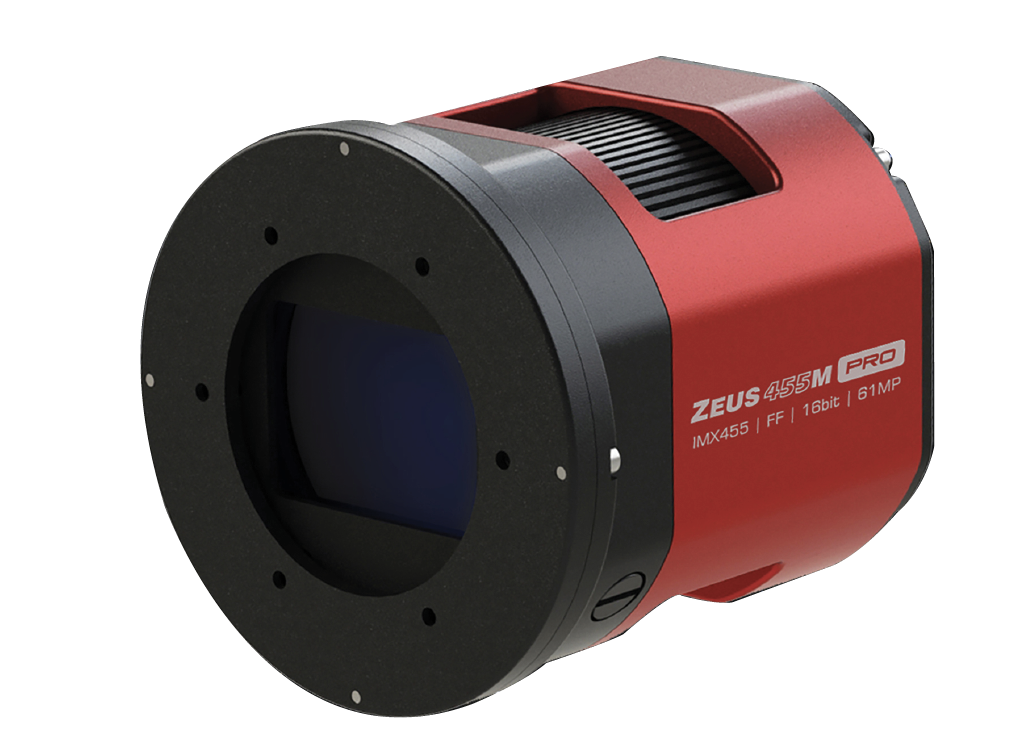
Player One Astronomy Zeus 455M Pro
Type: Monochrome camera
Sensor: SONY IMX455AQK-K full-frame CMOS (mono)
Chip size: 36mm by 24mm
Pixels: 9576 by 6388 (61 megapixels)
Exposure range: 32 microseconds to 2,000 seconds
Data port: Type-C USB 3.0/USB 2.0
Diameter: 3.54 inches (90 millimeters)
Weight: 22.9 ounces (650 grams)
Price: $3,699
Contact: Player One Astronomy
Room 522, Building 1, Maslong Building
168 Yuxin Road, Suzhou Industrial Park
Suzhou, China
https://player-one-astronomy.com
About the cameras
The Zeus — like many of Player One’s cameras — has efficient active cooling controlled by the imaging software. Greater efficiency means better cooling using less energy. For example, with the ambient air temperature at 44 degrees Fahrenheit (7 degrees Celsius) and the camera set to –20 F (–29 C), the camera only used 30 percent power to maintain that setting.
And here’s something of special note: The Apollo series, the company says, is the world’s first consumer camera line specifically engineered for solar imaging. Its passive and active cooling systems allow it to withstand extreme heat, enabling constant solar capture under the most demanding conditions.
The cameras and filter wheels all comply with the Astronomy Common Object Model (ASCOM) standard. This means that after an easy driver installation, the cameras can be controlled by just about any imaging software. The cameras need 12 volts DC at 3 amps for power, the filter wheels plug into the camera, and the fans use magnetic levitation to spin and have zero vibration.
World-famous planetary imager Damian Peach has been using Player One Astronomy cameras for more than three years. His favorites are the Saturn M-SQR for doing mono work, and the Uranus-C for one-shot color work. Both cameras have good sensitivity across a broad spectrum and low noise, and his results show all this advanced technology at work. In my experience, the stability, efficiency of cooling, rapid downloads (mere seconds), sensitivity, and low noise make these cameras a joy to work with.
Player One Astronomy has also placed great emphasis on their after sales service. I have had a few questions that I sent to them via email. Replies always came by the next day and sometimes within an hour. Their demeanor has been polite, friendly, and helpful.
Stellarvue Telescopes has recently become a dealer for Player One Astronomy, so you can buy the equipment through them. (At the time of this writing, tariffs are preventing Stellarvue from importing these cameras, so check with them before ordering.)
Anyone can become a “Player One.” All you need is the right camera and the ambition to be the best.