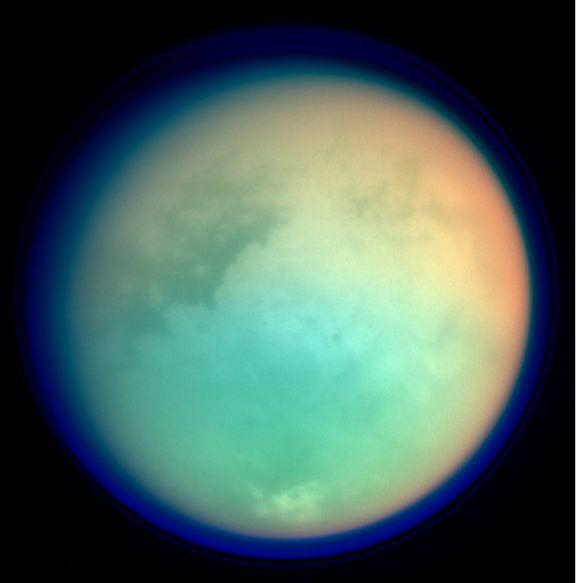
On Oct. 26, 2004, the Cassini spacecraft made its first close pass by Saturn’s planet-size moon, Titan (later known as Titan Flyby A). After a seven-year journey — the last four months of which were spent in orbit around Saturn — Cassini plunged within 745 miles (1,200 kilometers) of the world’s surface. It snapped hundreds of photographs, made its first radar observations, and even scooped up traces of the moon’s outer atmosphere.
The first close-up images showed a surface with lots of contrast and a complex interplay between the bright and dark expanses, and numerous bright streaks running parallel Titan’s to equator. The surface appeared young, as there was no immediate evidence of impact craters, even though Saturn’s other moons bear innumerable impact scars. In addition to imaging, instruments on Cassini collected scatterometry, radiometry, and magnometer and spectrometer results. Those traces of Titan’s atmosphere were also analyzed, in preparation for the Huygens probe to conduct a full study when it landed on the moon in January of the following year.