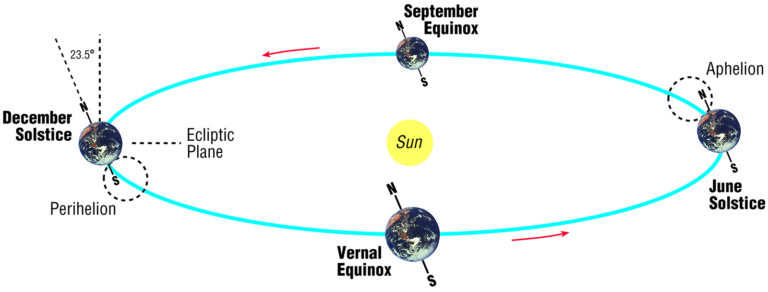
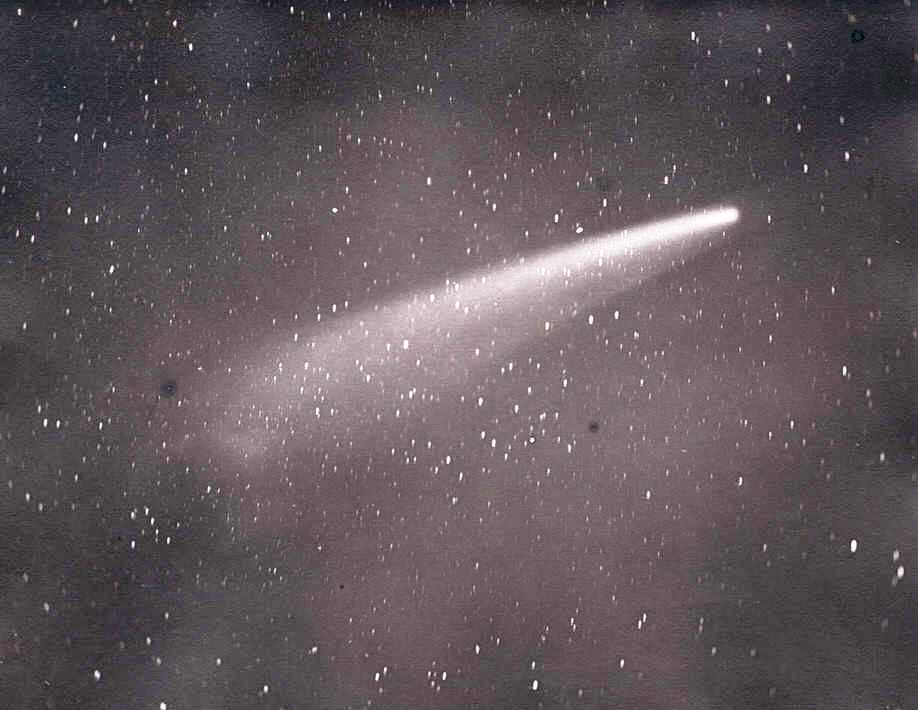
In early September 1882, a comet was sighted from the Cape of Good Hope in South Africa. The comet brightened over the following weeks, reaching a magnitude of -2 on the 15th; at perihelion two days later, it was bright enough to be visible during the day. But at the time, David Gill, the director of the Cape Observatory, was busy observing minor planets Victoria and Sappho. It wasn’t until Oct. 12 that, his minor planet observations completed, he turned his attention to the comet and began photographing it.
Gill captured images of the Great Comet of 1882 on Oct. 12, 20, and 21, and Nov. 7, 13, and 14. The Nov. 7 shot was the one he would become famous for, though: It was not the first photograph of a comet, but rather would signal a change in astronomers’ uses of astrophotography. The photo was a 100-minute exposure, resulting an image that included stars to 10th magnitude and the comet’s 18-degree tail. Spurred by the large number of stars captured in his photo, Gill saw the potential for using astrophotography for star mapping and began the Cape Photographic Durchmusterung. (Durchmusterung means “close examination” or “scrutiny.”) The project would catalog nearly a half-million southern stars. Gill shared the successes of the program internationally, prompting the assembly of the world’s first major astronomical conference. As a result, astronomers worldwide began to move away from traditional, manual star mapping and towards more efficient and comprehensive photographic techniques.