The U.S. satellite program was evolving in the early 1950s, first beginning at as joint Army-Navy venture called Project Orbiter, then becoming a wholly Navy civilian effort with Project Vanguard. But when the successful launch of Sputnik in October 1957 was followed by the explosion of the Vanguard rocket on the launchpad in December of that year, it became clear that the U.S. was seriously lagging behind the Soviets in the space race. The Army’s satellite program was revived.
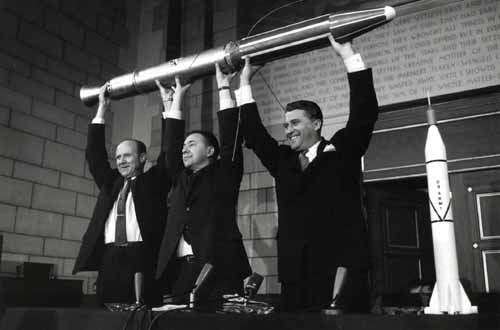
The Army Ballistic Missile Agency, led by Wernher von Braun, and the Jet Propulsion Laboratory, led by William Pickering, collaborated to build a satellite and rocket. In only 84 days, they’d produced the 30-pound Explorer 1, which was outfitted with a cosmic ray detector designed by James Van Allen.
Explorer 1 launched Jan. 31, 1958, marking the first major launch of the American Space Age. The scientific instrument on board was overwhelmed by readings much higher than expected, leading to the discovery of the Van Allen radiation belts. Explorer 1 continued transmitting data for almost four months, and even after its batteries died on May 23, 1958, stayed in orbit around Earth for another 12 years. On March 31, 1970, Explorer 1 burned up on reentry of Earth’s atmosphere.