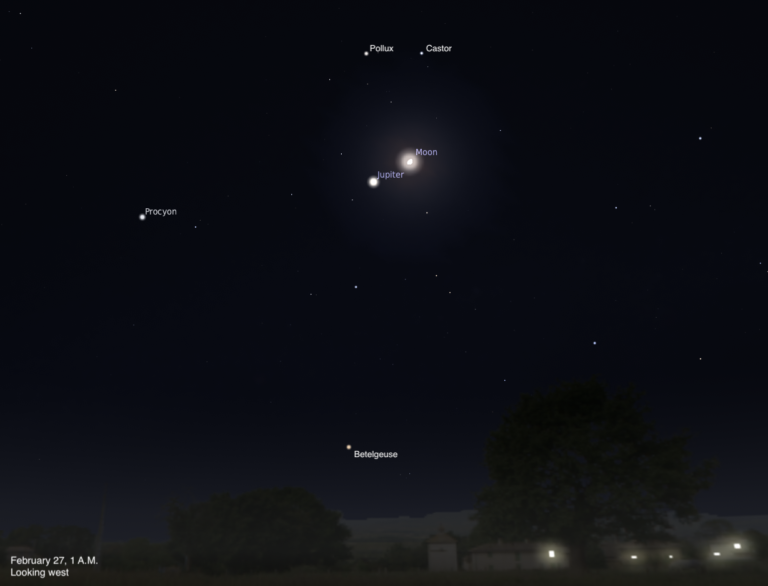
Early March finds us in a dramatic lull as far as viewing naked-eye planets goes, with four of them being uncomfortably close to the Sun for observation. Fortunately, that fate doesn’t apply to Jupiter. The giant planet remains prominent in the northern sky all evening, shining at magnitude –2.4 among the stars of central Gemini. Jupiter’s motion relative to the Twins’ backdrop is nearly imperceptible this month, as the planet reaches its stationary point March 11.
At a declination of 23°, Jupiter lies about as far north as it can get, which places it relatively low in the sky for Southern Hemisphere observers. It’s still worth taking a look through your telescope, however, particularly when the planet stands highest in the north in early evening. Jupiter’s 41″-diameter disk should show a wealth of atmospheric detail during moments of good seeing. And it’s always fun tracking the movements of the four bright Galilean satellites from night to night.
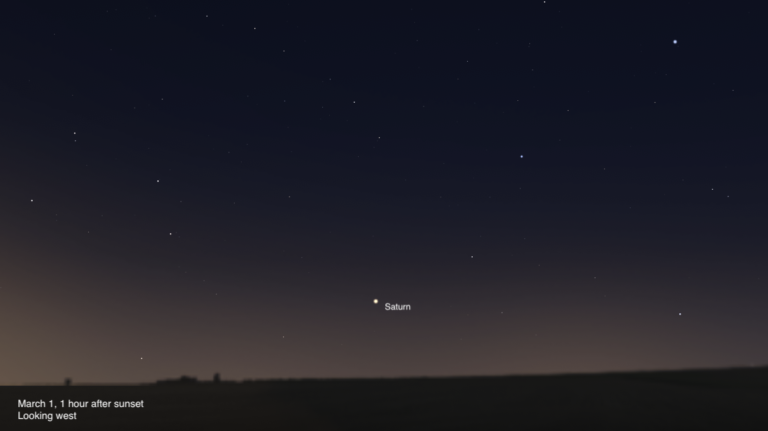
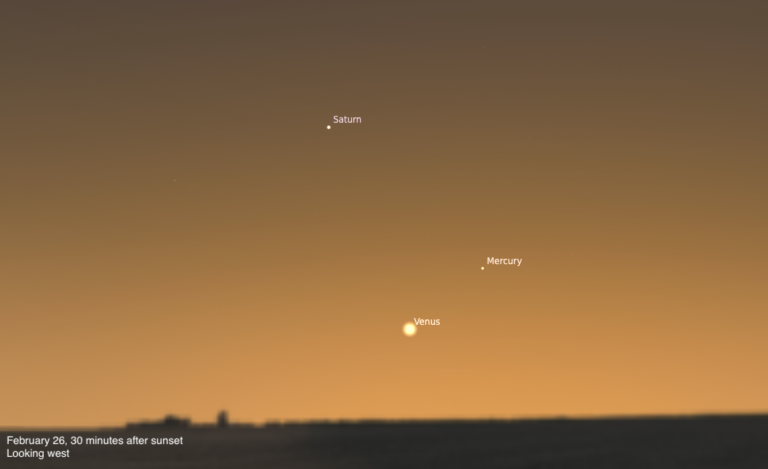
Before looking at Jupiter, see whether you can catch a final evening glimpse of Saturn. Although the ringed world is heading toward solar conjunction March 25, you might still spot the magnitude 1.0 object low in the west after civil twilight ends early in the month. Your odds improve if you live closer to the equator. But don’t bother pointing your telescope at Saturn. Your next decent view won’t come until it climbs higher in the morning sky later this autumn.
Mercury reaches inferior conjunction March 7, but then sweeps rapidly into view before dawn. Although the innermost planet won’t reach greatest elongation until early April, the views during the final week of March should be spectacular.
On the 24th, Mercury glows at magnitude 0.8 and stands 10° high in the east an hour before sunrise. A telescope shows the planet’s 9″-diameter disk, which appears 30 percent lit. By the 31st, Mercury shines at magnitude 0.4 and has gained 4° of altitude. Its disk then measures 8″ across and is 44 percent illuminated.
Look for Mars some 10° below Mercury at the end of the month. The Red Planet shines at magnitude 1.2 and will be harder to see than its companion. Don’t bother with your telescope — Mars’ 4″-diameter disk will show no detail.
The end of March is also the time to look for Venus. The inner world enters the evening sky late this month but stands only 5° high in the west 30 minutes after sunset. Shining brilliantly at magnitude –3.9, it should just be visible if you have an unobstructed horizon. As with Mars, a telescope adds nothing to the view.
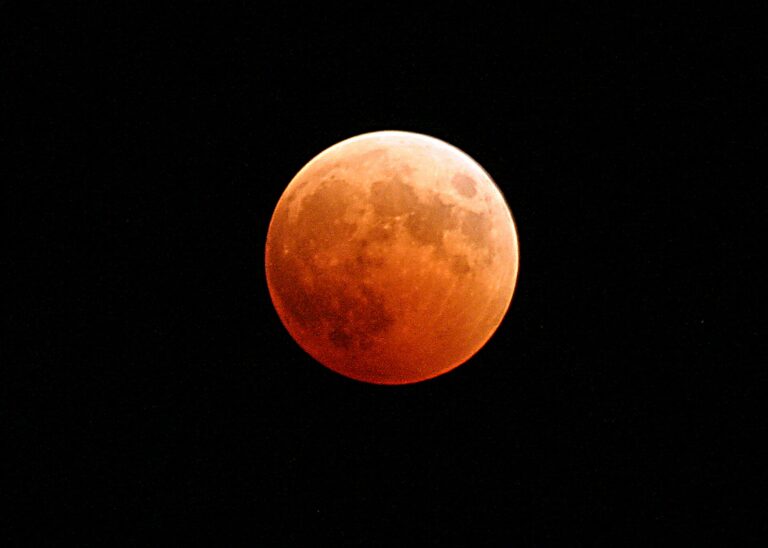
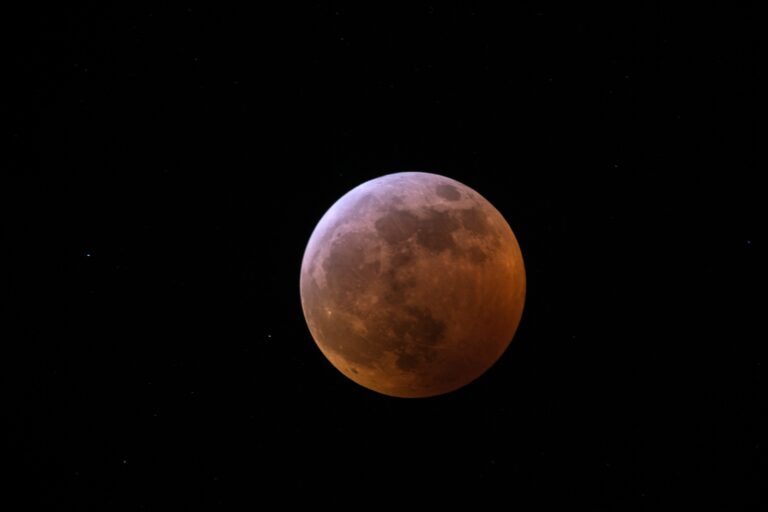
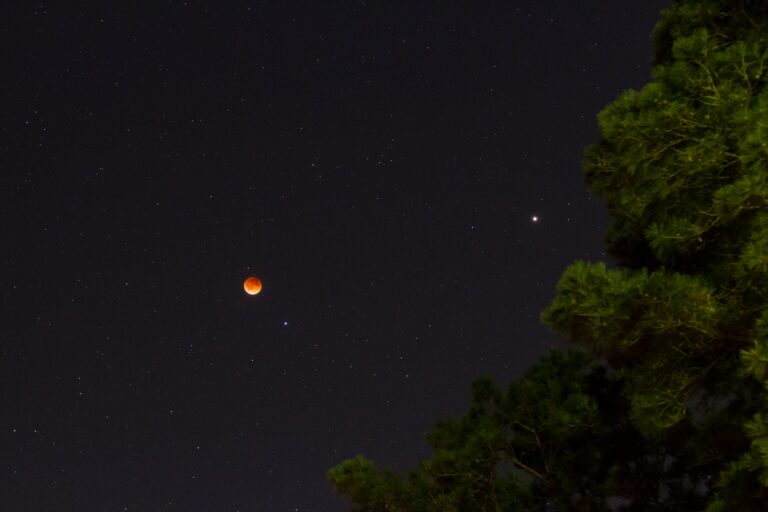
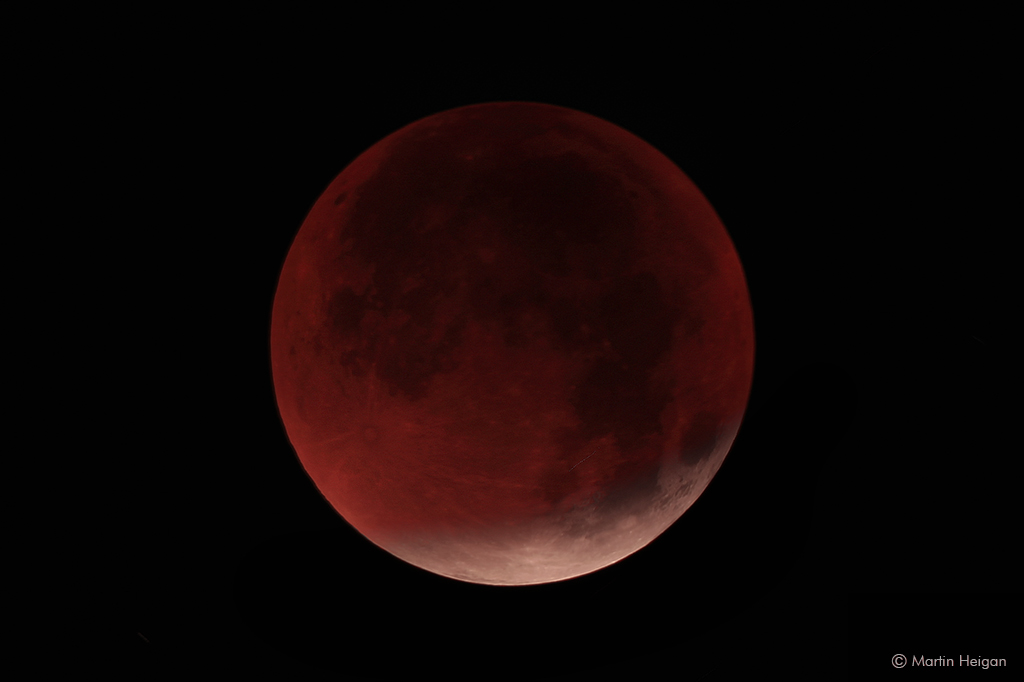
A total lunar eclipse takes place March 3. The best viewing locations in the Southern Hemisphere are the Pacific Ocean, New Zealand, and Australia. The umbral phase of the eclipse begins at 9h50m UT and ends at 13h18m UT, with totality running from 11h04m to 12h03m UT.
The starry sky
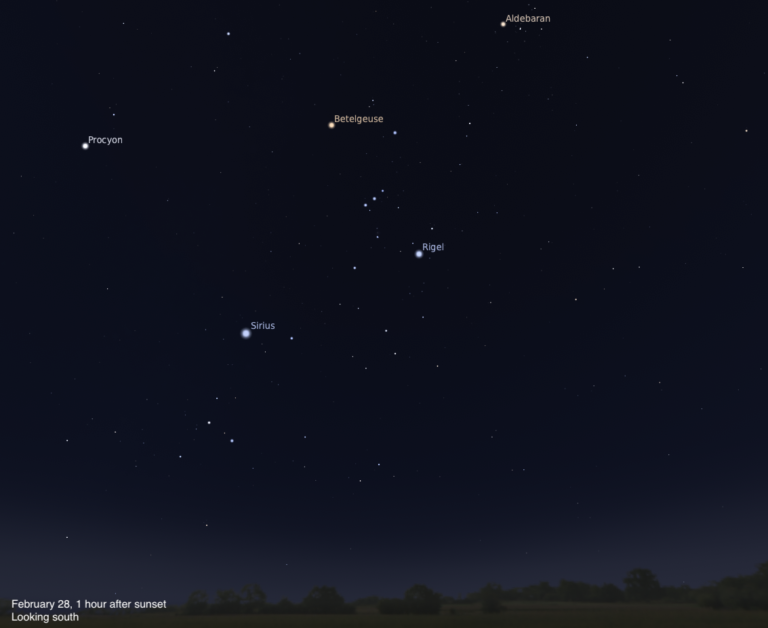
A few months ago, I was gazing at the constellation Canis Major when it was visible in the small hours of the morning toward the east. I always enjoy looking at the stars southeast of brilliant Sirius, whose shape reminds me of a coat hanger without a hook. My thoughts wandered to considering the name of that constellation, and how so many people pronounce its first three letters as if it rhymes with “man” or “tan.”
Over the years, however, I have delved into the “correct” ways to pronounce constellation names — as well as those of stars and some clusters, too. When I was little, I thought that the Beehive Cluster (M44), or Praesepe, in Cancer should be pronounced “pray-seep,” though I soon found out I was wrong. The correct way seems to be “pree-see-pee.” Even so, in H.B. Rumrill’s 1936 paper published by the Astronomical Society of the Pacific, he suggests a pronunciation of “pree-seep.”
Let’s head back to the Great Dog, which conveniently passes nearly overhead on March evenings. You will find the authoritative pronunciation for the constellation’s first word is “caynis,” which few people use — certainly not those in Australia, anyway.
Many guides to pronouncing astronomical names exist, but a favorite of mine is one published in some editions of the classic Norton’s Star Atlas. Browsing through that list, you’ll find many pronunciations matching what you would expect, such as Sirius. Others, not so much. Take Caelum the Chisel. It’s proper to say “see-lum,” with the “cae” being pronounced the same way as the “ce” in Cetus the Whale.
I find it instructive to look through some of these lists to confirm correct pronunciations. Nearly all agree that the constellation of the River should be “e-RID-a-nus.” But it’s not hard to uncover inconsistencies among sources. Norton’s suggests, for example, that the first two letters of Monoceros the Unicorn should be pronounced like “moh,” rhyming with “toe,” while other sources suggest “mon” for the first three letters. However, they all agree that the emphasis should go on the “nos.”
How about the southern constellation Grus the Crane? Although rhyming it with “truss” sounds wrong — I have always said it as “groose” — the former is listed by Norton’s (though one listing suggests both are acceptable).
Many names are so ancient that we may never know how people pronounced them originally, but it’s still fun doing the research.
Star Dome
The map below portrays the sky as seen near 30° south latitude. Located inside the border are the cardinal directions and their intermediate points. To find stars, hold the map overhead and orient it so one of the labels matches the direction you’re facing. The stars above the map’s horizon now match what’s in the sky.
The all-sky map shows how the sky looks at:
10 p.m. March 1
9 p.m. March 15
8 p.m. March 31
Planets are shown at midmonth